
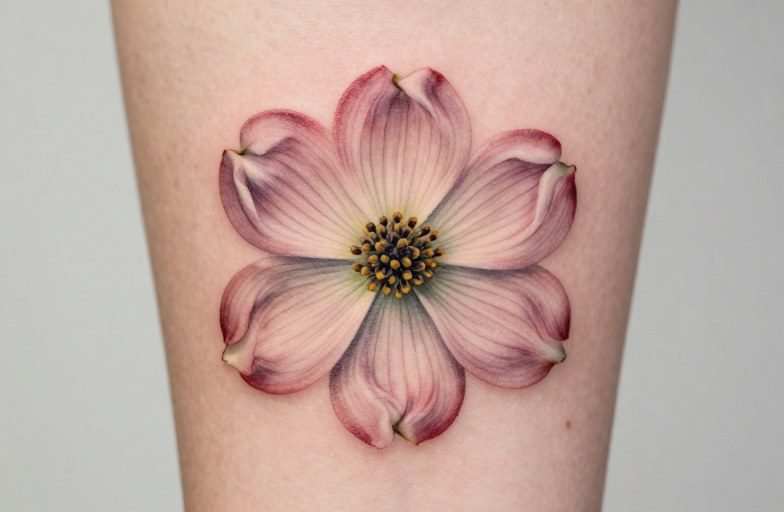
The dogwood flower tattoo most commonly signals resilience after hardship, unwavering faith, and the promise of renewal. Its four-petaled structure and central cluster of tiny florets give it instant visual recognition, while the flower’s actual biology, blooming early in spring, often against lingering cold, reinforces the metaphor of persistence. For many, this isn’t about decoration; it’s a permanent marker of surviving something that could have broken them.
Symbolism & Core Meaning
Resilience and Endurance
Dogwoods don’t push through soil in ideal conditions. They arrive when winter still has teeth, when frost threatens, when the landscape looks finished. That timing matters for tattoo meaning. People drawn to this flower often connect with the idea of thriving despite circumstance, not the triumphant hero narrative, but the quieter reality of continuing. The wood itself is dense and hard, historically used for loom shuttles and tool handles, which adds a practical layer to the floral softness. A dogwood tattoo can sit at that intersection: delicate appearance, stubborn substance.
Renewal and Spring’s Return
The bloom cycle reinforces another reading. Dogwoods flower before full leaf-out, creating that ghostly, suspended effect against bare branches. For someone marking a new chapter, sobriety, recovery, relocation, reinvention, the flower’s annual return from apparent dormancy resonates. The visual of something beautiful emerging from what looked dead carries weight without requiring words. See also: Depressed Tattoo Meaning: Symbolism, Design & Aging.
- Four large bracts (often mistaken for petals) surrounding a tight central cluster
- Color range from white to deep pink, with some cultivars trending red
- Brief but intense bloom period, typically two to three weeks
- Native range across eastern North America, with cultural concentration in the Southeast
Mythology & Folklore
The Christian Legend
A widely circulated story claims the dogwood was once a mighty tree, its wood used for Christ’s cross, then cursed to remain small and twisted so it could never serve that purpose again. The four bracts form a cross, the notched tips bear rust-colored stains representing blood, and the central cluster resembles a crown of thorns. This narrative is almost certainly a 19th or 20th-century American folk invention rather than ancient tradition, but its persistence has made the dogwood a common Easter and memorial flower in the South. Some trace it to Appalachian storytelling; others note it doesn’t appear in written record before the early 1900s. The legend’s power lies in its circulation, not its antiquity.
Indigenous and Regional Associations
Before European contact, various Native nations used dogwood bark medicinally, addressing fever, pain, and other conditions. The Cherokee name for the tree connects to its hard wood and arrow-making potential. These practical associations don’t map neatly onto modern tattoo symbolism, but they ground the flower in specific place and use rather than vague spiritual generalities. For someone with Appalachian or southeastern roots, the dogwood can carry regional identity more than religious narrative. See also: Realistic Tulip Tattoo: Complete Style Guide.
Common Variations & Styles
Line Work vs. Full Color
Black-and-grey dogwood tattoos emphasize structure: the veining in each bract, the negative space between them, the architectural quality of the central cluster. This approach ages cleanly, especially at smaller sizes. Full color allows the distinctive pink-to-white gradient that distinguishes dogwood from generic four-petaled flowers, but requires a skilled hand with saturation. Watercolor-style dogwoods have become common, though the technique risks muddying the precise bract edges that make the flower identifiable. For longevity, solid color packing with strategic soft edges outperforms true watercolor diffusion.
Placement and Scale
Popular placements follow the flower’s natural proportions. The shoulder cap and outer upper arm accommodate the radial spread of four bracts. Rib placements work for trailing branches with multiple blooms. Wrist and ankle dogwoods typically reduce to a single flower or tight cluster, which sacrifices some detail but gains readability. Behind-the-ear placement has gained traction, though the small scale limits color complexity. Forearm dogwoods often extend into branch work, incorporating the tree’s distinctive bark texture. See also: 100 Tattoo Meaning: Ambition, Completion, and New Beginnings.
- Single bloom: 2, 3 inches minimum for bract detail
- Branch with multiple flowers: 6, 10 inches for natural spacing
- Color longevity: pinks fade faster than deep reds; plan for touch-ups
- Background elements: often omitted to preserve the flower’s airy quality
Religious & Spiritual Angles
The Christian symbolism dominates American awareness, but the tattoo’s spiritual range extends further. For secular wearers, the flower’s association with Easter and spring creates a general renewal framework without doctrinal commitment. Some combine dogwood with cross imagery explicitly; others let the flower’s four-bract structure do the implicit work. Buddhist practitioners occasionally select dogwood for its brief, intense bloom period as a meditation on impermanence, though this requires the artist and wearer to foreground that interpretation through placement or accompanying elements.
The distinction between religious and spiritual dogwood tattoos often shows in accompanying imagery. Crosses, doves, or scripture references nail down the Christian reading. Butterflies, birds, or natural landscape elements suggest broader transformation themes. Memorial dates without religious symbols occupy a middle space, letting viewers project their own framework.
Who Chooses This Tattoo
Geographic and Cultural Patterns
North Carolina and Virginia residents show disproportionate dogwood selection, the flower is both states’ official bloom. Military members with southeastern connections often choose it as a home marker. The tattoo appears across age groups but clusters in two bands: younger wearers connecting to family tradition or regional identity, and older wearers marking survivorship (cancer, divorce, loss) with a symbol that feels dignified rather than dramatic.
Gender and Design Approach
Historically coded feminine in American tattoo culture, dogwood has shifted as floral tattoos generally have become less gendered. Masculine-presenting designs increasingly incorporate branch structure, bark texture, and darker color saturation. Feminine-presenting versions still trend toward softer shading, isolated blooms, and ornamental framing. These are tendencies, not rules, effective dogwood tattoos transcend the binary by focusing on the flower’s actual structure rather than imposed styling.
Similar & Related Symbols
Cherry blossom tattoos share the spring-renewal axis but carry stronger Japanese cultural associations and a more explicit mortality theme through mono no aware. Magnolia tattoos overlap in southern regional identity but project more permanence and less hardship-survival. Dogwood’s closest symbolic cousin may be the lotus, emerging from murky conditions into clean bloom, but the lotus carries heavier Eastern religious freight and less specific American regional grounding.
For Christian wearers considering alternatives, the passion flower offers more explicit crucifixion imagery (crown of thorns, nails, whip) but less visual subtlety. The dogwood’s advantage is its double reading: legible as Christian symbol to those who know the legend, readable as simple beautiful flower to those who don’t.
- Cherry blossom: more transient, more culturally specific
- Magnolia: more stately, less survival-narrative
- Lotus: more universal, less American-regional
- Passion flower: more doctrinally explicit, less visually restrained
Final Thoughts
The dogwood flower tattoo works because it carries weight without demanding attention. Its symbolism is specific enough to mean something, common enough to not require explanation, and structurally beautiful enough to justify permanent skin commitment regardless of narrative. The best versions respect the flower’s actual form, the notched bract tips, the clustered center, the way blooms sit on branches rather than floating in vacuum. Whether the meaning is Christian faith, southern roots, survivorship, or simply attraction to a structure that happens to resonate, the tattoo succeeds when the technical execution matches the symbolic intention. Choose an artist who can render botanical accuracy; the meaning follows from recognition.
Frequently Asked Questions
Does a dogwood tattoo always mean something religious?
No. While the Christian legend is widely known, many people choose dogwood for its spring renewal symbolism, regional identity, or simply its structural beauty. The meaning depends on accompanying imagery and personal context.
How well does dogwood tattoo color hold up over time?
Pinks and soft reds fade faster than deeper tones. White bracts with grey shading age more gracefully than full pink saturation. Expect touch-ups every 5, 8 years for color-dominant pieces, less often for black-and-grey.
What’s the difference between dogwood and cherry blossom tattoos?
Dogwood has four large notched bracts with a central cluster; cherry blossom has five distinct petals with visible stamens. Dogwood carries stronger American regional and Christian associations; cherry blossom connects to Japanese aesthetics and impermanence.
Can a dogwood tattoo work for someone who’s not from the South?
Absolutely. The flower’s structural appeal and symbolic range transcend geography. However, wearers without southeastern connections should be aware that viewers may assume regional roots, so clarity about personal meaning matters.
Related Tattoo Meanings
- Rebel Flag Tattoo Meaning: Symbolism, History Styles
- Dollar Sign Tattoo Meaning: Wealth, Hustle Risk
- Dragon Man Tattoo Meaning: Power, Protection Rebellion
- Explore more









