
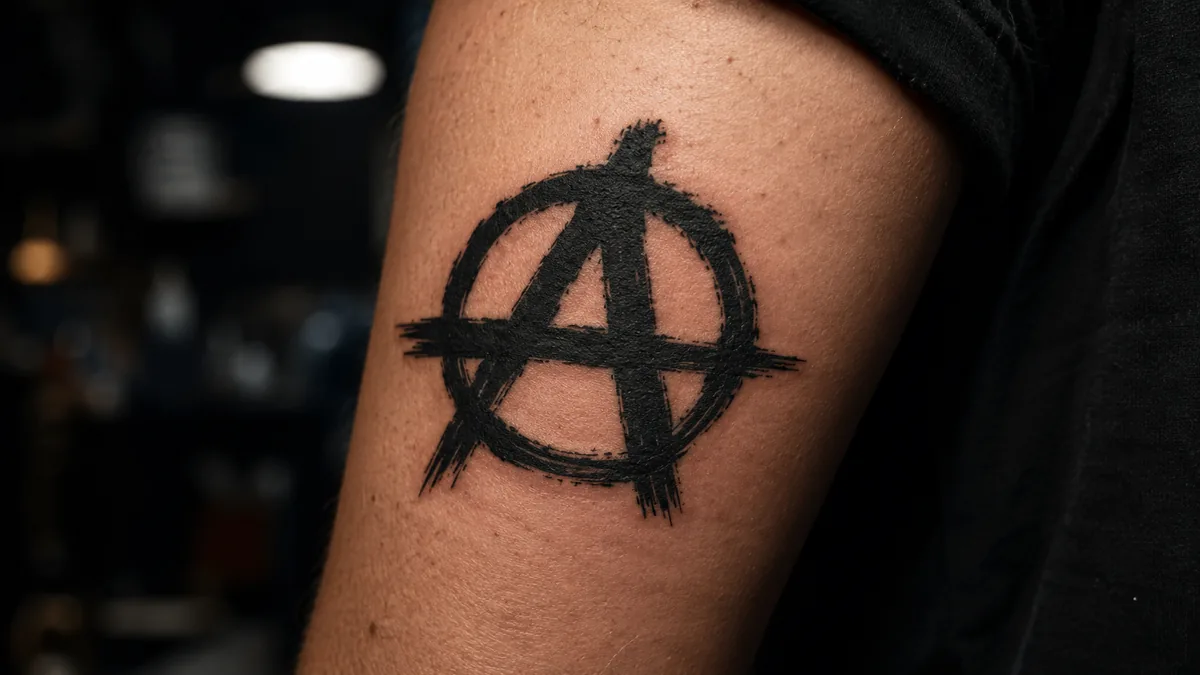
The anarchy tattoo is one of those designs that carries serious weight. it’s the circle-A, that iconic symbol of a capital A inside a circle, and it stands for the political and philosophical idea that society functions best without coercive authority. No rulers, no masters. It’s a declaration of radical personal freedom.
People who get this tattoo aren’t always anarchists in the strict political sense. Some are punks. Some are anti-establishment. Some just reject systems they see as corrupt or oppressive. Whatever the reason, this tattoo reads as bold, intentional, and uncompromising. It’s not a decoration. It’s a statement.
The Core Symbolism of the Anarchy Tattoo
The circle-A is the most recognized anarchy symbol worldwide. The A stands for anarchy, and the circle represents the unity of the movement, sometimes read as the letter O for “order,” referencing Pierre-Joseph Proudhon’s phrase “anarchy is order.” That duality is actually part of what makes it philosophically interesting. It’s not chaos for chaos’s sake. It’s the idea that voluntary cooperation replaces imposed authority.
Beyond the circle-A, people also tattoo the word “Anarchy” itself, or stylized variations that pull from punk, metal, or political art traditions. The meaning stays consistent: rejection of hierarchy, support for individual autonomy, and opposition to state control. Depending on the person, it can lean political, personal, or purely countercultural. All three readings are legitimate.
The History Behind the Symbol
The circle isn't decoration, it's the whole point: no rulers, no hierarchy, just the A.
The anarchist movement traces back to 19th-century Europe. Thinkers like Pierre-Joseph Proudhon, Mikhail Bakunin, and Peter Kropotkin laid the philosophical groundwork. The circle-A itself became widely used in the 1960s, popularized by the Iberian Anarchist Federation in Spain. By the 1970s, punk culture had adopted it hard, and the Sex Pistols era cemented it as a symbol of youth rebellion in the UK and US.
That punk connection is huge for tattoo culture. The circle-A showed up on leather jackets, band shirts, and skin throughout the 70s and 80s. It crossed from political organizing into subcultural identity. Today it sits at the intersection of both. Getting this tattoo in 2024 connects you to a lineage that runs through labor movements, anti-fascist organizing, and three generations of punk rock.
Popular Design Variations
The classic circle-A is the most popular version, and for good reason. Simple geometry, strong silhouette, reads from across the room. Artists can render it clean and precise for a minimalist look, or rough and distressed for a hand-drawn punk feel. Some clients want it with a dripping paint effect, others want it sharp and geometric. Both work. Bold will hold with this design since the shapes are thick enough to survive years on skin.
Beyond the basic circle-A, you’ll see it incorporated into skulls, fists, broken chains, and anarchist black flags. Some people tattoo it with roses, which brings in a nod to Emma Goldman’s famous quote about revolution and dancing. Text additions like “No Gods No Masters” or “Anarchy” in block letters are common. Lettering styles range from black metal script to clean sans-serif. The symbol scales well from a small quarter-sized piece to a full sleeve element.
Black and Grey vs. Color
Most anarchy tattoos are done in solid black. That’s intentional. The aesthetic of the symbol ties directly to black ink, punk culture, and political print tradition. A crispy black circle-A with clean lines is a classic for a reason. It heals nice, it stays legible, and it doesn’t need color to land. Black and grey with some shading or whip shade on the interior can add depth without losing the graphic punch.
Color versions exist but they’re less common. Red is the most natural addition since red-and-black anarchist imagery has a long political history, tying into both anarcho-communism and anarcho-syndicalism. Red fill on the A inside a black circle looks saturated and bold when freshly healed. Some clients go full punk with neon tones or offset color fills. These read well short-term but plan for touch-ups as bright colors fade faster than solid black.
Best Placements and How It Ages
For a small to medium circle-A, the forearm is a top choice. High visibility, relatively low pain, and the skin there holds ink well. The upper arm and bicep are solid for medium to large versions. The chest, ribs, and back open up if you want to go bigger or pair it with other imagery. Hands and knuckles are popular in punk and hardcore circles but those are high-wear zones. Expect faster fading and plan for touch-ups every few years.
Fingers, wrists, and the back of the neck are all spicy for pain and rough on ink longevity. Placement behind the ear is trendy but tiny designs lose detail fast there. The symbol is bold enough that it ages well in most placements as long as the lines are solid to begin with. Fine line versions of the circle-A are a risk, especially in high-wear spots. Thick, clean linework will hold the shape through decades. Ask your artist to go heavier than you think you need.
Who Gets the Anarchy Tattoo
Punks and hardcore kids have been getting this tattoo since the 1970s. That’s still a huge portion of the clientele. But the demographic is wider than most people assume. Political organizers, labor activists, anti-fascist community members, and people who’ve read their Kropotkin and mean it all get this tattoo. So do people who had a formative punk phase and want to carry that part of their identity permanently. None of these reasons is more valid than another.
Younger clients sometimes get it because they’re drawn to the aesthetic before they’ve dug deep into the philosophy. That’s fine too. Tattoos are personal. What matters is that you know what you’re putting on your skin and you’re comfortable owning that message in every context, including job interviews and family dinners. The circle-A is not subtle. It’s a conversation starter whether you want it to be or not. Get it if you mean it.
Making It Personal
The circle-A is versatile enough to work as a standalone piece or as part of a larger concept. If you want it personal, think about what anarchy means specifically to you. That shapes the visual. Someone drawn to the punk music angle might want it rough and hand-poked looking. Someone coming from a political organizing background might want it clean and precise, almost like a printed emblem. Both are legitimate interpretations of the same symbol.
Adding personal elements like meaningful dates in the circle, a specific flag or patch design framing it, or integrating it into a portrait or scene all work. Talk to your artist about what you’re trying to say. A good tattooer will help you figure out whether you want it to whisper or shout, and build the composition from there. Size it right for the placement. Keep the linework solid. This symbol has earned its place on skin. Wear it like you mean it.









