
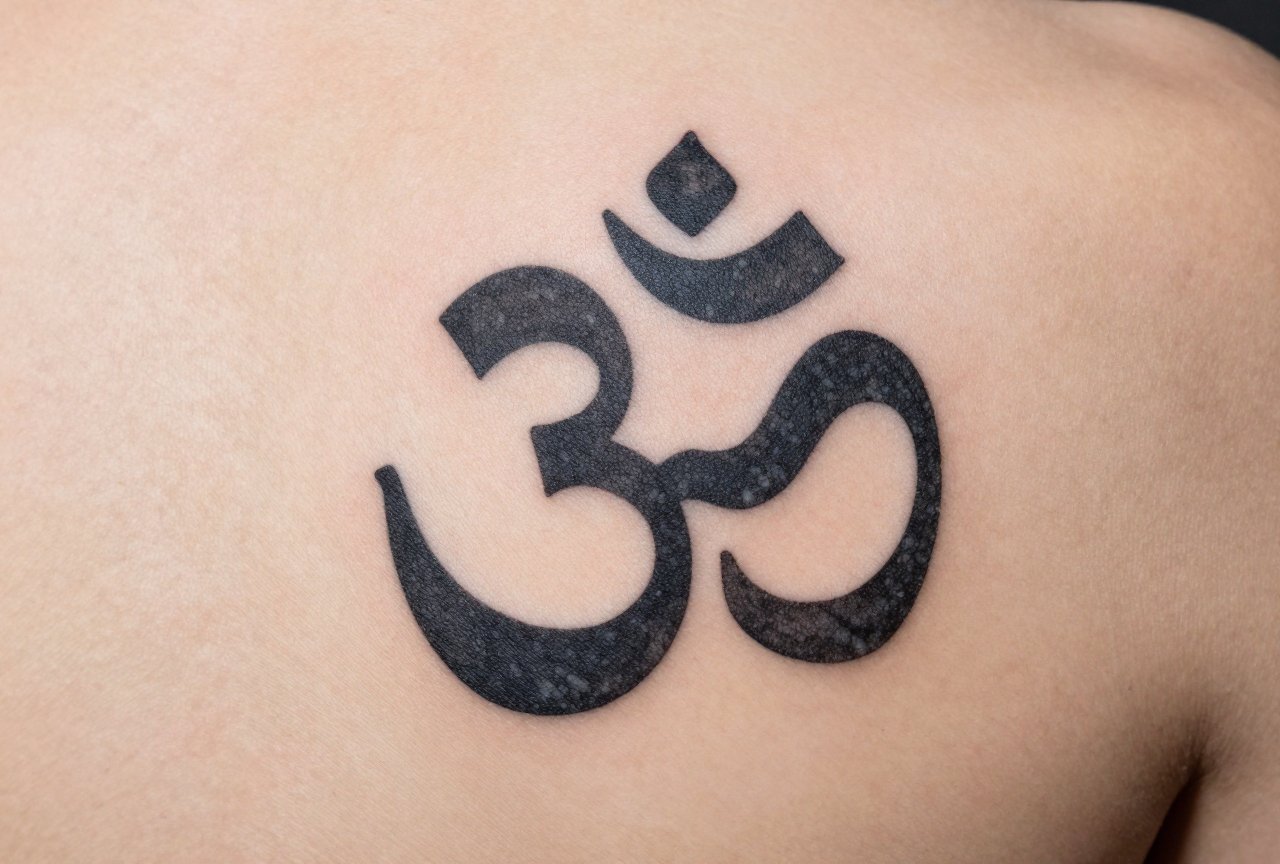
The Aum tattoo represents the primordial sound of the universe in Hindu and Buddhist traditions, the vibration from which all creation emerged. When someone sits in my chair asking for ॐ, they’re usually seeking something bigger than decoration: a permanent reminder of consciousness, breath, and the connection between mind, body, and spirit. The symbol itself breaks down into three curves and a dot, representing waking, dreaming, deep sleep, and the absolute silence beyond.
Symbolism & History
I’ve tattooed Aum on everyone from yoga teachers to metalheads who just dig the geometry. The symbol’s been around for roughly three millennia, carved into ancient temple walls across India and Nepal. In my experience, clients who research this design before booking usually have a story, they’re not impulse-walk-ins.
The Four States of Consciousness
Here’s what the curves actually mean, and I explain this while stenciling because it helps clients sit still:
- The lower curve (A): Waking state, conscious awareness, physical reality
- The middle curve (U): Dreaming state, the unconscious mind at play
- The upper curve (M): Deep sleep, pure consciousness without objects
- The dot and crescent: The fourth state, turiya, absolute silence beyond all three
The dot’s placement matters for tattooing. Too small and it blurs in a year. I’ve seen apprentices blow it out by going too deep on that fine point.
Sound Made Visible
Aum isn’t just a visual symbol, it’s sound crystallized. The chant moves from the back of the throat (A) to the palate (U) to closed lips (M), then silence. When clients tell me they want it because they “chant,” I know they’ll sit better for the needle. Breath awareness and pain tolerance correlate, in my chair at least.
Common Variations & Styles
Shop culture: we see Aum requests spike every January (resolution energy) and after major music festivals. The style choices reveal the client’s actual relationship to the symbol.
Traditional Sanskrit ॐ
The classic Devanagari script. Clean blackwork, single needle or tight three-liner for the curves. This ages best. I’ve got Aum tattoos on clients from ten years ago that still read crisp because we kept it simple, no trendy watercolor bleeding into the lines. The curves need to flow; a shaky hand makes it look like a pretzel.
Stylized & Fusion Designs
- Mandala integration: Aum at the center of geometric patterns, popular on sternums and upper backs
- Dotwork/halftone: Stippled shading around the symbol, creates depth without heavy black
- Floral surrounds: Lotus wrapping the curves, common for clients bridging Eastern symbolism with Western aesthetics
- Script combinations: Sanskrit mantras flowing beneath or around the main symbol
I did one last month where we hid Aum inside the negative space of a mountain range. The client sees it; others don’t. That’s a specific kind of devotion.
Best Placements
Skin matters. Aum’s curves need real estate to breathe, but the symbol also carries placement significance in traditional contexts.
- Inner forearm: Most common. Visible, the curves sit well across the muscle structure, easy to show during practice. I’ve done hundreds here.
- Behind the ear / neck nape: Subtle, personal. The small size works because the curves compress better than you’d expect. But neck skin moves; expect touch-ups.
- Sternum / chest center: The heart chakra connection. Painful spot, not for first-timers. The curves follow the sternum line naturally.
- Upper back between shoulders: Traditional placement, “the seat of consciousness.” Large format possible. I’ve done full-back pieces with Aum as the focal point.
- Ribcage: Popular with women, flows with the body’s curve. Hurts like hell. I warn people twice.
Finger and hand placements? I talk clients down. The symbol degrades fast there, and culturally, some Hindu practitioners consider feet and hands inappropriate for sacred marks. I don’t police, but I inform.
Who Chooses This Tattoo / Personal Meanings
In my chair, the stories split roughly three ways. Not scientific, just fifteen years of listening.
The Practitioner
Actual yoga or meditation practice. They can pronounce it correctly, they know the four states, they might have a teacher. These clients are calm, they tip well, they don’t flinch. The tattoo anchors their practice. I’ve heard “I wanted it where I can see it during downward dog” more than once.
The Seeker
Life transition, divorce, recovery, loss, awakening. Aum marks a before and after. These sessions get quiet. I don’t push conversation. The symbol holds grief or hope or both. One guy told me he got it after his guru died, same design his teacher had on his own forearm. That’s heavy. I lightened the needle pressure and gave him extra breaks.
The Aesthetic Draw
They love the shape. Maybe they saw it on a traveler in Bali, maybe it just hits right geometrically. I don’t judge this group, but I do ask questions. Cultural appropriation concerns are real in shop talk, and while I’m not the gatekeeper, I want clients walking out informed. If they can’t tell me anything beyond “it looks cool,” I suggest they research before we lock the stencil.
Similar Symbols
Clients sometimes confuse or combine these. Worth knowing the distinctions:
- Unalome: The spiral path to enlightenment in Buddhism. Often paired with Aum but separate symbol. The spiral tightness varies by tradition.
- Sri Yantra: Complex geometric meditation tool, nine interlocking triangles. Much heavier commitment, usually larger scale.
- Lotus: Frequently combined with Aum, representing purity emerging from mud. The pairing works visually and conceptually.
- Hamsa: Middle Eastern protective hand, sometimes confused due to similar “spiritual tattoo” category but totally different lineage.
I did a piece last year where we nested Aum inside the lotus inside a Sri Yantra. Three hours, client meditated through most of it. That’s rare. Most people check their phone.
Final Thoughts
Aum tattoos carry weight beyond the ink. The symbol has survived millennia because it compresses an entire cosmology into something your eye can hold in a glance. As a tattoo, it rewards simplicity, fine lines, confident curves, respect for the negative space. I’ve watched trends come and go; the Aum requests never fully stop because the symbol isn’t trending, it’s enduring.
If you’re considering one, sit with it. Literally. Chant it if that’s your practice. Look at the symbol daily for a month. The clients who do this prep work never regret the placement. The ones who rush sometimes end up in my chair again for cover-ups. Skin is permanent. Aum deserves that level of consideration.
And find an artist who understands the curves. I’ve fixed too many where the “M” curve got flattened or the dot floated off-center. Sacred geometry requires geometric precision. Your body deserves both the meaning and the craftsmanship.
Frequently Asked Questions
Do I need to be Hindu or Buddhist to get an Aum tattoo?
No, but understand the symbol’s weight. I tell clients to research its meaning and consider whether they’re honoring or just borrowing. Most artists will tattoo it regardless, but informed choice sits better long-term.
How much does an Aum tattoo typically cost?
Small simple Aum tattoos run $80-150 at reputable shops. Larger pieces with mandala work or detail can hit $300-500+. Price varies by city, artist experience, and time in the chair. Don’t bargain shop for sacred symbols.
Does the Aum tattoo have a specific direction it should face?
Traditionally, the open curve of the ‘3’ shape faces upward or toward the viewer. On limbs, I orient it so the symbol reads correctly to the client when they look down. Some prefer it facing outward for others to see, personal choice, not strict rule.
How well does fine-line Aum tattooing age over time?
The curves hold okay if the line weight is consistent, but the dot and crescent blur first. I recommend slightly bolder lines than trendy ultra-fine work, and solid black over watercolor or greywash for longevity. Expect a touch-up around year five.
Related Tattoo Meanings
- Baphomet Tattoo Meaning: Symbolism, Styles Shop Talk
- Birdcage Tattoo Meaning: Freedom, Captivity What Artists See
- Blacked Out Tattoo Meaning: Rebirth, Grief, and Starting Over
- Explore more









