
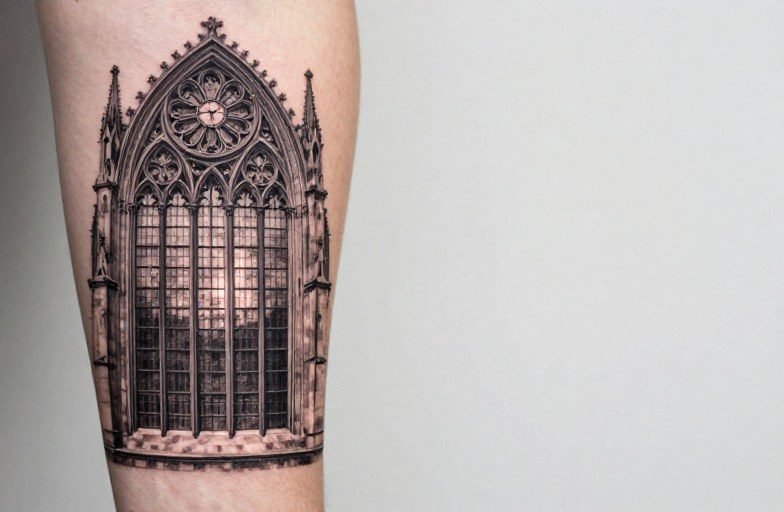
A cathedral window tattoo typically represents a threshold between the ordinary and the sacred, a framed view of light, memory, or something beyond reach. The Gothic arch or rose window creates a container for whatever the wearer places inside: a scene, a figure, abstract color, or pure negative space. The design speaks to structure meeting transcendence, the human impulse to build something that outlasts a single life.
Symbolism & Core Meaning
The cathedral window carries layered readings that shift depending on what is visible through the glass.
The Frame as Threshold
Stone tracery and pointed arches do practical work in architecture, they distribute weight, let light enter, keep weather out. In tattoo form, that same structure becomes symbolic boundary. The window edge separates inside from outside, known from unknown, self from whatever lies beyond. Many choose this frame to hold an image of someone lost, a landscape from childhood, or a celestial scene. The architecture says: this matters enough to build something permanent around it.
Light as Central Subject
Stained glass exists to transform light, not merely admit it. A cathedral window tattoo often makes light itself the subject, sunbursts through colored panes, beams rendered in yellow ink that will soften to amber over decades. The symbolism here is less about religious doctrine and more about attention: the design marks a moment or quality of illumination that felt worth preserving. Some keep the glass abstract; others fill it with specific imagery that catches and bends meaning the way real glass bends light.
Personal & Modern Meanings
Contemporary wearers rarely intend explicit religious statement. The cathedral window has become a flexible vessel for secular reverence.
Memory and Grief
One common use: framing a portrait or scene connected to someone who died. The Gothic arch becomes a memorial niche, the glass colors a mood rather than a dogma. The architectural gravity lends weight without requiring shared belief. This works especially well when the person being remembered had no religious affiliation, the window becomes pure gesture of lasting significance.
Secular Wonder
Others use the window to frame natural phenomena: nebulae, ocean horizons, forest interiors. The contrast between human-built stone and wild interior creates tension. It suggests that awe does not require wilderness, that structure and reverence can coexist. This reading often appeals to architects, engineers, and others who find beauty in deliberate construction.
Mythology & Folklore
Medieval cathedral construction carried folklore that occasionally surfaces in tattoo interpretation, though origins are often murky.
The Master Builder Legends
European folklore commonly associated certain cathedrals with competing master builders, stories of architects who made pacts, who were buried within walls, whose designs were stolen. These tales, often linked to specific buildings like Cologne or Strasbourg, emphasize the human cost of building something that outlasts its maker. A cathedral window tattoo can quietly reference this: the beauty visible, the sacrifice invisible.
Rose Window Geometry
The circular rose window, with its radiating petal-like tracery, drew on earlier forms though direct lineage is debated. Some trace it to Roman oculus designs, others to floral symbolism in medieval thought. The geometric precision, twelve sections, six sections, interlocking circles, carried numerological significance that most modern wearers ignore. The form persists because it satisfies the eye, not because wearers subscribe to medieval number symbolism.
How It Ages on Skin
Cathedral window tattoos present specific technical challenges that affect their longevity.
Line Weight and Tracery
The fine stone divisions between glass panels, tracery lines, are the first element to blur. Thin lines spread; hairline details become indistinct within five to ten years depending on placement and sun exposure. Experienced artists solve this by building tracery from multiple needle passes at slightly heavier weights, or by designing with intentional boldness in the structural lines while keeping interior color areas softer. The window must read as architecture even when details soften.
Placement and Distortion
Curved body areas warp straight architectural lines. The flat plane of a thigh or calf preserves the window’s geometry better than a shoulder or rib where skin stretches and compresses. For round rose windows, the upper back between scapulae offers natural circularity. Forearms work for tall lancet windows but require the artist to account for the slight cylinder distortion, lines that look straight on paper will appear to bow if not adjusted.
Color vs Black and Grey
The choice between stained glass color and monochrome stone significantly changes the tattoo’s effect and aging.
Stained Glass Color
Bright jewel tones, cobalt, ruby, emerald, gold, mimic actual glass and create immediate visual impact. These colors age differently: blues and greens hold longer; reds and yellows fade faster and warm toward orange or brown. White highlights, often used to suggest light transmission, yellow substantially on most skin tones. The overall effect deepens and mutes as colors settle; a bright window at two years becomes more subdued at ten, which some find appropriate, cathedral light is never constant.
Black and Grey Stone
Monochrome treatments emphasize texture and shadow over color narrative. Weathered stone, deep recesses, the play of light on carved surfaces, these read clearly in black and grey and age more predictably. The absence of color shifts focus to the window’s architecture and whatever scene appears through it. This approach suits smaller scales where color would muddy, and it heals with fewer surprises.
Similar & Related Symbols
Related architectural tattoos carry overlapping but distinct meanings.
- Gothic arch alone: The pointed arch without the window frame suggests aspiration and verticality but lacks the container quality, the sense of something framed and protected.
- Stained glass without stone: Isolated colored panels read as decorative pattern or pure color study; they lose the threshold meaning that the architectural frame provides.
- Doorways and portals: Similar threshold symbolism but more active, passage rather than viewing. Doors imply movement; windows imply witness.
- Mandala: Shared circular geometry and spiritual suggestion, but the mandala centers on emanation from a core point; the rose window centers on light entering from outside.
- Skylight or modern window: Contemporary architectural glass lacks the weight and historical resonance; these read as interior design rather than monument.
Final Thoughts
A cathedral window tattoo works best when the architecture serves what it frames, not when it dominates. The design rewards planning for decades of aging: bold enough tracery to survive, placement that respects the geometry, color choices that acknowledge fading. Whether holding religious iconography, personal memory, or abstract light, the form’s power lies in its dual nature, human labor building something that points beyond itself. The stone is mortal; what it frames is the point.
Frequently Asked Questions
Do cathedral window tattoos have to be religious?
No. While the form derives from sacred architecture, most contemporary wearers use it for secular purposes, framing nature scenes, memorial portraits, or abstract light. The structure suggests reverence without requiring doctrinal belief.
How big does a cathedral window tattoo need to be?
Minimum four to six inches for basic tracery readability; rose windows need more diameter to preserve their radiating geometry. Smaller than this, and the stone divisions blur into indistinct mush within a few years.
What is the best placement to keep the lines straight?
Flat, stable surfaces: outer thigh, calf, flat upper back. Avoid areas with significant muscle movement or curvature like ribs, shoulders, or inner biceps unless the design is adapted to account for distortion.
Will the colors really look like stained glass?
Initially, yes. Over time, all tattoo color mutes and shifts. Blues and greens last longest; reds and yellows warm toward brown. Expect the effect to move from bright transmission to something more like weathered glass, still beautiful, but different.
Related Tattoo Meanings
- Candlestick Tattoo Meaning: Light, Memory Time
- Supernatural Tattoo Meaning: Symbols, Styles Ink That Lasts
- Russian Mafia Tattoo Meaning: A Guide to Prison Ink Symbolism
- Explore more









