
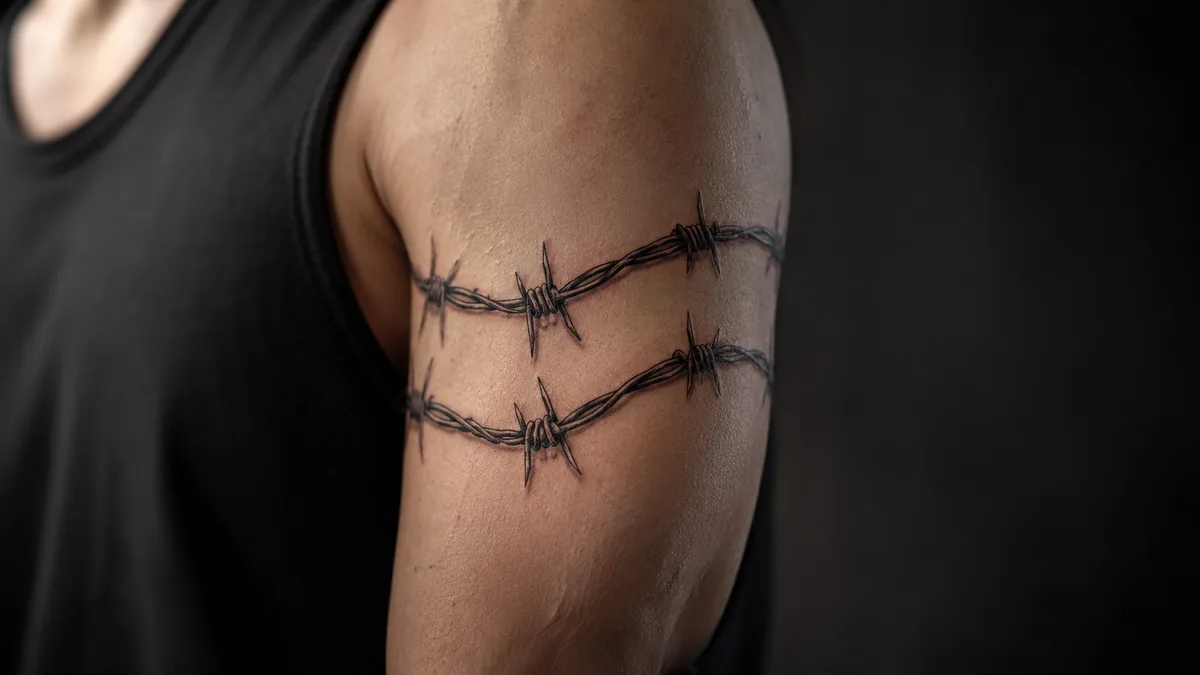
Barbed wire is one of the oldest tattoo motifs still getting requested in shops today. It’s not trendy. It doesn’t need to be. People get it because it says something real, something they feel in their chest before they can put it into words.
the barbed wire tattoo is about boundaries, endurance, and the cost of surviving something hard. The meaning shifts depending on the person wearing it, but it’s almost never chosen lightly. Here’s a straight breakdown of what it represents and what you need to know before you sit down for it.
Core Symbolism: What Barbed Wire Actually Means
Barbed wire represents protection through pain. The wire keeps things in and keeps things out, and both readings matter. People get it as a symbol of personal boundaries they had to fight to build. It says: getting close to me has a cost. That’s not aggression, that’s lived experience. Strength through hardship is the most consistent thread across all the people who choose this design.
It also speaks to confinement and survival. Anyone who has pushed through a stretch of their life that felt like a prison, physical, emotional, or otherwise, finds something honest in barbed wire. The pain of the situation and the endurance required to come out the other side. That duality is exactly why it holds up as a tattoo choice across decades.
Historical and Cultural Background
Wire that once held you back becomes the proof you broke through.
Barbed wire was invented in the 1870s and became the defining symbol of contested land in the American West. It ended the open range era. It could mark a boundary violently, quickly, cheaply. Military use through World War I and World War II deepened its association with imprisonment, frontlines, and survival under brutal conditions. POW camps were ringed with it. Soldiers crawled under it. It became embedded in the visual language of war and captivity.
In tattoo culture, it picked up major momentum in the 1990s partly due to celebrity visibility, most famously Pamela Anderson’s bicep wrap that blew up after Baywatch. That wave turned it briefly into a mainstream fashion piece. But the design existed in military and biker communities long before that moment. Its roots are blunt and practical, which fits exactly what the tattoo means.
Popular Design Variations
The classic is a continuous looping band wrapping around a limb, armband style. Clean, readable, bold. Some people run it straight, like a border or a fence line, which reads more aggressive and territorial. Others incorporate realistic texture, making each barb cast a slight shadow so the wire looks three-dimensional against the skin. That level of detail adds weight to the piece.
Cross combinations are common. Barbed wire wrapped around a cross carries a heavy religious layer, suffering, sacrifice, faith under pressure. Crown of thorns interpretations tie directly to that same symbolism. Some clients add roses tangled into the wire, which contrasts beauty and pain in a way that ages really well visually. Tribal-influenced barbed wire leans into bold geometry. Each variation shifts the emphasis without losing the core message.
Black and Grey vs. Color
Black and grey is the natural home for this design. Metal reads as metal in greyscale. A skilled artist can whip shade the wire to give it depth and roundness, making the barbs look like they could actually catch fabric. Black and grey also ages more gracefully. Saturated color on fine detail can bleed out over years, especially in high-movement zones like the inner arm or behind the knee.
Color is absolutely doable, but it changes the mood. Rust tones and warm browns keep it grounded and realistic. Some people go for a chrome or silver effect, which requires a light touch and a solid black base to pop. Red is popular when combined with roses or blood drops, adding a visceral intensity. Whatever direction you go, make sure your artist can demonstrate that style in their portfolio before you commit.
Placement, Pain, and How It Ages
The bicep wrap is the most requested placement, and for good reason. Solid muscle underneath means good definition, moderate pain, and the design holds up well over time. The forearm is another strong choice, especially for clients who want it visible. The thigh works well for larger pieces with more wraps or added elements. These are all relatively standard pain zones, firm but manageable for most people.
Avoid fine-line barbed wire anywhere that sees constant movement or sun exposure without a solid plan for touch-ups. The wrist, inner elbow, and top of foot are high-wear zones where thin lines blow out faster. Ribcage and shin placements are spicy, the shin especially. For longevity, go bolder than you think you need. Fine line barbs tend to shrink and fade to a grey suggestion within a few years. Bold will hold, and this design is built to be read from across the room.
Who Gets Barbed Wire Tattoos and How to Make It Personal
Military veterans get it to mark service and captivity survived. Survivors of abuse or addiction get it to mark a period of their life they fought through. Athletes get it as a symbol of discipline and the grind it takes to perform. Bikers and counterculture clients have claimed it for decades as a straightforward badge of toughness. The design crosses backgrounds because the feeling it represents, pushing through something that should have stopped you, is universal.
To make it yours, think about what element you want to emphasize. A single barb with a date marked nearby tells a specific story. Integrating a name, a phrase, or a symbol into the wire loops adds personal narrative without cluttering the design. Your artist can tighten the wrap for an aggressive, constricting look, or loosen it for something that reads more like armor. Bring in reference images and be specific about what you want it to say. That conversation makes the difference between a solid tattoo and a great one.









