
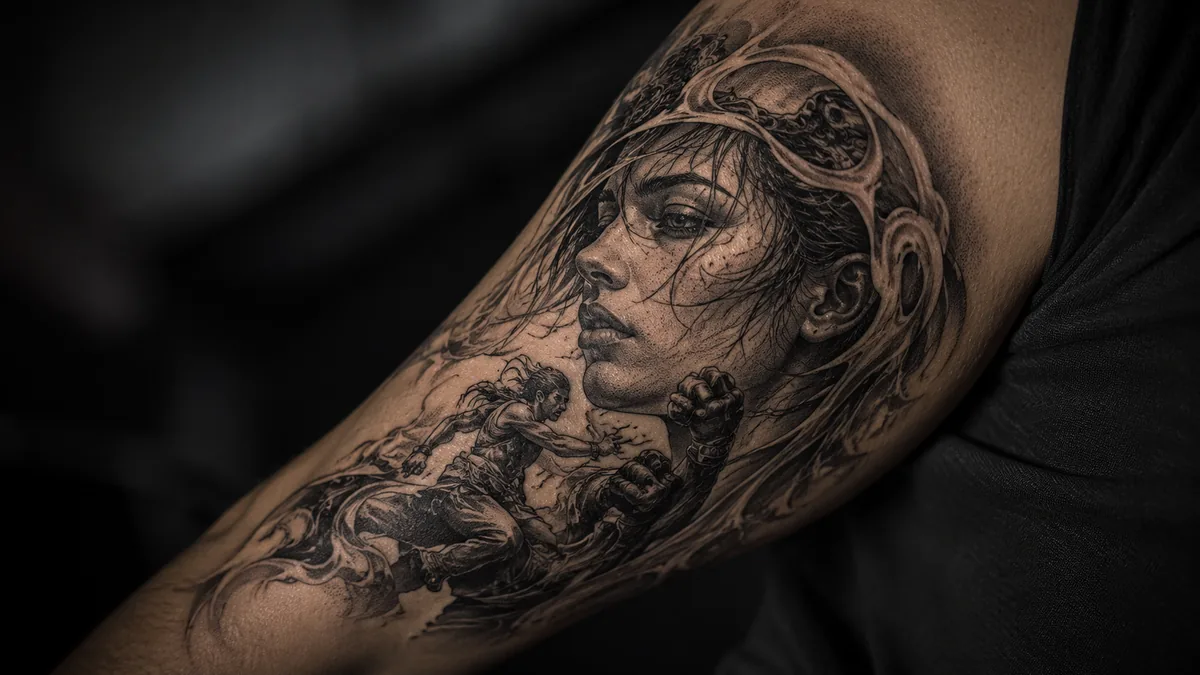
Payton Talbott is one of the most talked-about fighters in the UFC right now, and his tattoos generate almost as much conversation as his knockouts. Two pieces in particular keep coming up: a solid black circle on his torso and a large Hannya mask on his side. People want to know what they mean. Talbott has explained both himself.
The short version: the black circle is a void, inspired by the anime Bleach. The Hannya mask is a traditional Japanese symbol of emotional extremes and protection. Neither is random. Together they tell a specific story about how he sees himself and what he carries inside.
The Black Circle: What Talbott Says It Means
Talbott put it plainly in an interview: ‘It’s just a hole that goes through my body. It represents an internal void, emptiness, lack of emotion.’ That’s his own explanation, not fan speculation. The circle sits centered on his chest at the solar plexus level, and there’s a matching circle on his back at the same height. The visual intent is clear: a hole punched straight through him.
He also said something that landed with a lot of people: everyone feels that emptiness to some degree, but for him it’s more intense and constant. Tattooing it onto his body was a way to make an invisible feeling visible. That’s a legitimate tattoo reason. Not dark for the sake of dark, just honest about a persistent inner state.
The Bleach Connection: Grimmjow and the Hollow Hole
A hole where the heart should be, and a demon to guard what is left.
Talbott is openly a fan of anime, and the design is a direct reference to Bleach. In that series, Hollows are creatures born when a human soul loses its heart to grief or despair. The loss leaves a literal hole in the body, usually on the torso or chest. Arrancars, the highest-level Hollows, carry that hole even after regaining partial human form. It marks what they’re missing.
Grimmjow, the panther-type Arrancar, has his hollow hole in almost the exact same position as Talbott’s tattoo: low sternum to upper abdomen. In the series, Grimmjow’s void connects to a gut-level emptiness, a feral hunger he tries to fill through combat. Talbott mapped that concept onto himself. The symbolism isn’t borrowed lightly. He wore it on his body because the metaphor fit his actual experience.
The Hannya Mask: Traditional Japanese Symbolism
The Hannya mask comes from Noh theater, a classical Japanese performance tradition. It depicts a woman consumed by jealousy, obsession, or heartbreak so completely that she transforms into a demon. The face shows fury and grief at the same time. From one angle it reads as pure rage, from another as deep sorrow. That duality is the whole point of the design.
In traditional Japanese tattooing, the Hannya also functions as a protective talisman against evil and bad luck. You’re essentially wearing the demon so nothing worse can get in. That protective reading coexists with the darker emotional one. Most people who get a Hannya are working with both layers, not just one.
Talbott’s Hannya: Placement and Execution
His Hannya is on the left side of his torso, running along the ribs and abdomen, rendered as a full blackwork piece. No color. Solid black with strong contrast, horns up, mouth open, eyes empty. It reads instantly from across the cage. That’s the kind of tattoo that works in photos, under lights, in motion. The choice to do it in black rather than the classic red and gold keeps it in a more aggressive register.
The rib and side placement is a spicy spot. Lots of nerve endings, skin close to bone, minimal fat layer. That area moves when you breathe, which makes stenciling and tattooing harder. Getting a piece that size on the ribs takes commitment. The fact that it healed clean enough to look that sharp says something about the execution and aftercare both.
Void Tattoos as a Style: Black Circles and Negative Space
The hollow hole as a tattoo concept isn’t exclusive to Talbott. Solid black circles and void shapes have been popular for a few years in blackwork and contemporary graphic tattooing. They’re high-contrast, bold, and read from a distance. A clean saturated black disc holds its shape over time much better than fine-line work in the same area. Bold will hold.
The challenge with a piece like this is getting the black fully saturated without going patchy. You want deep, consistent black with a clean edge. Artists use multiple passes, pack the pigment dense, and the client has to let it heal right. Picking or peeling during healing kills the saturation and you end up with a grey blob instead of a sharp void.
Who Gets These Tattoos and How to Make Them Personal
The combo Talbott is working, a void symbol plus a Hannya, appeals to people who sit with difficult emotional states rather than trying to fix them immediately. Anime fans who connect with Bleach’s themes. People who’ve gone through something that hollowed them out and found a way to keep moving. Fighters, obviously, but also people who fight in less literal ways.
If you want something in this vein, don’t just copy Talbott’s tattoos. Figure out what the void means for you specifically. Maybe it’s a different placement. Maybe it’s a different shape. The Hannya has hundreds of variations, from classical Noh-accurate designs to heavily stylized modern interpretations. Work with your artist on reference, talk about what you’re carrying, and build something that’s yours.









