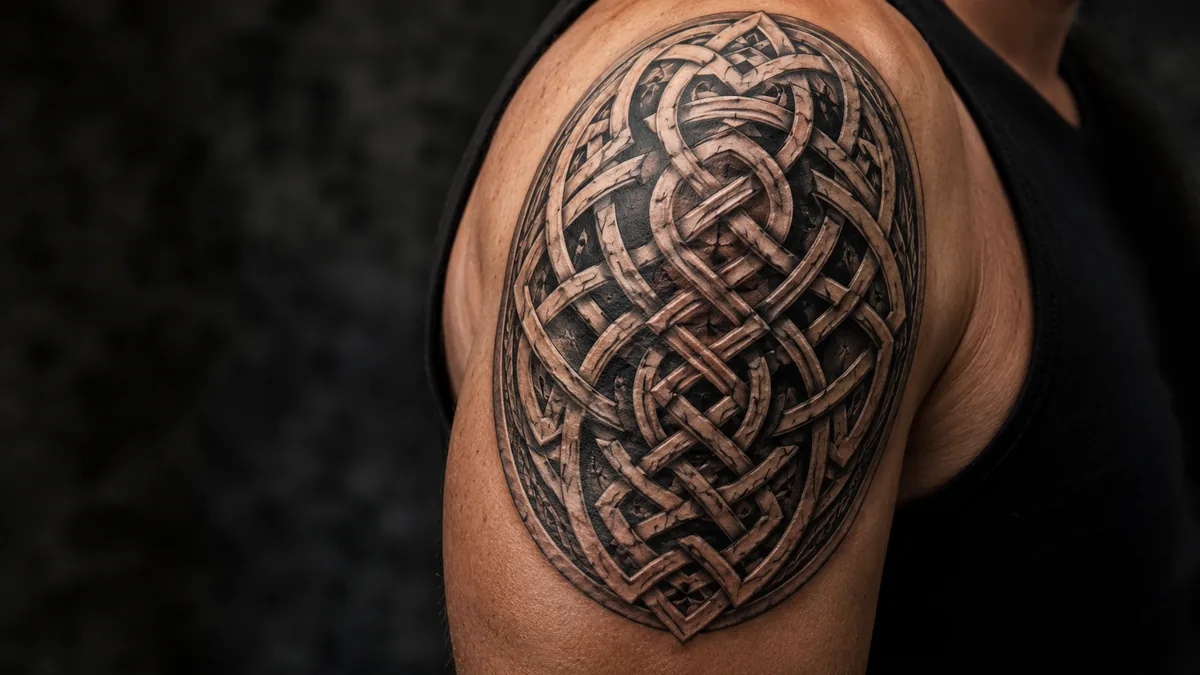
Celtic knot tattoos mean one thing at the core: no beginning, no end. That continuous loop is the whole point. These designs come out of early medieval Celtic and Insular art, and the interlaced lines represent the eternal nature of life, love, and the spirit. It’s a heavy concept packed into a tight, geometric shape.
People wear them for a lot of reasons. Grief, heritage, commitment, faith. The knot says something is unbreakable without spelling it out in a script tattoo. That restraint is exactly why they’ve stayed popular for decades and aren’t going anywhere.
Core Meaning: The Unbroken Line
The defining feature of any Celtic knot is that the line has no start and no finish. That continuous path is a visual statement about eternity. In Celtic thought, everything moves in cycles: life, death, and rebirth. The knot captures that idea in a form your eye can follow but never escape. That’s not an accident. It’s the whole design philosophy.
For most people getting one today, the meaning lands somewhere between permanence and connection. It says whatever this represents to me doesn’t end. Whether that’s a relationship, a bond to ancestry, a spiritual belief, or the memory of someone lost, the continuous line carries all of it without needing a caption.
Historical and Cultural Background
Every line loops back. That is the whole point.
Celtic knotwork as we know it developed between roughly the 7th and 9th centuries CE, most prominently in the illuminated manuscripts of the British Isles and Ireland. The Book of Kells is the most famous example. These designs weren’t invented as tattoos; they were decorative motifs used in religious manuscripts, metalwork, and stone carvings. The Celts themselves left almost no written record of what specific knots symbolized, so a lot of the meanings people cite today were layered on later.
That doesn’t make the symbolism fake. It means it evolved. Christian monks who created the manuscripts saw the endless line as a metaphor for divine eternity. Modern Celtic revival movements in the 19th and 20th centuries reattached the imagery to Irish and Scottish cultural identity. Both readings are real and both are still active in tattoo culture right now.
Popular Design Variations
The triquetra, or trinity knot, is probably the most recognized variation. Three interlocked arcs forming a pointed triangle. It gets read as Father, Son, and Holy Spirit in Christian contexts, or as the triple goddess in neopagan ones. Either way it’s compact, clean, and reads from across the room. The Dara knot is another common choice, derived from the Irish word for oak. It’s associated with strength and roots and works well in a heavier, more intricate style.
Solomon’s knot, the Sailor’s knot, the Shield knot, and full interlace patterns all show up regularly. Some clients want a single knot medallion, clean and precise. Others want a full sleeve with knotwork borders wrapping around figural work. The design is flexible. It plays well with other Celtic imagery like spirals, knotted animals from Pictish art, or standalone as a standalone geometric piece.
Black and Grey vs. Color
Most Celtic knotwork gets done in solid black. There’s a good reason for that. The design depends entirely on line clarity and the visual logic of over-under weaving. Color can muddy that fast if it’s not handled carefully. Black and grey lets the interlace breathe. A good artist will use the negative space and tight linework to make the whole thing pop without any fill at all. Bold will hold in black, and these pieces age well when the lines are saturated from the start.
Color versions exist and can look sharp, but the execution has to be precise. Some artists use a single accent color, like a deep forest green or a muted gold, to highlight specific sections without disrupting the weave logic. Fine line color work in knotwork tends to blow out over time, especially in high-wear areas. If you want color, go for a slightly heavier line weight and commit to the touchup schedule.
Best Placements and How They Age
Celtic knotwork is geometry, so placement matters more than with organic designs. Flat, stable surfaces give it the best canvas. Outer forearm, upper arm, calf, upper back, and chest all work well. Smaller knots, especially triquetra pieces, sit nicely on wrists, ankles, and behind the ear, though those spots are spicy and the fine detail can fade faster in high-friction zones. Ribs and hands are rougher to heal and harder to keep crisp long-term.
These tattoos age well when executed correctly. Solid black lines hold their shape over decades. The risk is in the negative space getting consumed if the lines were too close together at the start. A competent artist will account for skin spread and pack in enough black to keep the weave readable as the skin changes. Avoid artists who underestimate that. A Celtic knot with blown-out lines stops reading as a knot and just looks like a dark smudge.
Making It Personal
The most meaningful versions come when clients bring a specific reference point. Irish heritage, a deceased parent, a recovered faith, a long marriage. The knot becomes a container for that story without advertising it. Some people incorporate initials into the negative space, or frame a portrait with a knotwork border, or layer a family crest inside a shield knot. Those combinations work because the knot reinforces the theme rather than competing with it.
You can also work with a tattooer who specializes in Insular or Celtic art to design something completely custom, pulled from historical manuscript references rather than clip art. That approach produces pieces that feel genuinely connected to the tradition rather than generic. Bring reference images from the Book of Kells or Pictish carved stones. Your artist will appreciate the specificity, and the result will be something you actually want on your skin for life.