
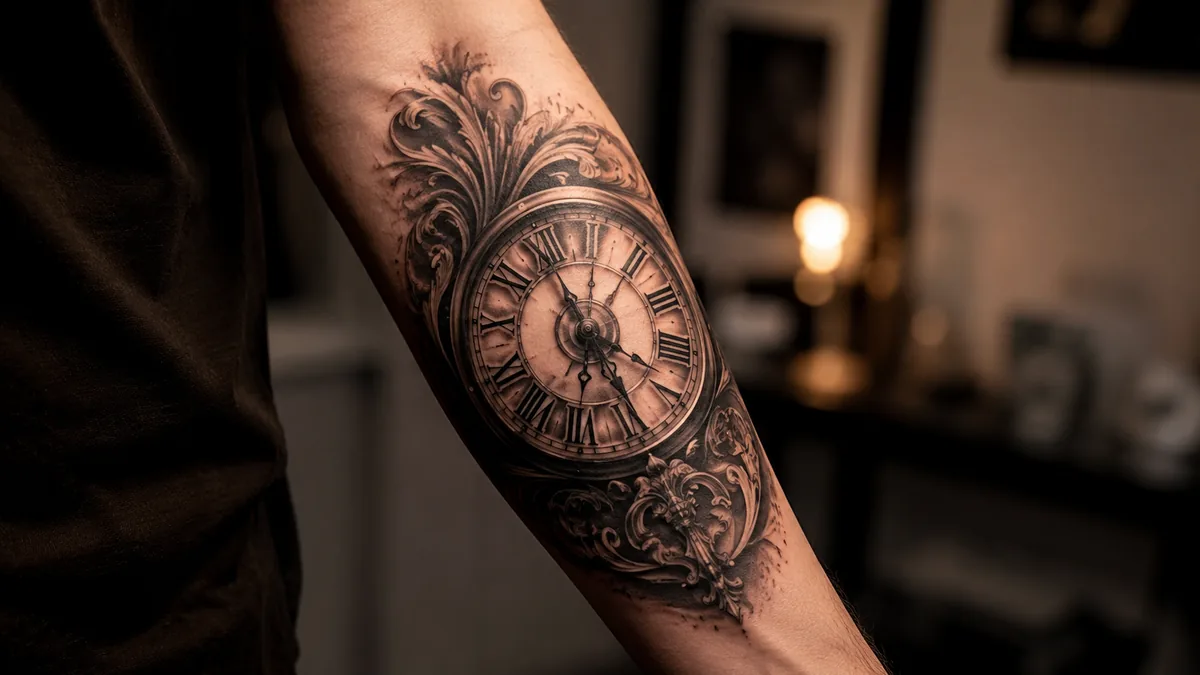
A clock tattoo is one of the most loaded pieces you can get. It’s not just a cool image. Every hand position, every style choice, every element you add is saying something about how you see time, loss, memory, or survival.
People get clocks for a hundred different reasons, and most of them are deeply personal. But there are core meanings that have stuck around for generations in tattoo culture. This is what the clock actually stands for, and how to get one that holds up.
The Core Meaning: Time and Mortality
The clock is fundamentally about the fact that time moves and doesn’t stop for anyone. In tattoo culture, that’s almost always tied to mortality. You’re alive right now. That clock is ticking. A lot of people get this piece after a close call, a health scare, or losing someone. It’s a reminder that every second counts, and you’re wearing that reminder permanently on your skin.
Some people go the opposite direction and use the clock to represent timelessness, a moment frozen forever. Think of a stopped clock or no hands at all. That reads as this moment matters so much I want it to last forever. Both interpretations are valid and both are common. The design usually signals which meaning you’re going for.
A Moment in Time: Personal Milestones
You're not tattooing a clock. You're tattooing the one minute you refuse to forget.
One of the most common reasons someone gets a clock is to mark a specific time. Birth of a child, death of a loved one, the hour you got sober, the minute something changed your life. When the clock hands point to a specific time, that piece carries a private meaning that only you might know. From across the room, it reads as a bold clock tattoo. Up close, it’s a timestamp of something real.
That specificity is what makes the clock tattoo so versatile. It can look classic and traditional while holding an intensely personal story underneath. A lot of clients come in with the exact hour and minute already decided before they even know what style they want. The time comes first. The art comes second.
Cultural and Historical Background
The memento mori tradition, Latin for remember you will die, has been around in European art since at least the medieval period. Skulls, hourglasses, and clocks were used in paintings and carvings as symbols of death’s inevitability. When sailors and soldiers started tattooing heavily in the 18th and 19th centuries, those symbols made their way onto skin. The hourglass came first, then pocket watches became fashionable in the 19th century and crossed over into tattoo flash.
In American traditional tattooing, the pocket watch appears regularly alongside roses, anchors, and banners. Japanese tattooing absorbed the clock motif later, often pairing it with serpents or cherry blossoms to emphasize the fleeting nature of beauty. Neither tradition invented the meaning. They borrowed from a long history of Western European vanitas art and made it wearable.
Popular Design Variations
The melting clock is one of the most recognized variations, pulled straight from Salvador Dali’s surrealist paintings. That design says time is fluid, subjective, or falling apart. It’s a popular choice for people who feel like their sense of time has been distorted by grief, trauma, or mental health struggles. It reads great in black and grey with soft whip shading on the drips.
Pocket watches are classic and hold heavy traditional weight. Grandfather clocks feel more gothic and dramatic, usually paired with ravens, roses, or dark imagery. Roman numerals around the clock face add an old-world feel. No-hands clocks mean timelessness or a refusal to be controlled by time. Cracked or broken clocks often represent loss or the end of something. Every variation shifts the meaning, so the details matter a lot.
Black and Grey vs. Color
Most clock tattoos land in black and grey, and for good reason. The subject matter is serious, and black and grey carries weight in a way that saturated color sometimes doesn’t. A well-executed black and grey clock with tight linework and smooth gradient shading can look crispy and clean decades out. It reads well from a distance and ages better than fine-line work in high-wear areas.
Color clocks work well in neo-traditional or illustrative styles where bold, saturated fills and thick outlines keep everything legible as the piece ages. Going full color with thin delicate lines is a risk, especially on areas that see a lot of sun or friction. If you want color, make sure your artist is drawing bold shapes. Bold will hold. Thin colored lines in direct sunlight will fade and blur faster than you expect.
Best Placements and How It Ages
The forearm is the classic clock placement. It’s a good canvas, relatively flat, and the piece stays visible. The upper arm and thigh give you more real estate for a detailed piece with surrounding elements. The chest and ribcage are popular for larger compositions but the ribcage is spicy on the pain scale, and ribs shift with weight changes over time. The back of the calf ages well and doesn’t get the sun exposure that a forearm does.
Avoid placing a detailed clock on the inner wrist, fingers, or feet if you want it to look sharp long-term. High-wear zones mean faster fading, more touchups, and a higher blowout risk on fine detail work. A clock with intricate gears and roman numerals needs room and stable skin to age properly. Talk to your artist about sizing up. Too small and the details turn to mud in a few years. Give it space to breathe.
Who Gets Clock Tattoos and How to Make Yours Personal
Clock tattoos cross every demographic. Young people get them after a loss, middle-aged people mark a survival milestone, collectors add them to sleeves as a thematic anchor. The image is classic enough to work in almost any style and personal enough to mean something real. That combination keeps it consistently popular without ever feeling overdone.
To make yours specific, bring the time. Bring a reference to what that time means. Tell your artist whether you want the clock stopped, melting, intact, cracked, or running. Add elements that reinforce the meaning: a rose for love, a skull for mortality, a banner with a name or date, a bird flying out. A good artist will build around your story. Don’t just ask for a clock tattoo. Know what yours is about before you sit down.









