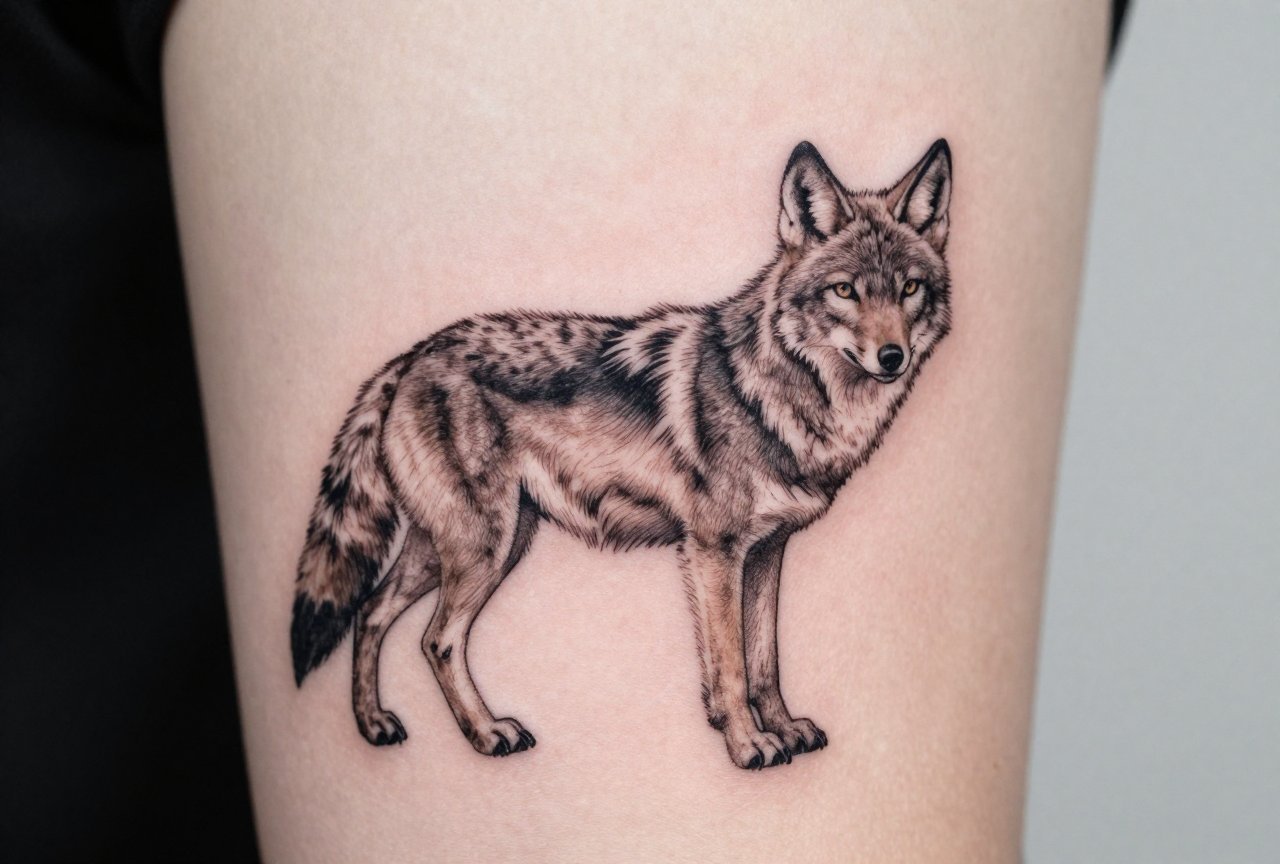
The coyote tattoo means survival, cunning, and the refusal to be tamed. Across Indigenous traditions of the Southwest and Great Plains, Old Man Coyote is the trickster who steals fire, shapeshifts, and outwits beings far more powerful, sometimes to teach a lesson, sometimes just because he can. For people getting this ink today, that energy translates to resilience, sharp instincts, and a certain playful defiance against life’s rules.
Symbolism & History
I’ve tattooed coyotes on ranchers, musicians, and a wildlife biologist who literally studied them for ten years. Each person connects to a different thread of what this animal represents. The symbolism runs deep and varied.
Trickster & Transformation
In Lakota, Diné, and Hopi stories, Coyote doesn’t follow the straight path. He disrupts, he creates chaos, but that chaos often births change. I’ve had clients tell me they want the coyote because they “keep landing on their feet when they shouldn’t.” The trickster isn’t evil, he’s the one who questions authority, finds loopholes, survives through wit rather than force. A howling coyote with a sly half-grin captures this perfectly. I’ve done pieces where the coyote’s eyes are human-like, watching the viewer, that uncanny intelligence that makes you uneasy and amused at once.
Survivor & Adaptability
Coyotes expanded their range while wolves were being eradicated. They eat anything, live anywhere, thrive in cities and wilderness both. That adaptability speaks to people who’ve rebuilt themselves, addiction recovery, career pivots, surviving systems that tried to break them. One client, a veteran, got a scarred coyote with one ear torn, walking through sagebrush. “They tried to wipe them out too,” he said. “Still here.” The image hit hard. We used heavy black for the body, negative space for the scars, so they’d read as history rather than decoration.
Common Variations & Styles
The style changes the meaning more than people expect. Same animal, totally different feeling.
- Traditional American: Bold lines, limited color palette, often howling or mid-stride. Reads classic, timeless, a bit rebellious. The heavy black holds up for decades, I have traditional coyotes on clients from fifteen years ago that still punch.
- Neo-traditional: More ornamental, jewel tones, decorative florals or geometric frames. Feminine energy without being soft. I’ve done neo-traditional coyotes with desert flowers woven through the fur, the trickster domesticated by beauty but still wild underneath.
- Blackwork/dotwork: Stippled fur texture, high contrast, often solitary. Feels spiritual, stark, like a cave painting. Ages beautifully if the dot density is consistent, too sparse and it blurs to gray mush in five years.
- Realistic/nature scene: Full color, landscape background, photorealistic fur. Demands space, thigh, back, upper arm. The meaning here is ecological, connected to place, often someone’s specific memory of the Southwest.
- Minimalist/line: Single continuous line, or just the silhouette. Quiet, personal, the coyote as spirit rather than story. These heal fast but require precise aftercare, any scabbing pulls the fine lines.
We see a lot of coyote-skull variations too. Not my favorite personally, it edges toward the generic “dead animal skull” trend, but when done with specific cultural reference (Diné coyote imagery, for instance), it carries weight. The skull says transformation through death, the cycle, not just edginess.
Best Placements
Where you put it changes how the coyote moves.
High Visibility: Arms, Calves, Chest
Forearm coyotes face outward, confronting the world. They’re statements: I identify with this energy, I’m not hiding it. The calf gives a running coyote natural motion, the muscle flex mimics stride. Chest pieces over the heart read protective, the trickster guarding its territory. I’ve done chest coyotes where the head turns to watch behind, that paranoia that keeps you alive.
Hidden or Intimate: Ribs, Thigh, Back of Neck
Ribs hurt. Everyone knows ribs hurt. But the coyote curled there, hidden under a shirt, feels secretive. For the person who survives by being underestimated. Thigh pieces allow detail, full scenes, multiple animals, storytelling. The back of neck, the nape, is vulnerable placement. A small coyote there watches your back. Literally.
Line weight matters for longevity. Fine lines on hands or feet? The coyote becomes a blur. I’ve had to thicken or redo too many delicate pieces that seemed elegant at first but couldn’t handle the wear. For finger tattoos or top of foot, go bold or go home.
Who Chooses This Tattoo / Personal Meanings
In my chair, the coyote draws specific personalities. Not the wolf people, wolves are pack animals, loyal, structured. The coyote people are loners, grifters, survivors of systems that didn’t fit them. They’re often funny, self-deprecating, sharp.
- The survivor: Abuse, addiction, institutional failure. The coyote who shouldn’t have made it but did.
- The trickster: Comedians, writers, people who weaponize humor. The coyote as archetype of creative disruption.
- The outsider: Small town kid in the city, city kid in the rural West. The coyote belongs everywhere and nowhere.
- The spiritual seeker: Specifically drawn to Southwest Indigenous traditions, often with permission and research, sometimes problematically not. I ask questions. The coyote isn’t a spirit animal you claim lightly.
One of my regulars, a truck driver, has a coyote for every state he’s hauled through, six now, scattered across his legs, each in that state’s landscape. That’s the personal meaning that transcends the generic. The coyote as witness to his miles.
Similar Symbols
People often waver between the coyote and related animals. Here’s how I talk them through it.
- Wolf: Pack loyalty, social structure, noble suffering. The wolf howls with others; the coyote howls alone. Choose wolf if your story is about belonging. Coyote if it’s about surviving outside.
- Fox: Also trickster, but more European, more fairy-tale. Slicker, less scrappy. The fox charms; the coyote endures. Fox is seduction, coyote is persistence.
- Raven/Crow: Another trickster, another survivor, but airborne, intellectual, messenger. Coyote is grounded, bodily, hungry. Raven thinks; coyote does.
- Jackal: Egyptian associations, death, liminal spaces. Less playful, more solemn. The jackal guards thresholds; the coyote crosses them without permission.
Some clients combine them, coyote and raven together, that desert partnership, both scavengers, both smart enough to let humans think they’re in charge.
Final Thoughts
The coyote tattoo means what you need it to mean, but it carries weight you can’t ignore. This isn’t a butterfly or a generic tribal pattern. The coyote has history, cultural specificity, real ecology. I’ve turned away clients who wanted “something Native American looking” without any connection or research. Respect the source.
That said, when the connection is real, this tattoo holds power. It ages well if you respect the craft, bold lines, proper scale, placement that matches your life. The coyote doesn’t ask permission. It finds the gap, slips through, keeps moving. Your tattoo should do the same. Fifteen years from now, you’ll look at that scarred, clever survivor on your skin and remember why you chose to keep going when the easier path was surrender.
Frequently Asked Questions
Does a coyote tattoo have to be howling?
No. Howling coyotes are common, but sleeping, running, or slyly grinning coyotes carry different energy. I ask clients what moment of the animal speaks to them, alert, resting, or mid-hunt changes the whole feeling.
Will a detailed coyote face still look good in ten years?
Facial detail depends on size and line weight. A palm-sized coyote face with fine whisker lines will blur. I recommend at least four inches for detail work, with bold enough lines that the eyes and expression hold as the ink settles.
Is it disrespectful to get a coyote if I’m not Indigenous?
The coyote as animal belongs to no one. Specific sacred imagery, certain Hopi katsina associations, Diné healing references, requires cultural knowledge and often permission. I guide clients toward respectful personal symbolism rather than borrowed religious iconography.
Why do some coyote tattoos look like dogs or wolves?
Artists unfamiliar with coyote anatomy default to wolf proportions, broader head, heavier build. Real coyotes are rangier, with narrower snouts and taller ears. Reference photos matter. I keep a folder of wildlife shots to show the difference.
Related Tattoo Meanings
- Curse Mark Tattoo Meaning: Symbolism, Styles What Artists See
- Dagger Through Rose Tattoo Meaning: Love, Pain Protection
- Death Before Dishonor Tattoo Meaning: Origins Symbolism
- Explore more