
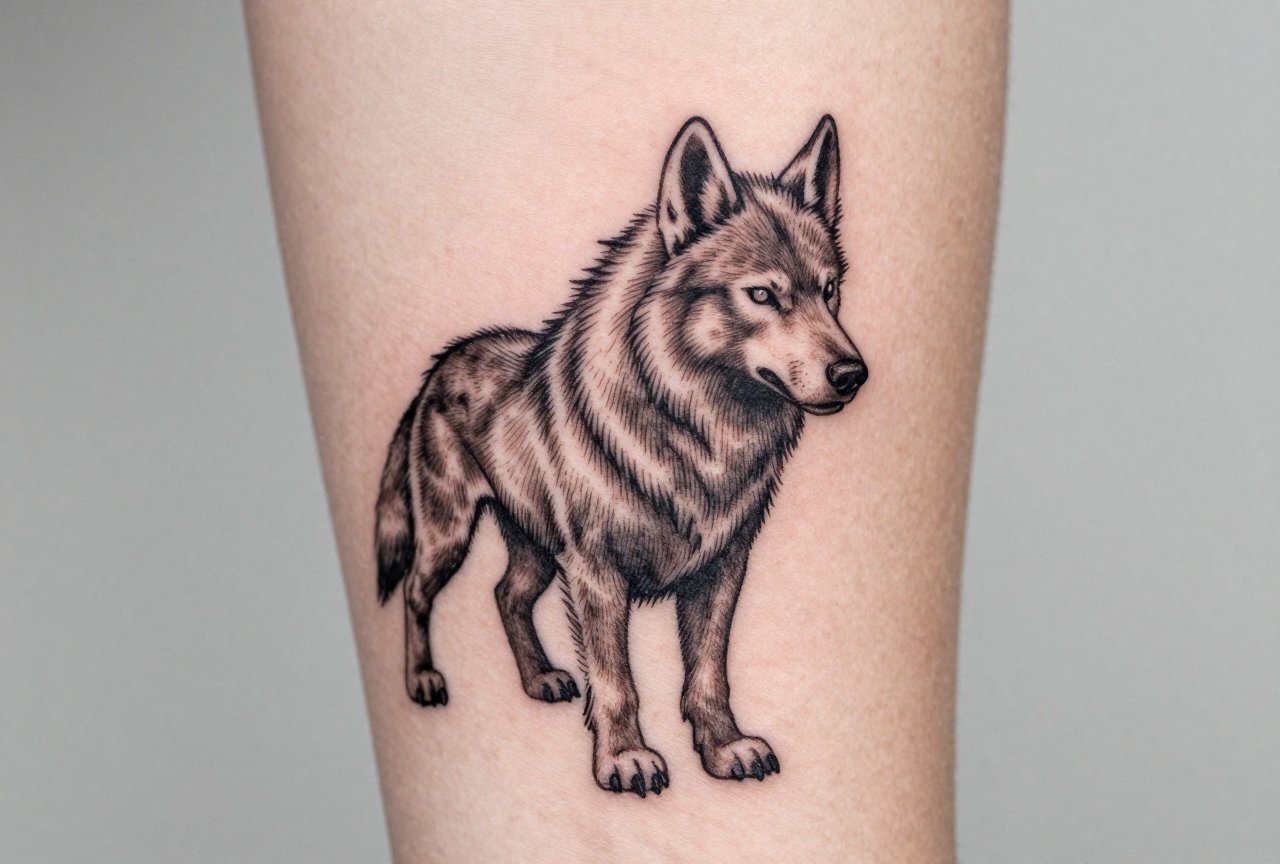
A Fenrir tattoo carries the weight of Norse mythology’s most feared beast: the giant wolf destined to break his chains and devour Odin at Ragnarök. It’s not a pet. It’s not a spirit animal in the soft, modern sense. Fenrir represents raw, uncontrollable force, the inevitability of fate, and the price of binding what refuses to be tamed. I’ve had clients sit in my chair wanting everything from warrior strength to a reminder that some things can’t be caged.
Symbolism & History
The Prose Edda and Poetic Edda tell us Fenrir was born of Loki and the giantess Angrboða. The gods raised him among them, but fear grew as he did. They tried chaining him twice with forged bonds; he broke both. The third, Gleipnir, was crafted by dwarves from impossible things, the roots of a mountain, the beard of a woman, the breath of a fish, the sound of a cat’s footfall, the sinews of a bear. It held.
The symbolism runs deep and often contradictory, which is exactly what makes it compelling skin art.
Chaos and Destruction
Fenrir is Ragnarök’s engine. When he breaks Gleipnir at the end times, his lower jaw touches the earth, his upper the sky. He kills Odin. The sun turns black. I’ve tattooed this on bouncers, veterans, guys who’ve been through custody battles, they don’t want pretty. They want the honest acknowledgment that destruction walks beside us. The imagery works brutally well in black and grey: massive jaws, ropes snapping, saliva frozen mid-drip.
Fate and Inevitability
There’s no version where Fenrir doesn’t break free. The gods know it. He knows it. The binding only delays. Some clients choose this angle specifically, the acceptance that certain outcomes can’t be outrun. I’ve had a cancer survivor request Fenrir with Gleipnir fraying, not broken yet. She didn’t need to explain. The tattoo spoke.
Rebellion and the Price of Freedom
The gods betrayed Fenrir’s trust. Tyr, the only god brave enough to feed him, lost his hand to the wolf’s jaws during the binding. This layers the symbol: the state fears your power, lies to contain you, and you destroy even your friends in the breaking. I’ve seen this resonate hard with people who’ve done time, who’ve been institutionalized, who’ve had their autonomy stripped by systems or families. The tattoo becomes a map of damage and surviving anyway.
Common Variations & Styles
Not every Fenrir piece needs to be a back-piece monster. The wolf adapts to scale and style surprisingly well, though certain approaches carry more visual punch.
- Traditional Norse/Icelandic: Heavy black lines, knotwork framing, the wolf stylized rather than realistic. Works on forearms, calves, upper arms. Ages clean because the bold lines hold.
- Black and grey realism: Fur texture, saliva, broken chains. Demands space, thigh, ribs, full back, maybe a meaty upper arm. I’ve done a chest piece where Fenrir’s head emerged from the client’s sternum, teeth at the collarbone. Two sessions. Worth it.
- Neo-traditional with color: Blood reds, gold Gleipnir, green Norse runes. The color pops but needs touch-ups in 5-7 years, especially on sun-exposed spots.
- Minimalist/linework: Single needle, profile silhouette, maybe one snapped chain link. Delicate, but the meaning reads. I’ve seen this behind ears, on inner wrists, along the ribcage floating.
- Fenrir with Tyr’s hand: The severed hand in the wolf’s mouth. Graphic. Not for the faint. I’ve only done this twice, both clients had specific personal mythology around sacrifice and betrayal.
Runes often accompany: ᚠ (Fehu, wealth/property, sometimes used for Fenrir’s name), ᚦ (Thurisaz, giant/thorn, chaos), or the Helm of Awe (Ægishjálmr) as background protection symbolism. Be careful, some runes have been co-opted by groups you don’t want to be associated with. Your artist should know which ones to avoid or contextualize.
Best Placements
Fenrir wants room to breathe. The jaw, the tension in the neck, the snap of chain, these need inches to read properly.
Large-Scale Pieces
Full back. Thigh front or side. Ribs (if you’re committed to the pain, ribs are no joke, and wolf fur detail over bone is a special misery). Chest plates work if the wolf’s head centers on the sternum with body wrapping toward the shoulders. I’ve done two full-back Fenrirs in twelve years. Both took 15+ hours. Both clients cried at some point. Not from the needle, from the weight of wearing something that big.
Medium and Small Adaptations
Forearm is the sweet spot for most. Vertical orientation, wolf’s head howling or snarling, maybe Gleipnir wrapping the wrist like a bracelet continuation. Calf works similarly. Upper arm, inside bicep, hidden, personal, the wolf facing inward. I’ve tattooed Fenrir’s eye alone, just that amber slit, on a client’s inner forearm. Small. Devastating. She said it was the thing watching her when no one else was.
Hands and neck? I’d counsel against it unless you’re heavily covered already. The imagery is aggressive; placement amplifies that. Employers read it fast. Make sure that’s the conversation you want to have daily.
Who Chooses This Tattoo / Personal Meanings
In my chair, Fenrir clients rarely fit one type. I’ve tattooed it on:
- A Marine who’d done three deployments, who wanted the enemy he couldn’t kill, his own capacity for violence
- A woman leaving a religious community, the wolf her celebration of being “unbound”
- A father whose son had died; Fenrir’s inevitability matched his grief, the binding his attempt to hold it
- A musician, purely aesthetic, drawn to the visual drama
The through-line is intensity. Fenrir isn’t a casual choice. Clients who pick it have usually thought longer than average, sometimes years. They bring reference images from the Eddas, from video games (God of War, Assassin’s Creed Valhalla), from other tattoos they admire. The best pieces happen when they let go of the references and trust the artist to interpret.
I always ask: “Do you want the wolf bound or free?” The answer shapes everything. Bound suggests struggle, containment, the fight against one’s nature. Free is apocalypse, acceptance, power unleashed. Most choose mid-snap, the moment of breaking. That tension is where the art lives.
Similar Symbols
If Fenrir feels too destructive, clients sometimes pivot to related Norse imagery:
- Sköll and Hati: The wolves who chase the sun and moon across the sky. Less apocalyptic, more eternal pursuit. Good for determination, ambition.
- Geri and Freki: Odin’s companion wolves. Loyal, battle-hungry, but domesticated in their way. Fits brotherhood, military bonds, chosen family.
- Odin’s wolves (broader): Sometimes paired with his ravens, Huginn and Muninn. The full set creates a narrative piece, thought, memory, hunger, ferocity.
- Jörmungandr: The world serpent, Fenrir’s sibling. Circular, ouroboros-like, more about cycles and endings that return.
I’ve had clients start with Fenrir and end with Jörmungandr mid-conversation, or combine them as a sleeve representing Loki’s three monstrous children. The mythology is flexible. Your skin is the constant.
Final Thoughts
A Fenrir tattoo is a commitment to darkness with meaning. It doesn’t promise transformation or growth in the soft, Instagram-quote sense. It says: I contain something that could destroy me, that others fear, that will one day break loose. That honesty is what makes it powerful.
If you’re considering it, sit with the image. Not for a week. For months. The wolf deserves that patience. When you’re ready, find an artist who knows Norse imagery beyond Pinterest, who can tell Gleipnir from a regular chain, who understands why the hand in the mouth matters. The tattoo will outlast the trend. Make sure it outlasts your doubt too.
Frequently Asked Questions
Is a Fenrir tattoo considered offensive or associated with hate groups?
Norse symbols have been misused by extremist groups, but Fenrir himself isn’t specifically co-opted the way some runes are. Context matters, pairing with certain runes or symbols can signal affiliation. A knowledgeable artist can help you avoid unintended associations while keeping the mythological meaning intact.
How much does a detailed Fenrir tattoo typically cost?
A small linework piece might run $200-400, while a full-back black and grey realism piece can reach $2,000-4,000 across multiple sessions. The complexity of fur texture, chain elements, and size drive most of the cost. Good Norse work isn’t cheap; cheap work isn’t good.
Does Fenrir tattoo well on darker skin tones?
Absolutely. Black and grey realism with high contrast reads beautifully on all skin tones. The key is an artist experienced in adapting contrast and line weight, not lightening the design, but structuring it so the depth and detail hold. I’ve seen stunning Fenrir work on deep melanin-rich skin where the shadows became the art.
Can I combine Fenrir with other Norse gods in one piece?
Yes, but consider the narrative. Fenrir kills Odin at Ragnarök, so pairing them as allies reads confused unless you’re deliberately showing that conflict. Tyr works well, he’s the one who sacrifices his hand. Loki as Fenrir’s father creates a family portrait of sorts. Think story, not collage.
Related Tattoo Meanings
- Norse Tattoo Meaning
- Fig Tattoo Meaning: Symbolism, History Shop Talk
- Five Dots Tattoo Meaning: Symbolism, History What Artists Know
- Explore more









