
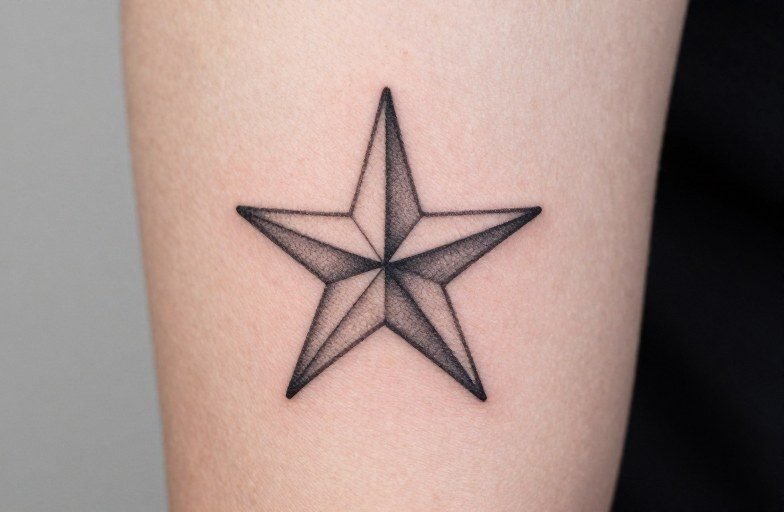
The five point star, also called a pentagram when drawn with connecting lines, carries some of the most layered and contested symbolism in tattoo culture. it represents direction, balance, and the human form (head, two arms, two legs), though specific meaning depends heavily on orientation, line work, and personal intent. A single point-up star reads as protective or aspirational; point-down, it has historically been linked to occult traditions, though plenty of people wear it simply for aesthetic edge.
Symbolism & History
Ancient Roots and Layered Meanings
The five point star predates organized religion by millennia. Sumerian cuneiform tablets often linked it to Ishtar, the goddess of love and war. In later Greek tradition, the Pythagoreans called it the pentalpha and considered it a symbol of health and harmony. The mathematical perfection of the star, its lines intersecting in golden ratio proportions, gave it an almost mystical reputation in early geometry.
Medieval Christianity adopted the single point-up star as a representation of the five wounds of Christ, or sometimes the five joys of Mary. Sailors began tattooing nautical stars (typically two-toned, with alternating light and dark points) as early as the 1700s, though precise dating is murky. The design marked someone who had traveled a significant distance, often across the equator, and served as a hopeful talisman for finding one’s way home.
Modern Interpretations
Today, the symbol fragments across subcultures. Military personnel sometimes choose it for guidance through difficult transitions. Wiccans and neopagans may use it as an elemental symbol (earth, air, fire, water, spirit). Street and prison tattooing has occasionally used point-down variants for affiliation purposes, though this varies enormously by region and era. The key takeaway: context matters more than any universal dictionary definition.
Common Variations & Styles
Not all five point stars read the same. The difference between a crisp geometric linework piece and a shaded, dimensional design changes both aesthetic and implication.
- Nautical star: Two alternating colors (traditionally red/black or green/black), often with a compass rose center. Heavy American traditional lineage, thick black outlines, limited color saturation.
- Outline pentagram: Continuous line forming the star shape, no fill. Reads cleaner, ages better on high-movement areas. Popular in blackwork and minimalist styles.
- Filled pentagram: Solid black or color inside the lines. More visually aggressive, requires more touch-ups over time as saturation settles.
- Circled (pentacle): Star enclosed in a circle. In some traditions, this represents containment of elemental forces; in others, simple aesthetic balance. The circle adds structural integrity to the design long-term.
- Broken or exploded star: Points separated, sometimes scattered. Purely contemporary, often decorative rather than symbolic.
Line weight matters enormously here. A single-needle star at two inches will blur into indistinctness within five to seven years on a high-movement area. Traditional bold lines (8-12 needle groupings) hold their geometry far longer. If you want fine detail, plan for a larger placement or accept that crispness will soften.
Best Placements
Where the Design Holds Up
Five point stars reward flat, stable skin. The geometry is unforgiving, any distortion from muscle movement or weight fluctuation throws off the symmetry that makes the symbol satisfying.
- Outer forearm: Visible, relatively flat, easy to show or hide with sleeves. Slight radial distortion when the arm rotates, but generally stable.
- Upper chest/shoulder: Classic for nautical stars. The pectoral flatness preserves geometry; the shoulder cap allows for dynamic compositions with multiple stars.
- Behind the ear: Trendy but technically challenging. Skin here moves constantly with jaw motion and has thin subcutaneous tissue. Stars in this zone often need significant touch-up within two years.
- Ribs/sternum: High pain, high stretch risk. The star’s points align naturally with the sternum’s vertical axis, but breathing motion and potential weight change distort it over time.
- Hands and fingers: Bold statement, poor longevity. Finger skin regenerates rapidly; even well-saturated stars typically need reinforcement every two to four years.
Scale Considerations
At under two inches, a five point star’s inner angles become too small to hold ink cleanly. The center fills in unpredictably, becoming a blob rather than defined geometry. Minimum recommended size for a clean pentagram: two and a half to three inches. For single-needle or fine-line styles, go larger to compensate for inevitable spread.
Who Chooses This Tattoo / Personal Meanings
The five point star attracts a specific kind of decision-maker: someone wanting symbolism without narrative overload. It offers recognizable weight without the literalness of names, dates, or figurative imagery.
Military veterans sometimes pair it with specific coordinates or unit designators, keeping the star as the central navigational anchor. People in recovery have used it to mark a fixed point of orientation, something steady when personal geography felt chaotic. Musicians and touring workers often gravitate toward the nautical variant, less for maritime authenticity than for the metaphor of constant movement with a home reference.
The point-down orientation draws a different crowd: people deliberately reclaiming a symbol from negative associations, or those genuinely practicing traditions where that orientation has specific technical meaning. It’s worth noting that in most tattoo shops, orientation raises no eyebrows, artists are generally more concerned with technical execution than symbolic policing.
Similar Symbols
Confusion between the five point star and related symbols is common. Understanding the distinctions helps clarify what you actually want.
- Six point star (hexagram/Star of David): Two overlapping triangles, not a continuous five-point form. Distinct Jewish identity symbol; the geometry and cultural weight are entirely separate.
- Seven point star (heptagram): Less common in tattooing, associated with some esoteric traditions and specific regional flags. More complex geometry, harder to execute cleanly at small scale.
- Compass rose: Often incorporates a star at center, but includes directional markers and sometimes latitudinal rings. More explicitly about navigation, less about personal symbolism.
- North star specifically: Usually depicted with exaggerated downward point or trailing light. More singular and aspirational than the balanced five-point form.
If you’re drawn to the star’s geometry but uncertain about loaded meaning, the nautical variant offers the cleanest escape route, historically documented, visually distinctive, and relatively neutral in contemporary interpretation.
Final Thoughts
The five point star endures because it compresses multiple registers into a simple form: mathematical, spiritual, practical, decorative. That compression is also its risk, assumptions about your intent will vary by who’s looking. The solution isn’t to over-explain your tattoo to strangers, but to know your own reasons clearly before committing to the design.
Technically, this is a forgiving choice for a first tattoo if you respect scale and placement. The shape is ancient, the application modern. What matters is the specific version you wear: the line weight, the orientation, the presence or absence of a circle, the color choice. These details determine not just how it ages on your skin, but what conversation it starts when visible. Choose deliberately, heal properly, and let the geometry do its work.
Frequently Asked Questions
Does a point-down five point star always mean something negative?
Not at all. While point-down pentagrams have been used in some occult and countercultural contexts, many people choose this orientation purely for visual balance or personal aesthetic preference. Meaning depends on the wearer’s intent, not universal rules.
How well does a fine-line five point star age compared to bold traditional work?
Fine-line stars blur faster, especially on high-movement areas like wrists or ankles. The inner angles of a five point star are particularly vulnerable to ink spread. Bold traditional lines with 8-12 needle groupings typically hold geometry for decades longer.
What’s the difference between a pentagram and a pentacle tattoo?
A pentagram is the five-point star itself, drawn with continuous lines. A pentacle adds a surrounding circle. The circle can represent containment, wholeness, or simply visual framing, interpretation varies by tradition and individual.
Can a five point star tattoo be easily covered up or modified later?
Small, black-filled stars are challenging to cover without going significantly larger or darker. Outline-only stars offer more flexibility for incorporation into larger designs. If you’re uncertain, start with an outline and build outward rather than committing to dense fill immediately.
Related Tattoo Meanings
- Flor de Lis Symbol Tattoo Meaning: History, Style Placement
- Fly Tattoo Meaning: Decay, Resilience, and Unflinching Honesty
- Ilia Topuria Back Tattoo Meaning: Symbolism Style Guide
- Explore more









