
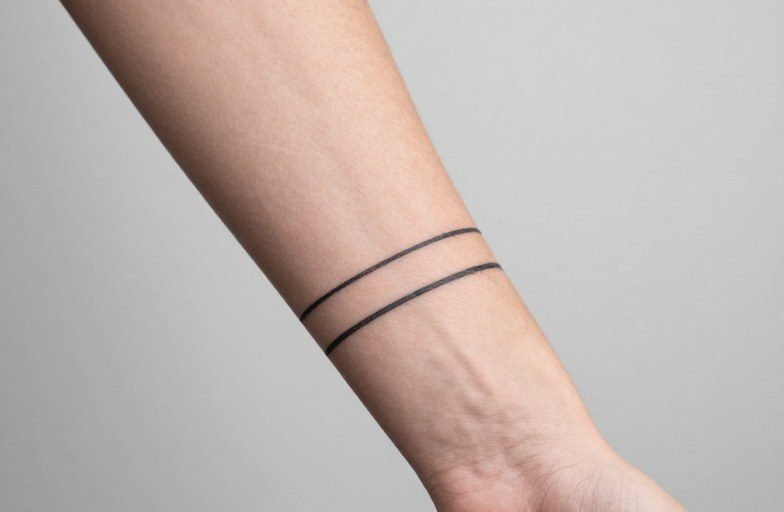
Two parallel lines tattooed on the forearm most commonly represent duality, balance, and the constants that run through a person’s life. The placement matters, visible, straightforward, impossible to ignore, which often signals that the wearer wants this particular meaning front and center. What starts as a simple geometric choice usually carries more personal weight than it first appears.
Mythology & Folklore
Parallel lines show up across cultures, though rarely as standalone symbols. The connection to duality, light and dark, life and death, order and chaos, runs deep in many traditions.
Norse and Celtic Threads
In Norse visual culture, paired lines sometimes framed runic inscriptions or bordered protective symbols. The doubling suggested reinforcement, a way to strengthen what lay between. Celtic knotwork occasionally used parallel bands as structural elements, though these were always interwoven rather than truly separate. Some trace the modern two-line tattoo’s aesthetic to these bordered traditions, stripped down to their simplest form.
Eastern Philosophies
The concept of duality in Taoism, yin and yang, offers a familiar parallel. Two lines can evoke this balance without depicting the full circular symbol. The forearm placement makes this visible during everyday gestures, turning ordinary movement into a quiet reference to opposing forces in harmony. In Japanese aesthetics, ma (negative space) between two marks holds as much significance as the marks themselves. The gap between the lines becomes part of the meaning.
Personal & Modern Meanings
Contemporary wearers assign specific, often private significance to this design. The simplicity invites projection without demanding explanation.
Life’s Before and After
Many choose two lines to mark a definitive split, who they were versus who they’ve become. The top line might represent a past self, the bottom the current one. The forearm’s visibility means this division stays in sight during typing, lifting, reaching, constant reinforcement of personal evolution. Some pair the design with dates or coordinates placed nearby, though the lines themselves remain unadorned.
Relationships and Bonds
- Two siblings, two friends, two partners, matching or complementary line tattoos
- Parent and child, with line thickness indicating generation
- Two significant locations, the lines representing paths that run parallel
- A commitment to two core values held in balance
The design’s restraint prevents it from reading as sentimental or obvious. It suggests rather than announces.
Similar & Related Symbols
Understanding what two lines aren’t helps clarify what they are. Several adjacent designs share visual DNA but carry distinct associations.
Three lines, often called the “deathly hallows” arrangement or simply triple bands, introduce narrative complexity: past, present, future; mind, body, spirit. The reduction to two strips away that progression, fixing meaning in opposition rather than sequence. A single line, by contrast, reads as path or timeline, continuous and singular. The doubling creates dialogue between elements.
Armband tattoos encircle the limb, suggesting containment or cyclical return. Two forearm lines stop where they start, open-ended, implying continuation beyond the visible. They’re closer to written equals signs than to closed rings. This openness matters for interpretation, nothing resolves, nothing completes.
Broken or dashed parallel lines introduce fragility, interruption. Solid unbroken bands insist on persistence, on things that hold despite pressure. The choice between these variations significantly shifts tone.
How It Ages on Skin
Line tattoos age differently than shaded work, and forearm placement presents specific challenges and advantages.
Placement Realities
The outer forearm receives substantial sun exposure, which degrades black ink faster than protected areas. Inner forearm skin is thinner and more prone to blowout, ink spreading beyond the intended line. A skilled artist accounts for this by adjusting needle depth and machine speed. Lines placed too close together may blur into a single band over decades; optimal spacing usually sits at 3-5 millimeters apart for longevity.
Technical Specifics
- Single needle or tight round liner produces crisp, fine lines that soften within 5-10 years
- Thicker 7-9 round liner work holds definition longer but reads heavier initially
- Hand-poked (stick and poke) lines often heal slightly irregular, which some prefer for organic character
- Touch-ups every 7-12 years keep edges sharp; neglect this and the design becomes two fuzzy suggestions
Black-only designs age more predictably than colored alternatives. Greywash between or around lines adds dimension but requires more maintenance.
Common Variations & Styles
The basic two-line concept supports numerous stylistic interpretations without losing its core identity.
Equal thickness, equal length: the most neutral presentation, balanced and declarative. Unequal thickness, one bold, one fine, creates hierarchy, often interpreted as dominant and subordinate elements in a relationship. Offset placement, where one line begins slightly above or below the other, introduces dynamism, suggesting movement or chronological sequence.
Some incorporate subtle breaks: a gap in one line, a perpendicular connector, a point where they nearly touch. These modifications shift meaning toward connection rather than pure parallelism. Others add minimal text between the lines, though this risks cluttering the essential restraint that makes the design effective.
Vertical orientation on the inner forearm reads differently than horizontal wrapping. Vertical suggests pillars, standards, things upheld. Horizontal reads as horizon, limit, boundary. Most choose horizontal for the outer forearm, vertical for the inner, following natural arm structure.
Who Chooses This Tattoo
Certain patterns emerge among people drawn to this specific design, though no single demographic dominates.
First-time tattoo recipients often gravitate toward two lines for their apparent simplicity and reversibility (though all tattoos are permanent, minimal designs feel less committing). People in technical or creative fields, where visible tattoos may carry stigma, appreciate the design’s ability to read as almost accidental at glance, deliberate upon inspection. Those who’ve experienced significant life transitions frequently select this as a marker without wanting explicit narrative imagery.
The choice often signals preference for understatement over declaration. Someone with extensive tattoo collections might add two lines as palate cleanser, negative space between more complex pieces. Alternatively, it might stand alone as the only tattoo, chosen precisely for its refusal to explain itself.
The Bottom Line
Two lines on the forearm work because they resist fixed meaning while suggesting depth. The design rewards attention without demanding it, offers symbolism without prescribing it. Technical execution matters enormously, precise spacing, consistent saturation, appropriate needle selection determine whether this reads as intentional art or accidental mark. For those considering the design, the essential question isn’t what two lines “mean” universally, but what two specific lines, placed by a specific hand, at a specific moment in life, come to represent through daily encounter. The forearm ensures that encounter happens constantly.
Frequently Asked Questions
How much should two parallel forearm lines cost?
Expect $80-200 depending on artist hourly rate and studio minimums. Simple line work doesn’t mean quick work, precise, even lines actually require more skill and time than they appear to. Avoid bargain pricing that suggests rushed execution.
Will two lines stretch or distort with muscle gain?
Forearm skin has moderate elasticity. Significant muscle increase can shift placement slightly, but two straight lines handle this better than complex imagery. The design’s simplicity makes minor distortion less visually disruptive than with detailed tattoos.
Can two lines be easily covered or removed later?
Black lines are among the most straightforward tattoos to laser remove, though complete removal requires multiple sessions over years. Cover-up options are limited by the design’s starkness, most covers require significantly larger, darker work.
How do I choose spacing between the two lines?
3-5 millimeters provides optimal visual separation with aging buffer. Too close and they’ll blur together; too far and they read as unrelated marks. Your artist should stencil multiple options so you can see proportion against your specific forearm dimensions.
Related Tattoo Meanings
- FTW Tattoo Meaning: Origins, Symbolism and Design Choices
- Fudog Tattoo Meaning: Guardian Lions, Protection Power
- Gecko Tattoo Meaning: Adaptation, Survival Quiet Luck
- Explore more









