
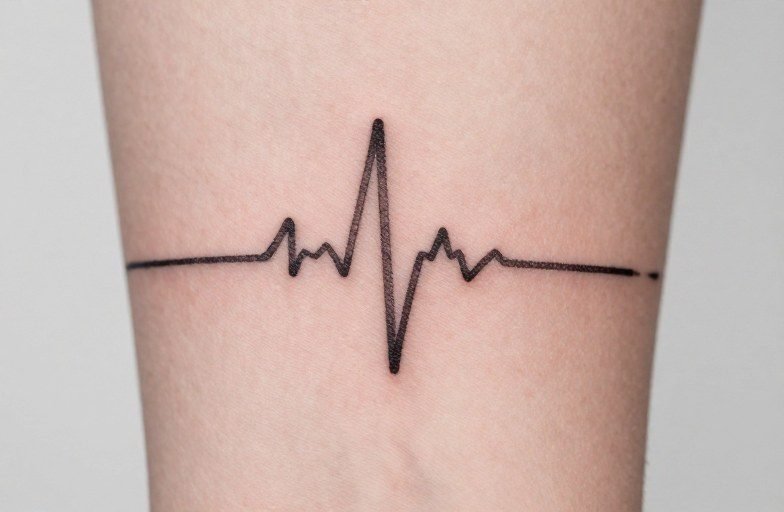
The heartbeat tattoo, usually rendered as an electrocardiogram (EKG) line, carries core associations with life, vitality, love, and survival. Most people choose it to mark a health scare overcome, to honor someone lost, or to express that love itself keeps them alive. The design’s power comes from its stark simplicity: a single continuous line that flatlines, peaks, or integrates with other symbols.
Symbolism & History
Medical Roots vs. Personal Meaning
The EKG line entered tattoo culture through hospital imagery, not ancient tradition. Unlike crosses or anchors with centuries of symbolic buildup, the heartbeat line is a modern invention, gaining traction as cardiac monitoring became visually familiar in the late 20th century. Its tattoo meaning typically clusters around three themes: survival after heart problems, memorial for someone whose heart stopped, and romantic love as a “heart that beats for another.”
Some trace the romantic variant to couples getting matching pulse lines in the 2000s, though pinpointing exact origins is speculative. The medical-survival version often follows real ICU experiences, patients seeing their own EKG printouts and later wanting that specific waveform preserved. What matters more than origin is how the symbol functions now: it’s instantly readable, emotionally direct, and adaptable without losing recognition.
What the Flatline Does to the Symbol
A heartbeat tattoo that ends in a flatline carries fundamentally different weight than one that continues pulsing. The flatline version often memorializes death, sometimes with a date integrated at the end. Continuing rhythm suggests ongoing life, resilience, or love that persists. This single design choice, where the line ends, shifts the entire emotional register. Artists note that clients sometimes don’t consider this beforehand and need guidance on the implication.
Common Variations & Styles
Integrated Designs
The standalone EKG line is common, but integration with other elements creates more specific meaning:
- Heartbeat into name or word: The line peaks into letterforms, often a partner’s name or “MOM.” Line work must be precise; the transition from organic waveform to structured text is technically demanding.
- Heartbeat with heart shape: The line forms a literal heart at one peak, then continues. This reads more romantic than medical. Shading inside the heart shape helps it hold up over time.
- Heartbeat with religious symbols: Crosses, praying hands, or Bible verses at the line’s end. Popular in memorial pieces.
- Actual EKG waveform: Some clients bring their own hospital printouts. Tattooing an exact waveform requires enlargement; at small sizes, the fine details blur together and lose definition.
Style Considerations for Longevity
Thin single-line EKG tattoos look elegant fresh but age poorly. The gaps between peaks and valleys close in as ink spreads slightly under skin. For longevity, opt for:
- Minimum line weight of 3mm for the main waveform
- Slight contrast variation, darker peaks, lighter valleys, rather than uniform weight throughout
- Avoiding extremely small size; under 2 inches wide, the line becomes indistinct within 5-10 years
- Black ink only; colored EKG lines (red for medical accuracy, for instance) fade faster and lose the graphic punch
Watercolor backgrounds behind heartbeat lines are popular but problematic. The soft, bleeding color behind a hard-edged medical graphic creates visual tension that often looks dated within a few years. Solid blackwork backgrounds or negative space serve the design better.
Best Placements
The heartbeat line’s horizontal orientation suits certain body parts naturally:
- Inner forearm: Most common. Visible, moderate pain level, flat surface preserves line integrity. The natural wrist-to-elbow flow follows the EKG’s left-to-right reading.
- Over the actual heart (left chest): Directly literal placement. Requires caution: chest skin moves significantly with breathing and arm motion, which can distort straight lines over time. Slightly larger sizing helps compensate.
- Ribcage: Painful but private. The long, narrow format fits rib anatomy well. Skin here is thinner; linework must be confident and single-pass where possible.
- Behind the ear / side of neck: Small, visible, socially acceptable in most workplaces. Limited space means simplified waveform, fewer peaks, broader spacing.
- Along the collarbone: Horizontal alignment works, but this area sun-exposes heavily and fades faster than covered skin.
- Finger / side of hand: Popular for couples. High visibility but also high maintenance, hand tattoos need touch-ups every 2-4 years as a general rule, and the fine lines of a heartbeat blur quickly here.
Wrist placement specifically over the pulse point is thematically satisfying but practically tricky. The constant flexion and the watch/bracelet friction accelerate aging. Many artists suggest placing it slightly higher on the forearm instead.
Who Chooses This Tattoo / Personal Meanings
No single demographic dominates, but patterns emerge. Medical professionals, nurses, paramedics, doctors, sometimes get EKG lines as professional identifiers, though this overlaps with dark humor about mortality. Cardiac patients and their families form another clear group, often timing the tattoo around anniversary dates of surgery or recovery.
Parents choose heartbeat tattoos to represent a child’s life, sometimes incorporating the actual prenatal ultrasound heartbeat rhythm if recorded. This requires the audio file’s waveform visualization, which tattoo artists can transfer but need clean source material for accuracy.
The romantic variant attracts couples seeking matching or complementary pieces. The risk here is obvious: relationship tattoos carry inherent gamble. Some artists gently raise this, not to discourage but to ensure placement allows future cover-up or modification. Forearm lines extend more easily into larger pieces than finger or chest placements if the relationship ends.
Less commonly, the heartbeat represents creative or professional passion, “this is what keeps me alive” applied to music, art, or career. These versions usually integrate relevant imagery (guitar neck, paintbrush, camera) rather than remaining pure EKG.
Similar Symbols
Clients considering heartbeat tattoos often weigh alternatives:
- Semicolon: Mental health survival, specifically suicide prevention awareness. More specifically narrative than the heartbeat; less visually flexible for integration.
- Infinity symbol: Eternal love or connection. Smoother, less medically charged. Works better for purely romantic intent without the survival or mortality layer.
- Anchor: Stability, often paired with “refuse to sink.” Nautical tradition gives it more symbolic history but less personal medical connection.
- Phoenix: Rebirth through destruction. More visually complex, more painful to execute, more overtly dramatic.
- Date numerals: Direct memorial without symbolic mediation. Some prefer this literalness; others want the EKG’s visual poetry.
The heartbeat occupies a middle space: medically grounded enough to feel real, symbolically open enough to carry multiple meanings, graphically simple enough to work small or integrated.
Final Thoughts
The heartbeat tattoo works because of its immediate legibility and emotional directness. It doesn’t require explanation, yet it accommodates deep personal specificity, your actual hospital waveform, your partner’s name in the peaks, a date where the line ends. The design’s simplicity is its strength and its weakness. Executed with too-thin lines or too-small scale, it becomes a blur. Placed without thought to the flatline implication, it can convey unintended messages. Work with an artist who will push back on technical choices that won’t age well, and come prepared with reference material if you want medical accuracy. The best heartbeat tattoos look like they took two minutes to conceive and two hours to execute precisely, which is harder than it sounds.
Frequently Asked Questions
Do heartbeat tattoos have to represent a real medical event?
No. Many people choose them for romantic meaning, general life appreciation, or aesthetic reasons. The symbol has broadened beyond its medical origins, though survival and memorial remain common motivations.
How well do fine-line EKG tattoos hold up over time?
Poorly if done too thin. The gaps between waveform peaks tend to close as ink settles and spreads. Ask your artist for minimum 3mm line weight and avoid extremely small sizes if you want the design readable in ten years.
Can I use my actual EKG reading from a hospital visit?
Yes, but the printout needs to be enlarged significantly. At tattoo size, the fine details of a real medical waveform blur together. Your artist will simplify the peaks and valleys while keeping the overall pattern recognizable.
Is the heartbeat tattoo considered overdone or cliché?
It’s common, but execution and personalization matter more than uniqueness. A generic clip-art EKG line looks dated; one incorporating your specific waveform, meaningful words, or thoughtful placement becomes distinctly yours.
Related Tattoo Meanings
- Just Breathe Tattoo Meaning: Calm, Survival, and Reminder
- Treble Clef Tattoo Meaning: Music, Identity Self-Expression
- Hawaii Symbols Meanings Tattoo: Island Heritage Inked
- Explore more









