Coming up with tattoo ideas is where almost everyone gets stuck. I’ve watched clients sit in my chair for years with a Pinterest board full of stuff they don’t actually want on their body. The truth is, good tattoo ideas don’t usually drop out of the sky fully formed. They come from paying attention to what already matters to you, then finding a visual language that fits your skin, your budget, and your patience for the process. This guide walks through how I actually help people figure it out, no mystical nonsense, just what works in real shops.
Start With What’s Already Yours
The best tattoos I’ve done came from conversations, not image searches. I ask clients: what do you look at every day? What song lyric do you mutter without thinking? What object lives in your pocket until the finish wears off?
Memory and Place
Your grandmother’s handwriting on a recipe card. The coordinates of the apartment where you finally got your shit together. The view from a specific window. These carry weight because they’re yours alone. I’ve tattooed the skyline of a client’s hometown in single needle on her ribs, she sees it when she breathes, and that’s the point. Another guy brought in his kid’s actual drawing of their dog, weird proportions and all. We cleaned it up just enough to read as a tattoo, kept the wobbly energy. That’s the stuff that holds up emotionally.
The Stuff You Collect
Look at what accumulates on your shelves. Vintage keys, pressed flowers, concert stubs, fishing lures. One of my regulars builds guitar pedals; we turned a schematic into a sleeve that wraps his forearm. The lines mean something to him because he stares at them at work. Your collections already show what your brain returns to.
- Take photos of five objects you’d grab in a fire
- Write down three phrases you say or think weekly
- Note any recurring dream images or symbols
- Flip through your camera roll, what do you photograph repeatedly?
Think in Placement, Not Just Pictures
This is where a lot of people trip up. They find an image they love, then try to wedge it somewhere. I tell clients to reverse it: where on your body does this belong? The shape of the space changes everything.
Flat vs. Curved Canvas
Your chest is relatively flat. Your bicep swells and tapers. Your ribs move. A design that looks killer on paper can warp or compress if you ignore the terrain. I’ve seen beautiful mandalas squeezed onto wrists where the bone turns them oval. I’ve also seen tiny text on fingers blur into blue smears within two years because the skin there sheds fast and takes ink poorly.
Long vertical designs read well on outer forearms. Rounded compositions suit shoulders and knees. Delicate single-needle work needs stable, low-movement skin, think inner bicep, upper back, thigh. Bold traditional holds up anywhere because the lines are fat and the contrast is high.
- Inner arm: good for detail, relatively protected from sun
- Hands and feet: high movement, faster fading, more pain, more touch-ups
- Ribs and sternum: painful, but the canvas is large and private
- Back of neck: visible, hard to hide, limits future options
Find Your Visual Language
Not every idea translates directly. “I love my dog” doesn’t have to mean a portrait. It could mean paw prints in your kid’s actual size. It could mean the breed’s silhouette in negative space. It could mean the date you got them in your mom’s handwriting.
Abstracting What Matters
I had a client who wanted to mark surviving a rough year. We didn’t do a semicolon or a phoenix, too literal, too common. She described the feeling as “finally being able to breathe underwater.” We did a simple black line of a figure floating, arms out, done in a loose brushstroke style. It’s abstract enough that strangers see art; she sees the exact moment she stopped drowning.
Ask yourself: if I couldn’t use words or obvious symbols, how would I show this feeling? That’s where interesting tattoos live.
Work With an Artist Early
The best ideas get better when you stop hoarding them and start collaborating. I don’t want to be a printer. I want to take your starting point and make it something that works on skin, moves with you, and ages like it should.
What to Bring to Consultation
Bring references, not blueprints. Five images that capture a mood or element. One image of a style you like. Notes on size and placement. Then listen when the artist pushes back. If I say “that detail won’t hold at that size,” I’m not being difficult. I’m trying to save you from a blurry regret in five years. If I suggest simplifying a face or going bolder on lines, it’s because I’ve watched thousands of tattoos heal and I know what survives.
- Reference images: 5-10 max, varied sources
- Notes on your pain tolerance and session stamina
- Budget honesty: good work costs, and rushing hurts everyone
- Flexibility: the final design should be a collaboration
Shop culture matters here. Walk into a few shops. See whose portfolio makes you stop scrolling. Notice who asks you questions versus who just nods and quotes. The artists who dig into your idea are the ones who’ll make it better.
Live With It Before You Commit
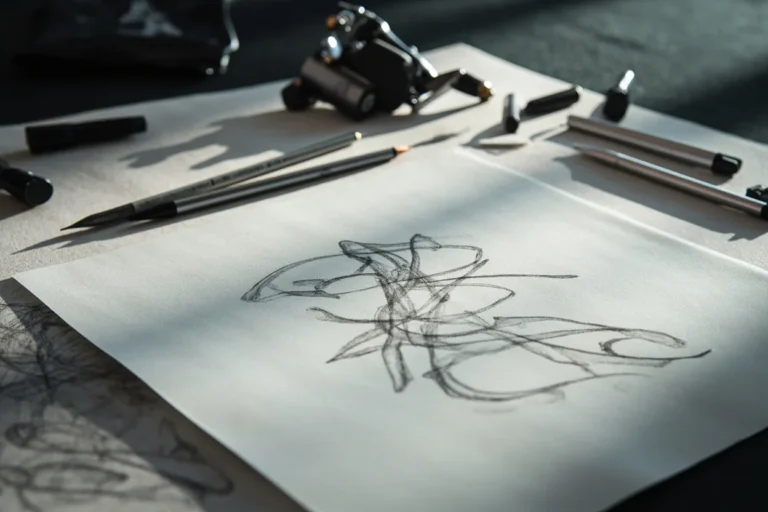
I tell every client: draw it, tape it, wait. Even if you can’t draw, sketch the basic shape and size. Tape a printout to your mirror. Live with it for a month. Does it become invisible? Does it annoy you? Does it feel more right over time?
The impulse tattoo can work, I’ve done plenty at 2 AM that people love forever, but those usually come from people who already know their own taste cold. If you’re unsure, time is free. A month of consideration costs nothing. Laser removal costs thousands and hurts worse than the tattoo did.
Key Takeaways
Good tattoo ideas come from your actual life, not from scrolling. Start with what you already care about, then find the visual language that fits. Think about where on your body it lives, not just what it looks like on paper. Bring references to artists, not finished designs, and trust their experience with how ink ages on skin. Live with the concept before you commit. The best tattoos aren’t the most original or the most impressive, they’re the ones that still feel like yours in twenty years when your skin has changed and your life has too.
Frequently Asked Questions
How small can a tattoo be before it starts to blur?
Fine lines under two inches often spread or drop out within a few years. I generally warn against text smaller than a dime or faces smaller than a palm. Bold, simple designs hold up much better at small sizes than detailed ones.
Should I bring my own design or let the artist create it?
Bring your concept and references, but stay open. Artists know how to adapt ideas for skin movement, aging, and your specific body. A rigid design you won’t adjust usually leads to a worse tattoo than one developed together.
How much should I expect to pay for a custom piece?
Most reputable shops charge $150-250 per hour, with minimums around $100-150 for small work. A palm-sized custom piece might run $300-600. Price varies by city, artist experience, and complexity. Good work isn’t cheap; cheap work usually isn’t good.
Is it okay to get a tattoo just because I like how it looks?
Absolutely. Not every tattoo needs deep meaning. I’ve done plenty of roses, snakes, and geometric patterns because someone just wanted to wear beautiful art. The only requirement is that you want it on your body for the long haul.
Related Tattoo Guides
- How to Cover Up a Tattoo: A Working Artist s Guide
- How to Draw a Rose Tattoo: A Realistic Guide
- How to Get a Temporary Tattoo Off Your Face Safely
- Explore more