Operating a tattoo machine means controlling three things at once: your voltage, your needle depth, and your hand speed. Get one wrong and the line blows out or falls out. I’ve watched apprentices struggle for months because they tried to muscle the machine instead of letting it do the work. The machine is a tool, not a pen, you’re guiding it, not forcing it. Here’s how it actually works in a real shop, from unboxing to that first clean pass on skin.
Know Your Machine Type
Most shops run rotaries or coils, and each wants something different from your hand. I started on coils, and I still love that buzz and the give you feel when the needle hits skin. But rotaries are quieter, lighter, and more forgiving for beginners. Doesn’t matter which you learn on, what matters is you learn one machine intimately before bouncing around.
Coil Machines
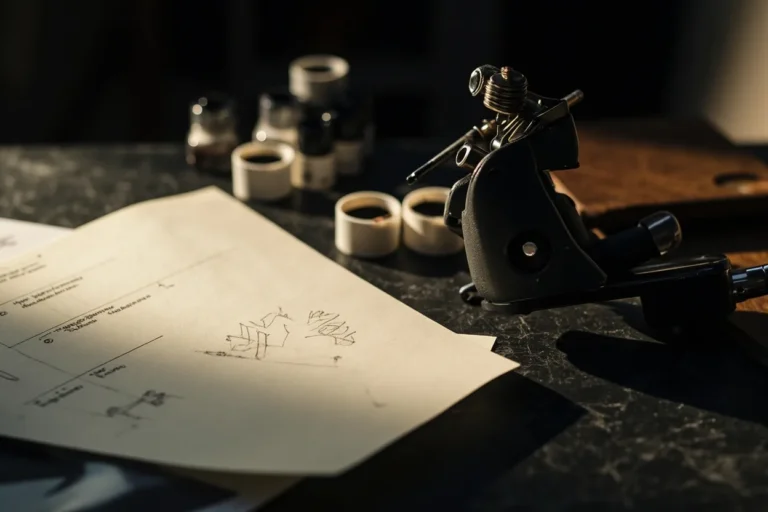
Coils run on electromagnetic current. That buzzing you hear? That’s the armature bar snapping up and down. You tune them by adjusting the front and back spring tension, the contact screw, and the capacitor. In my chair, I tell new artists: listen to the machine. A smooth buzz means it’s running clean. A rattle or choke means something’s off, usually the contact screw gap or a loose grommet. Coil machines hit harder, which is great for bold lines and packing solid black, but they’ll chew skin if you don’t respect them.
Rotary and Pen-Style Machines
Rotaries use a motor to drive the needle. Less maintenance, more consistent, and the stroke length is usually fixed or adjustable via cam. Pen machines, what half my clients ask about by name now, are basically rotaries in a pen grip. Lighter weight means less hand fatigue over long sessions. The trade-off: less feedback through your fingers. You have to learn to read skin visually instead of feeling the machine’s resistance.
Setting Up Safely
Setup is where I see the most mistakes. Rushing this part guarantees a bad tattoo. Here’s the order I teach in my shop:
- Wash hands, gloved, clean station with hospital-grade disinfectant
- Unpack needle cartridge from sterile blister pack, never touch the needle tip
- Insert cartridge into machine grip, rotate until it clicks
- Adjust needle hang: with no voltage running, the needle should extend about 2mm from the tip
- Run machine, watch for straight needle bar travel, wobble means bent bar or bad cartridge
- Dip in ink cap, check flow: should carry ink smoothly, not drip or run dry
- Apply petroleum jelly or stencil transfer gel to working area
That needle hang is crucial. Too short and you’re not reaching the dermis; too long and you’re digging into subcutaneous fat, which causes blowouts, those fuzzy, blurred lines that age terribly on hands and feet. I check hang on every setup, even fifteen years in.
Voltage and Speed
Voltage controls how fast your needle cycles. I run liners around 7-8 volts, shaders down to 5.5-7, depending on the machine and the skin I’m working on. But here’s the thing nobody tells you: voltage without matching hand speed is meaningless.
Your hand moves at a consistent pace. The machine cycles at a set speed. When they sync, you get clean lines. When they don’t, you get either choppy, dot-dash lines (hand too fast) or blown-out, overworked skin (hand too slow). I practice on fake skin or fruit until the rhythm feels automatic. Grapefruit gives decent resistance; pig ears from the butcher are closer to real skin. Some artists use silicone practice pads. I don’t love them, they’re too uniform, don’t teach you how real skin stretches and varies.
Reading Skin Resistance
Every body part feels different under the needle. Ribs are thin and springy. Thighs are dense and take more pressure. Inner bicep has that give where skin wants to roll. I adjust my stretch, how I pull the skin taut with my free hand, constantly. No stretch, no clean line. The needle skips, the ink sits uneven, and the tattoo heals patchy. I tell clients: “This is why I’m grabbing you like I’m trying to win at tug-of-war.” It’s not gentle, but it’s necessary.
Needle Depth and Angle
Proper depth is about 1.5 to 2 millimeters into the dermis. Too shallow and the ink sheds during healing, what we call a “fallout.” Too deep and you get blowouts, excessive bleeding, and scarring. The angle matters too. I hold liners at about 45 degrees, shaders flatter, maybe 30 degrees or less for smooth gradients.
In my early years, I tattooed a straight line on my own leg to learn depth. Healed it, studied it, did it again. That’s the repetition nobody escapes. You can’t read about this in a book and know it. Your fingers have to learn what right feels like.
We see this a lot: new artists angle the machine like a pencil, 90 degrees straight in. That’s how you make dots instead of lines, or worse, how you punch through skin. The needle should glide, not stab. Think of it like a plane landing, shallow approach, smooth contact, continuous motion.
Hand Position and Body Mechanics
Tattooing destroys your body if you let it. I know artists who retired at forty with ruined wrists and backs. The machine’s vibration travels up your arm, and hours of tension compound fast.
I anchor my pinky or the heel of my hand on the client or the armrest. That anchor point is everything, it stabilizes the needle, absorbs vibration, and lets my fingers make micro-adjustments instead of my whole arm. My body faces the work. I move around the client, not twist my spine. Good shops invest in adjustable chairs and armrests for this reason. Cheap setup, expensive chiropractor bills.
The “Three-Point” Contact
- Machine grip in your dominant hand, relaxed but controlled
- Stretching hand creating taut surface, usually thumb and fingers spread
- Anchor point on client or furniture, giving you a triangle of stability
When I lose that triangle, my lines wobble. Every time. It’s a physical law in my chair.
During the Tattoo: Working the Skin
Real tattooing isn’t one continuous pass. I work in sections, wiping excess ink and blood with a clean paper towel between passes. That wipe shows me what actually stuck. Fresh ink looks dark and wet; what’s actually in skin has a slightly matte, settled quality. I don’t overwork areas. If I go back and forth too many times, the skin swells, gets shiny, and stops taking ink. That’s called overworking, and it heals terrible, scarred, patchy, slow to recover.
I also watch for plasma buildup. Clear or slightly pink fluid means normal trauma. Thick, opaque pus means stop, clean, assess. I’m not a doctor, but I know when skin is angry versus infected. Angry skin calms with a break; infection needs medical attention, and I send clients to urgent care without ego.
Aftercare Guidance I Actually Give
Aftercare isn’t mystical. I keep it simple: wash gently with unscented soap, pat dry, thin layer of recommended ointment or plain moisturizer, don’t pick, don’t soak, keep out of sun. The first few days, the tattoo weeps plasma and ink, that’s normal. By day four or five, it starts flaking. I warn clients: “It’ll look like it’s falling apart. It’s not. Leave it alone.”
Pain varies by placement and person. Ribs, feet, inner arm near elbow, those sting. Meatier areas like outer thigh or calf are easier. Cost runs roughly $150-200 per hour in most US cities, with minimums around $100-150 even for small pieces. Good work isn’t cheap; cheap work isn’t good. I’ve covered enough bad tattoos to know.
Key Takeaways
Operating a tattoo machine well means respecting the machine, reading the skin, and building physical habits that let you work clean for hours. Start with one machine type and learn it cold. Dial in your needle hang and voltage before touching skin. Match your hand speed to your machine cycle. Stretch skin aggressively. Anchor your hand. Watch for overworking. And accept that this takes years, not weekends, to do well. I’ve tattooed thousands of hours and I’m still learning something every session. That’s the job. That’s the craft.
Frequently Asked Questions
How long should I practice on fake skin before tattooing a person?
Most apprentices need several months of consistent practice on fruit, silicone, or pig skin before working on willing friends under supervision. There’s no set timeline, it’s when your lines stay consistent and your depth control becomes automatic.
Why does my tattoo machine keep snagging or skipping?
Usually it’s needle hang set too short, a bent needle bar, not enough stretch on the skin, or voltage too low for your hand speed. Check each variable methodically rather than cranking voltage as a fix-all.
Can I use the same voltage for lining and shading?
Generally no, liners want slightly higher voltage for crisp single-pass lines, while shaders run lower for smoother, slower build-up of tone. The exact numbers depend on your specific machine and needle configuration.
How do I know if I’m going too deep while tattooing?
Excessive bleeding, immediate redness that spreads beyond the line, a popping sensation through the skin layers, or ink that appears blurry right away are all signs you’re too deep. Proper depth feels like consistent resistance without punching through.
Related Tattoo Guides
- How Much Does a Chest Tattoo Cost? A Real Shop Breakdown
- How to Become a Tattoo Removal Technician: A Real Guide
- Does Insurance Cover Tattoo Removal? What Artists Know
- Explore more