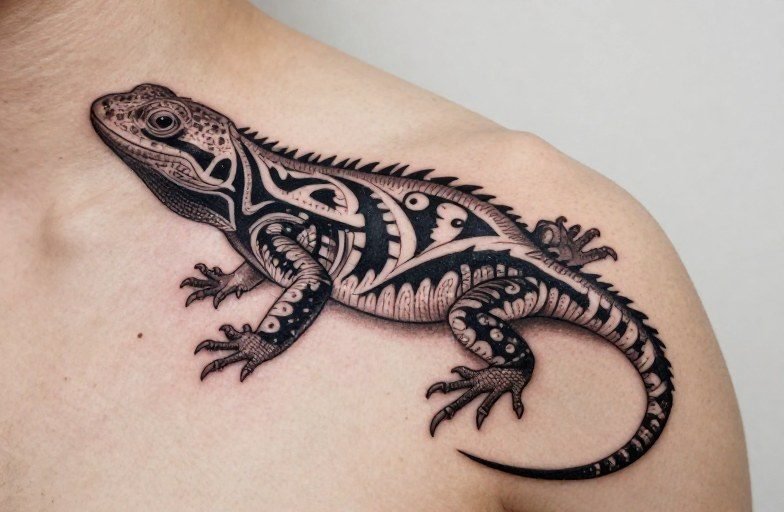
A lizard tribal tattoo fuses the reptile’s sinuous silhouette with the sharp, interlocking geometry of tribal design. The style strips the lizard to essential curves, elongated tail, splayed digits, arched spine, then wraps those forms in black bands, spear points, and repeating patterns that follow the body’s natural flow. Done well, the image reads instantly as both creature and abstraction. Done poorly, it collapses into muddy, indistinguishable blotches. The difference lies in line weight, spacing, and understanding how bold black ink behaves on skin over time.
Aftercare Notes
Tribal work heals differently than fine-line pieces. The dense black packing creates more surface trauma, which means more plasma and ink shedding during the first 48 hours. Your aftercare needs to account for that saturation without letting scabs thicken enough to pull ink out.
The First Week
Wash gently with unscented soap, pat dry with disposable paper towels, never fabric towels that harbor bacteria. Apply a thin layer of recommended aftercare ointment; thick gobs suffocate the wound and cause bubbling in solid black fields. Sleep with the tattoo exposed to air when possible, or loosely covered with clean cotton if you’re prone to rolling onto it. Lizard tribal designs often wrap joints or curve along ribs, so friction from clothing demands extra attention to keeping the area clean and minimally irritated.
Long-Term Care
- UV exposure degrades black ink faster than most people realize; a tribal lizard on a frequently sun-exposed forearm will soften noticeably within five years without protection
- Moisturize the area regularly once healed, dry skin makes solid black look ashy and uneven
- Avoid swimming pools and hot tubs until fully healed; chlorine and bacterial load threaten dense blackwork more than lighter styles
How It Ages
Tribal tattoos age through expansion and blur, not fading to nothing. The carbon-based blacks used in most tribal work hold their darkness for decades, but the crisp edges that define lizard scales and geometric borders gradually soften. What starts as a razor-sharp 2mm line can spread to 4mm over fifteen years. This matters enormously for lizard tribal designs because their readability depends on negative space, the skin showing through between black elements.
Design Choices That Last
Wide gaps between pattern bands age better than hairline separations. A lizard tribal with 3mm of skin between each black stripe will still read clearly at age fifty. One with 1mm gaps may seal into a single dark mass. Similarly, the lizard’s eye, often rendered as a small negative-space circle, needs sufficient surrounding black to maintain its definition. Ask your artist to show you healed photos from five-plus years back, not just fresh work.
Best Placements
The lizard form offers natural adaptability to body contours. Its elongated body stretches along limbs; its splayed limbs wrap around curves. But not all placements suit the tribal treatment equally.
High-Impact Locations
The outer forearm remains the most common placement for good reason. The flat plane shows off the full silhouette, and the natural viewing angle lets others see the design’s geometry. The calf offers similar flatness with more vertical space for a tail that tapers. The shoulder cap allows the lizard’s head to point toward the collarbone while the body curves over the deltoid, dynamic without distorting the proportions.
Challenging Spots
Ribs and stomach skin shift significantly with breathing and weight fluctuation. A lizard tribal here requires the artist to design for distortion, placing the densest black where stretching is minimal and leaving the tail or limb extensions in more mobile zones. Hands and feet present another problem: rapid cell turnover and near-constant abrasion cause tribal black to fall out unevenly. These spots need touch-ups and realistic expectations.
Choosing the Right Artist
Not every artist who “does tribal” understands its structural demands. The style requires confidence in pulling consistent lines without wobble, packing black evenly without overworking the skin, and designing patterns that flow with musculature rather than fighting it.
What to Look For
- A portfolio with healed photos showing solid black fields without patchiness or scar tissue
- Understanding of Polynesian, Maori, or other indigenous pattern traditions, artists who know where tribal geometry originates design more coherent, respectful work
- Willingness to customize the lizard form rather than pulling from flash sheets; the best pieces adapt the reptile’s proportions to your specific body
Red Flags
Artists who default to symmetrical, mirror-image designs for asymmetrical body parts. A lizard tribal wrapping your left arm shouldn’t be a flipped copy of one on your right, the flow needs to follow each limb’s unique musculature. Similarly, avoid artists who can’t explain why they’ve placed a particular pattern element; every band and point should serve the composition, not fill space.
Cost & Sessions
Pricing for lizard tribal work varies by scale and complexity, but the style’s density means it generally costs more than equivalent-sized illustrative work. A palm-sized lizard with moderate patterning might run 2-3 hours. A full forearm wrap with detailed geometric infill could demand 8-12 hours across multiple sessions.
Session Breakdown
Most artists won’t pack dense black for more than 3-4 hours at once, the skin swells and stops accepting ink evenly, and the artist’s hand tires, risking line quality. Large pieces get split by outline first, then fill. Some artists prefer to complete one section fully (black and all) per session, working from wrist toward elbow or ankle toward knee, which lets you see finished segments while waiting.
Color vs Black and Grey
Traditional lizard tribal is strictly black on skin. The style’s power comes from that contrast, from the way negative space becomes as active as the ink. Color tribal exists, reds, deep greens, occasionally blues worked into the pattern, but it shifts the piece into a different visual register.
When Color Works
Subtle dark green worked into the lizard’s eye or as a thin accent line can add dimension without breaking the tribal effect. Some artists use greywash to create depth within black bands, giving the pattern a carved or three-dimensional quality. These approaches require an artist who understands how colored pigments settle differently than black, greens especially can heal unevenly or shift tone.
When to Stay Black
If you want the classic tribal impact, commit to black. The style’s history and visual language depend on that starkness. Adding color to follow a trend often dates the work; solid black tribal from 1995 and 2025 share a visual continuity that colored variants lack. For a lizard specifically, the black silhouette against skin evokes the reptile’s actual appearance, many species read as near-black in shadow, their form defined by contour rather than coloration.
What to Remember
A lizard tribal tattoo succeeds or fails on fundamentals: clean lines, intelligent spacing, placement that respects the body, and an artist who treats the form as geometry rather than mere decoration. The style carries weight from its indigenous roots, and the best contemporary work honors that lineage rather than treating it as aesthetic raw material. Choose your artist for their healed portfolio and their understanding of pattern flow, not just their ability to draw a lizard shape. Give the piece room to breathe in the design phase, crowded tribal heals poorly and ages worse. And protect it from sun once healed; blackwork’s longevity is its strength, but only if you don’t let UV degrade it prematurely. The lizard’s symbolism, adaptability, regeneration, quiet observation, pairs naturally with tribal’s permanence. Make sure the technical execution matches that endurance.
Frequently Asked Questions
How painful is a lizard tribal tattoo compared to other styles?
The dense black packing requires more needle passes than lighter styles, so it generally hurts more during the session. However, the work is often faster per square inch than detailed shading, so total session time may be shorter for equivalent coverage.
Can a lizard tribal tattoo be covered up or modified later?
Covering solid black tribal is extremely difficult. Laser removal works but requires many sessions due to the density. Modification is more feasible, adding greywash texture or extending the pattern into new areas, but the core black silhouette largely commits you to the design.
What’s the difference between Polynesian tribal and generic tribal lizard designs?
Polynesian patterns follow specific cultural conventions, certain shapes reference family, status, or navigation. Generic tribal borrows the visual language without those meanings. A knowledgeable artist can explain which they’re using and why.
How long before I can work out after getting a lizard tribal tattoo?
Wait at least 48 hours before light exercise, and a week before anything that stretches the tattooed skin significantly or exposes it to gym equipment bacteria. Sweat and friction are enemies of healing blackwork.
Related Style Guides
- Traditional Japanese Tattoo Artists: A Real Shop Guide
- Realistic Dragon Tattoos: A Working Artist s Guide
- Fantasy Tattoo Ideas for Dreamers and Builders
- Explore more