I’ve had a lot of Louisiana natives in my chair over the years, and they always come with stories. Not just ideas, stories. Their grandmaw’s gumbo recipe, the first time they saw a gator up close, the way the Spanish moss hangs off cypress trees after a storm. Louisiana tattoos aren’t about checking a box. They’re about carrying home with you. I’ve tattooed fleurs-de-lis on ribcages that took three hours and crawfish on forearms that took twenty minutes. Both hurt. Both mattered. Let me walk you through what actually works, what heals clean, and what I tell clients when they walk in saying “something Louisiana, but not cheesy.”
Popular Styles That Feel Authentic
Style matters more than subject. A badly rendered fleur-de-lis in the wrong style looks like a hotel logo. Same image, done with woodcut texture or traditional bold lines, becomes something you want to keep.
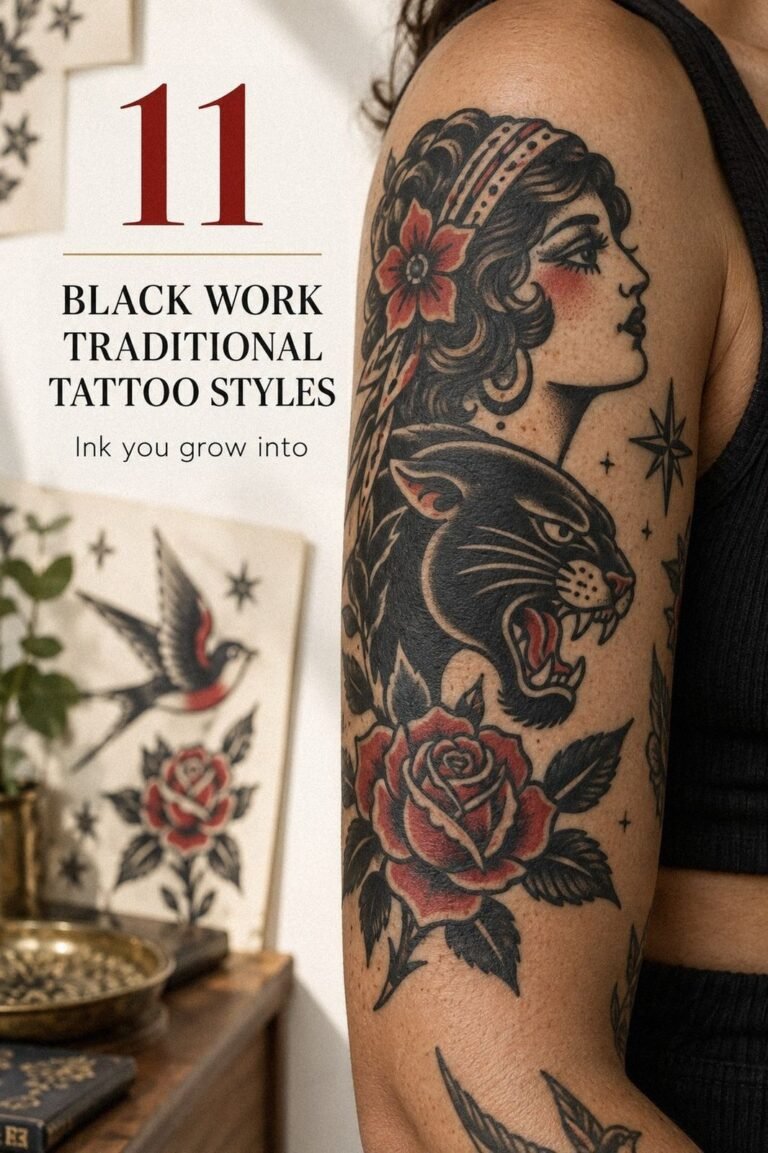
Traditional American
This is my go-to recommendation for Louisiana imagery. Bold black outlines. Limited color palette. It ages like a dream. I’ve done traditional crawfish with bright red claws and heavy black shells that still read clean five years later. The high contrast survives sun exposure, which matters down here. Traditional pelicans, steamboats, even Mardi Gras masks in this style hold their shape. The lines don’t blur into mush.
Blackwork and Etching Style
For cypress trees, swamp scenes, and architectural details like shotgun houses or iron balconies, I lean toward blackwork. Crosshatching creates texture that mimics engraving. It looks sophisticated. It heals flat and even. I’ve tattooed entire Louisiana skylines in this style, St. Louis Cathedral, the Crescent City Connection, the Superdome small in the distance, using only black ink. The detail holds because there’s no color to migrate or fade unevenly.
- Traditional: bold, readable, ages best on high-movement areas
- Blackwork/etching: detail-oriented, great for back pieces and thighs
- Neo-traditional: more color gradients, needs larger scale to age well
- Script/Lettering: French phrases, street names, family recipes, always check spelling twice
Design Ideas Beyond the Obvious
Everyone asks for fleurs-de-lis. It’s the safe choice. But Louisiana’s visual language runs deeper, and the best tattoos come from personal specifics.
Food and Culture References
I’ve tattooed a tiny cast iron skillet on a chef’s wrist. A string of cayenne peppers wrapping a bicep. A po’boy sandwich, fully dressed, on a food blogger’s calf. These work because they’re specific. A generic “gumbo” pot looks like any stockpot. But a crawfish boil scene with newspaper spread out, lemons, corn, and Zatarain’s box in the corner? That’s a memory. That’s a tattoo with weight. I did a king cake with the baby showing on a client’s ankle last January. She wanted the purple, green, and gold icing dripping. We used bold outlines on the cake itself, softer shading on the icing so it would read as “messy” rather than “muddy” after healing.
Nature and Landscape
Swamp imagery is tricky. Too much green and brown, and in five years it becomes a bruise-colored blob. I tell clients: pick one element to highlight. A single heron in black and grey, standing in water suggested by negative space. A cypress knee rising from a forearm. Spanish moss works best as fine line work in fresh tattoos, but I warn people, it spreads. Those delicate strands blur over time. Better to suggest it with heavier clumps in traditional style, or leave it out and focus on the tree’s silhouette.
- Specific food moments: crawfish boils, beignets at Cafe du Monde, sno-ball stands
- Single animals: pelicans, alligators, nutria, herons, done with personality, not textbook accuracy
- Architecture: shotgun houses, creole cottages, ironwork patterns (excellent for band tattoos)
- Music references: brass instruments, piano keys, second line umbrellas
- Text elements: street signs, French phrases, handwritten recipe snippets
Best Placements for Louisiana Imagery
Placement changes how a design reads. I see this constantly in the shop, same image, different spot, completely different effect.
Forearms are popular for Louisiana tattoos because they’re visible. You want to show where you’re from. But forearms also take sun. A color-heavy design here needs touch-ups. I did a pelican in flight on a guy’s forearm, wings spread across the inner and outer arm. We used heavy black in the wing tips, saved the color for the beak pouch only. Five years later, the black still reads; the orange faded to a warm rust that actually looks intentional.
Thighs and calves give you real estate for landscape scenes. I love doing Louisiana marsh views on outer thighs. The curve of the muscle follows the horizon line naturally. Space for a sunset gradient, water reflection, maybe a small boat. These age well because thighs don’t stretch as dramatically as stomachs, and they’re easy to protect from sun.
Ribcages hurt. Everyone knows this. But for Louisiana text, longer phrases, recipe ingredients, street addresses, it’s worth it. The vertical space fits lists. I tattooed a client’s grandmother’s gumbo recipe down her ribs, twelve ingredients in her own handwriting. Took four hours. She cried. Not from the pain, though there was plenty.
- Forearm: high visibility, needs bold lines, plan for sun exposure
- Thigh/calf: best for landscape scenes, more detail possible
- Ribs/side: ideal for text, vertical compositions, personal writing
- Upper arm/shoulder: traditional designs, fleurs-de-lis, single bold images
- Hands/fingers: avoid tiny detail, goes blurry fast; simple symbols only
Color Choices That Survive
Color theory in tattooing isn’t about what looks good fresh. It’s about what looks good at year three, year ten.
Purple, green, and gold, the Mardi Gras trinity, are requested constantly. Here’s what I tell clients: these colors fade at different rates. Purple (dioxazine) often goes muddy. Gold/yellow needs a white base to pop, and that white disappears first. Green varies wildly by brand. What works? Bold outlines around every color block. Limited color areas surrounded by black. I did a Mardi Gras mask on a shoulder once where we used black for 70% of the design, purple and green only in accent stripes, gold as tiny highlight dots. Still reads as festive. Still reads at all.
For swamp scenes, I push clients toward black and grey with one accent color. A single red heron beak. One green lily pad. The eye goes there, and the rest stays legible as it ages. Full color realism on swamp water turns to blue-grey mush. I’ve seen it. I’ve fixed it. It’s not fun for anyone.
- Black and grey: safest, most timeless, works for any Louisiana subject
- Red accents: crawfish, cayenne, cardinal birds, holds better than yellow
- Purple/green: use sparingly, surround with black, expect touch-ups
- White ink: avoid as primary element, use only for small highlights
Tips for Choosing Your Design
I’ve watched people agonize for months and I’ve watched people walk in with a napkin sketch. Both can work. Here’s what separates good Louisiana tattoos from regrettable ones.
First: specificity beats generality. “I want something with Louisiana” is a starting point, not a design. I ask clients: what’s the last thing you ate there that you can’t get anywhere else? What’s a sound? A smell? A door you remember? The best tattoo I did last year was a simple line drawing of a specific oyster bar’s awning, with the street number. The client had met her wife there. That tattoo has a life. A generic oyster? Decoration.
Second: consider your future self. I have clients in their twenties wanting full sleeves of Mardi Gras chaos. I don’t talk them out of it, but I ask: will this still feel like you at forty? At sixty? Sometimes the answer is yes, and we go big. Sometimes we scale back to one meaningful element that can stand alone or expand later.
Third: find an artist who gets it. Not every tattooer understands Louisiana culture. I’ve seen artists from out of state butcher fleur-de-lis proportions, draw crawfish that look like lobsters, miss the architectural details that make a shotgun house recognizable. Look at portfolios. Ask if they’ve done Louisiana imagery before. A good artist admits when something isn’t their specialty.
- Bring reference photos, not just Pinterest boards, personal photos have detail
- Consider the story, not just the symbol
- Plan for aging from day one, not as an afterthought
- Be willing to travel for the right artist, especially for large pieces
- Listen when your artist pushes back on size, placement, or color
Final Thoughts
Louisiana tattoos should feel lived-in from the start, not like tourist souvenirs. I’ve tattooed enough of them to know the difference. The ones that last, in meaning and in skin quality, come from specific memories, bold technical choices, and honest conversations between artist and client. If you’re born there, spent formative years there, or just got changed by one perfect week in New Orleans, your tattoo can carry that weight. Just give it the thought it deserves. And please, for the love of all things holy, spell-check any French text twice. I’ve seen “Laissez les bons temps rouler” go wrong in permanent ways. Your artist wants to get it right. Help them out.
Frequently Asked Questions
Do fleur-de-lis tattoos always look too common?
Not if you personalize them. I’ve done fleurs with cracks from Katrina floodlines, integrated into family crests, and rendered in woodcut style. The symbol is public domain, your version of it makes it yours.
How do swamp scene tattoos age over time?
They need careful planning. Too much fine green detail turns muddy. I recommend black and grey with one accent color, bold outlines on focal elements, and avoiding tiny detail in moss or water reflections.
Is it okay to get a Louisiana tattoo if I’m not from there?
If the place genuinely changed you, yes. I tattooed a California woman who rebuilt houses in the Lower Ninth for two years. Her shotgun house tattoo means more than some natives’ ink. Meaning matters more than birthplace.
What’s the most painful spot for a detailed Louisiana piece?
Ribs for long text or recipes, hands for any detail. I did a crawfish boil scene on a guy’s ribs, four hours, lots of shading. He said the lower ribs where we put the newspaper detail were worse than the crawfish claws on the upper ribs. Placement changes everything.
More Tattoo Ideas
- New Skool Tattoo Designs That Actually Work
- Pretty Tattoo Ideas That Actually Work
- Soccer Tattoo Ideas That Actually Work on Skin
- Explore more