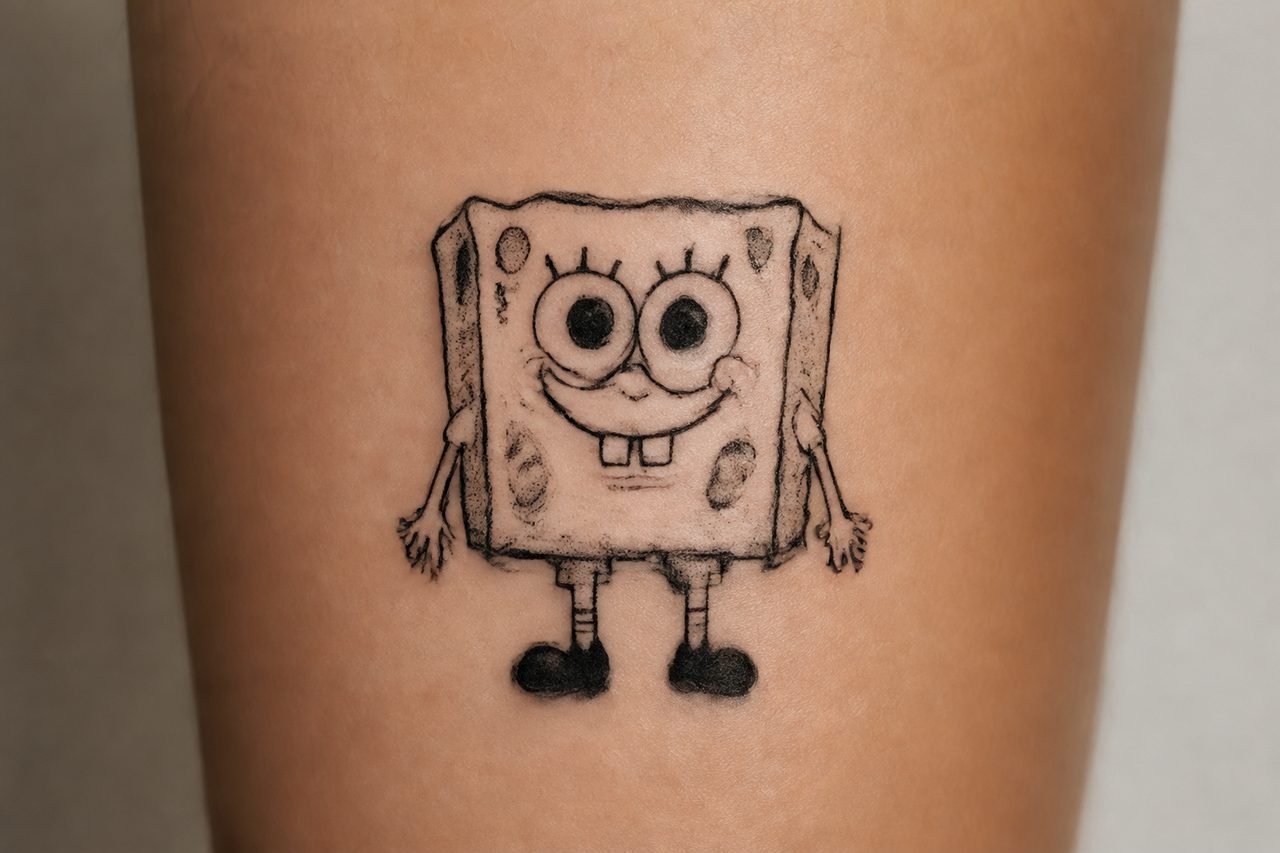
Spongebob Squarepants has been a visual staple for over two decades, and the character translates surprisingly well to minimalist tattoo work. The challenge is capturing that recognizable silhouette and energy without overworking the skin. Done right, a minimalist Spongebob tattoo stays readable at small sizes and ages gracefully. Done poorly, it becomes a yellow blur. Here’s how to get it right.
Popular Styles
Single-Line Work
One continuous line forming Spongebob’s outline is harder than it looks. The artist must nail the wavy rectangle of his body, the protruding nose, and those two front teeth without lifting the needle. This style works best at 2-3 inches minimum, any smaller and the line weight becomes inconsistent. Single-line Spongebob tattoos age best on areas with stable skin, like the forearm or calf. Avoid spots where the line might stretch or distort.
Geometric Reduction
Breaking Spongebob into basic shapes, circles for eyes, rectangles for body, triangles for the collar, creates a modern, almost abstract result. Some artists use dotwork for his porous texture instead of solid fill. This approach keeps the tattoo light and prevents the heavy saturation that causes yellow ink to blow out over time.
- Outline-only: No fill, just black lines. Most forgiving for aging.
- Partial fill: Only the eyes and mouth filled, body left as contour.
- Negative space: Spongebob’s shape carved out of a small black square or circle.
Design Ideas
Iconic Expressions
The mockingly smug face, the wide-eyed excitement, the exhausted droop, Spongebob’s exaggerated expressions are his real signature. A minimalist tattoo can capture these with just eyes, mouth, and nose. The “Imagination” rainbow pose, reduced to a simple arc and his raised arms, reads instantly to anyone who knows the show. The key is choosing an expression with enough distinct features to survive simplification.
Object Pairings
Spongebob holding a tiny spatula. Spongebob’s silhouette inside a jellyfish bell. His pineapple house reduced to a triangle with a crosshatch door. These pairings add context without clutter. The best minimalist combinations use one additional element, not three or four. Patrick’s star shape paired with Spongebob’s square creates a nice visual contrast that works as a matching set or standalone piece.
- Krabby Patty: Just the bun shape with eyes peeking over.
- Bubble: A circle containing his face in profile.
- Boating school: His head plus a tiny steering wheel.
Best Placements
Minimalist Spongebob tattoos need space to breathe, but not much. The ideal size range is 1.5 to 4 inches. Smaller than that and the facial details merge; larger and you’re no longer in minimalist territory.
High-Visibility Spots
Inner forearm, outer bicep, and ankle are the most common requests. The forearm offers flat, stable skin and easy aftercare access. Ankle placement works well for smaller designs but sees more sun exposure, factor in touch-ups. The ribcage and sternum can accommodate slightly larger minimalist pieces, but the stretching from breathing means fine lines may soften faster there.
Hidden or Personal Locations
Behind the ear, the side of the finger, and the inner lip have all been done. Behind the ear works for a tiny outline if you keep hair away during healing. Finger tattoos of Spongebob’s face are popular but notoriously high-maintenance; the constant use and regeneration of hand skin means significant fading within two years. The inner lip fades even faster and poses genuine infection risks from oral bacteria.
- Best for longevity: Forearm, upper arm, calf, upper back.
- Acceptable with caveats: Ankle, wrist, collarbone.
- Avoid for fine lines: Fingers, palms, feet, inner lip.
Color Choices
The Yellow Problem
Spongebob’s signature yellow is the hardest part. Bright yellow ink is notoriously fugitive, it fades fast, turns greenish, and can blow out into surrounding skin. Many experienced artists recommend golden yellow or ochre over neon yellow for better stability. Some skip yellow fill entirely, using skin tone as the “yellow” and only inking the outlines and features. This reads as Spongebob to anyone familiar, and it eliminates the aging issue entirely.
Strategic Color Use
If you want color, limit it. Brown for the pants, red for the tie, white for the eyes, these small accents anchor the design without overwhelming it. A full-color Spongebob at minimalist scale becomes a blob. The most successful color minimalism uses black for 80% of the tattoo, with two or three tiny color accents. Blue for the iris dots. A thin red necktie line. That’s enough.
- Black and grey: Most age-resistant, reads as intentional artistic choice.
- Black with one accent: Usually the red tie or blue eyes.
- Full yellow fill: Requires touch-ups, best on lighter skin tones where yellow shows.
Tips for Choosing
Reference material matters. Bring screenshots, not descriptions. The show’s animation style changed slightly over its run, early seasons have rougher lines, later ones are cleaner. Decide which version you want. A good artist will study the reference and adapt it to tattooable line weights, not just trace a screenshot.
Check portfolios for cartoon or anime work specifically. Realism skills don’t transfer to stylized characters. Look for clean, consistent lines in their existing pieces, and ask how they handle yellow ink if you’re set on color. Some artists won’t do yellow fill under a certain size; respect that boundary.
Aftercare Specifics
Minimalist tattoos with fine lines need careful healing. The thin skin in Spongebob’s porous texture, if rendered as dotwork or stippling, can scab and lose definition if picked or soaked. Keep it dry for the first 48 hours, then light moisturizing. Sunscreen matters enormously for yellow ink; UV exposure accelerates the greenish shift that ruins the character’s recognizable tone.
- Wait at least two weeks before swimming or submerging the tattoo.
- Avoid tight clothing over fresh work on the calf or ribcage.
- Plan a touch-up at 6-12 months, especially for color or finger placements.
Final Thoughts
A minimalist Spongebob tattoo succeeds when someone spots it from across the room and grins before they even process the details. That recognition comes from restraint, capturing the essential shapes and energy without overbuilding. The best pieces in this style look almost effortless, which is always the mark of careful planning. Choose an artist who understands how cartoon geometry translates to skin, be realistic about yellow ink’s limitations, and give the work the healing attention it needs. The result is a small, permanent piece of a show that shaped a generation’s visual language, rendered clean enough to wear for decades.
Frequently Asked Questions
Will a yellow Spongebob tattoo turn green over time?
Bright yellow ink can shift toward a greenish tone as it fades, especially with sun exposure. Golden or ochre yellows hold better, and many artists recommend using skin tone as the yellow base instead of filling with ink.
How small can a minimalist Spongebob tattoo be and still look right?
About 1.5 inches is the practical minimum. Smaller than that and the facial features merge into an unreadable blob, especially if you’re including both eyes, the nose, and the teeth.
Do I need to find an artist who specifically does cartoon tattoos?
Yes, cartoon and anime stylization require different skills than realism or traditional Americana. Look for clean, consistent line work in their portfolio and ask how they approach simplifying character designs.
Is a single-line Spongebob tattoo more expensive than a regular outline?
Often yes, because it’s technically harder to execute without lifting the needle. The artist must plan the entire path in advance, and mistakes can’t be easily corrected mid-tattoo.
More Tattoo Ideas
- Small Butterfly Tattoos for Women: Ideas Placement
- Son Tattoo Designs for Dads
- Pinterest Tattoo Ideas for Women That Actually Work
- Explore more