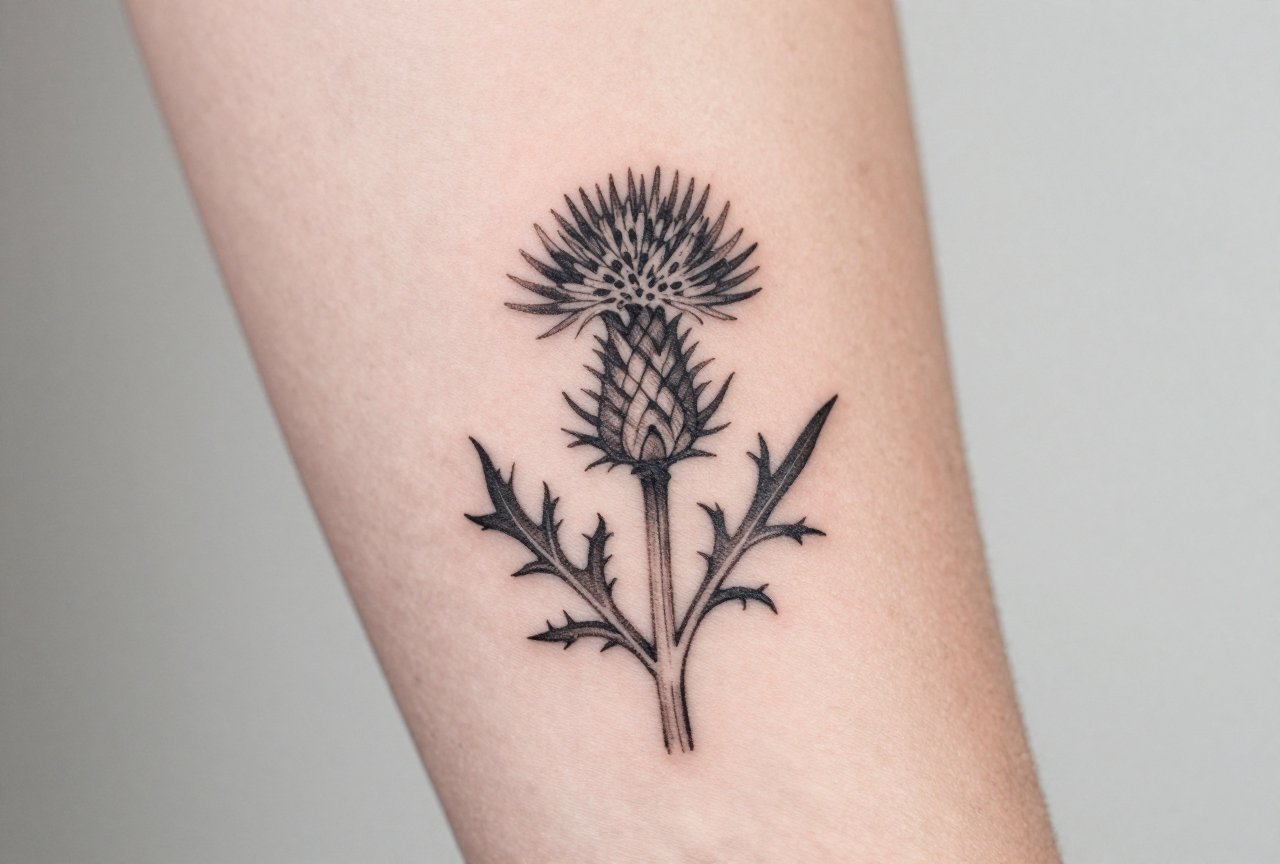
I’ve tattooed thistles on ribcages, ankles, behind ears, and once on a guy’s wrist the morning after his Edinburgh wedding. The thistle doesn’t shout. It pricks. That’s the whole point. In my chair, people ask for it when they want something Scottish without the bagpipes, something resilient without the warrior clichés. A minimalist thistle strips the national flower down to its architecture: the bulb, the spines, the purple crown. What you leave out matters as much as what you put in.
Popular Styles
Minimalism isn’t one look. In real shops, we see three approaches that actually work on skin long-term.
Single Needle and Fine Line
Single needle (usually 1RL or 3RL) gives you hair-thin spines and delicate crown details. I’ve done these behind ears where the needle practically hums against the skull. The catch? Fine lines blur. Not immediately, maybe year three, year five. The thistle’s spines soften into threads. Some clients love that aged quality. Others come back for a touch-up. I always tell people: fine line thistles look incredible fresh, but photograph them on day one. That’s their sharpest moment.
Blackwork Silhouette
Thicker lines, solid black bulb, negative-space spines. This style holds. I’ve watched a blackwork thistle on a forearm stay crisp for eight years. The silhouette reads instantly from across a room. No confusion, no “is that a flower or a grenade?” The trade-off is weight. A heavy black thistle on a small placement can feel like a stamp. We usually scale these slightly larger, two to three inches minimum, to let the negative space breathe.
Botanical Illustration Style
Think pressed flower, not clip art. Light crosshatching for texture, a single accent line for the stem’s curve. This borrows from old botanical plates. I did one on a botanist’s inner arm with three tiny dots marking where the flower met the stem, her idea, referencing her field notes. That specificity makes it. Generic botanical thistles look like they came from a flash sheet. The good ones carry someone’s actual memory.
Design Ideas
The thistle’s structure invites variation. Here’s what actually works in skin, not just on paper.
- Stem-only thistle: Just the curved spine and a few leaves. Reads abstract. I’ve placed these along collarbone curves where the stem follows the bone. Takes ten minutes, heals clean, ages gracefully.
- Crown focus: The purple flower head, simplified to concentric circles or a single dome with radiating lines. Good for color minimalism, one purple, maybe a yellow dot for the center.
- Broken thistle: A snapped stem, one leaf falling. Sounds dramatic, but rendered minimally it’s quiet. A client got this after her divorce; the break was at the exact angle of a scar she already had. We integrated them.
- Geometric frame: Thistle inside a thin circle or triangle. The geometry contains the organic shape, gives it intention. Works great as a matching piece, two friends got mirror circles on their inner biceps, thistles facing each other.
- Text integration: “Nemo me impune lacessit” in tiny type beside or below. The Scottish motto. I’ve done this twice. Both clients could pronounce it correctly, which matters. Don’t get words you can’t say.
Best Placements
Minimalist thistles suit small spaces because the design has natural directionality. The stem wants to flow somewhere.
Behind the Ear
My most common request. The curve fits the stem perfectly. Pain is sharp, needle on bone, vibration in your teeth, but it’s over fast. Healing is annoying because you sleep on it, hair catches it, glasses rub. I send people home with a travel pillow to keep pressure off. The result? Peekaboo visibility. Hair up, it’s there. Hair down, gone. That control appeals to people.
Inner Wrist and Forearm
The wrist is honest. You see it constantly, so does everyone else. Thistles here work best slightly larger, maybe two inches, so the spines don’t muddy together. Forearm placement gives more stem length. I’ve wrapped thistles around the forearm’s inner curve so the crown sits near the elbow crease and the root points toward the wrist. Follows the muscle. Moves with you.
Ribcage and Hip
Private. The stretch is real here, breathing, sitting, standing all distort the skin. I draw thistles for rib placement with the client standing, then check the sketch seated. The stem lengthens or compresses. A minimalist thistle handles this better than dense designs because there’s less to warp. Hip placements edge toward intimate. I’ve done these for people who want the meaning personal, not performative.
Ankle and Foot
The ankle bone is a bastard to tattoo. Skin’s thin, tendon moves, everything swells. But a small thistle, inch and a half, simple lines, heals fine if you stay off it initially. Top of foot is worse for longevity. Shoes rub. Ink falls out. I talk most clients out of foot thistles unless they’re committed to touch-ups.
Color Choices
Minimalism doesn’t mean black-only. It means restraint.
Black and grey dominates for good reason. It ages clean, works on all skin tones, and the thistle’s form reads without color cues. I’ve done hundreds. When someone asks for purple, I reach for a muted violet, not electric. The historical thistle is a soft purple, almost grey in certain lights. Bright purple tattoos yellow over time. Muted purples just soften.
Green stems are tricky. Green ink has a reputation for fading fast, especially lighter yellow-greens. If someone wants stem color, I suggest dark forest green, almost black, or we skip it. The crown gets the color, the stem stays line work.
One approach I love: black thistle with a single dot of purple in the flower’s center. Minimal color, maximum focus. Your eye goes straight there. It’s a technique borrowed from Japanese tattooing, one accent color in a monochrome piece.
Tips for Choosing
After fifteen years, here’s what I tell clients in consultation.
- Bring reference, not Pinterest boards: One image you love, three you hate. Explaining why you hate something reveals more than why you love something. “Too busy” means you want cleaner. “Too dark” means you want lighter line weight.
- Consider your real wardrobe: If you never wear short sleeves, a forearm thistle is for others, not you. If you’re in scrubs or uniforms with strict policies, behind ear or ribcage keeps it yours.
- Size for the detail: A thistle with individual spine lines needs space. At under an inch, those lines become a blur. I draw the minimum size on paper, show it to clients, let them hold it against their skin. Changes minds.
- Think about the why in one sentence: Not a paragraph. One sentence. “My grandmother was Scottish.” “I moved here alone.” “I like that it grows in cracks.” That sentence guides the design more than any aesthetic reference.
- Healing is part of the tattoo: The first week, your minimalist thistle will look too bold, then too scabby, then too pale. Around week three, it settles. Don’t panic at day five. Don’t over-moisturize. Let it flake.
Final Thoughts
A minimalist thistle tattoo works because the flower itself is already graphic. Nature did the design work. Our job is not adding too much. I’ve seen thistles ruined by over-detailing, every spine shaded, every leaf veined, the crown rendered in six colors. The skin can’t hold that delicacy small. It becomes mush.
The best minimalist thistles I’ve done, the ones I remember, came from clients who knew exactly why they wanted it and trusted the process. One guy, Scottish father he’d never met, got a stem-only thistle on his ribcage. No color. Took twenty minutes. He didn’t flinch. Sometimes the simplest marks carry the most weight. That’s what minimalism is, really. Not less for fashion’s sake. Less because the meaning doesn’t need decoration.
If you’re considering one, find an artist whose fine line work you can see healed, not just fresh. Ask about their needle groupings. Look at their one-year-healed photos if they have them. The thistle will outlast the trend. Make sure the tattoo does too.
Frequently Asked Questions
Do minimalist thistle tattoos fade faster than detailed ones?
Fine line work softens over time regardless of subject, but the thistle’s simple shape actually ages better than dense shading. Blackwork silhouettes hold the longest. Single needle pieces may need touch-ups after five to seven years depending on placement and sun exposure.
How much should I expect to pay for a small minimalist thistle?
Most shops charge minimums between eighty and one hundred fifty dollars for small pieces. A behind-the-ear thistle might take thirty minutes. Don’t bargain shop, single needle work requires steady hands and good machines. The cheap option often costs more in fixes later.
Can a minimalist thistle work as a cover-up?
Generally no. Minimalist designs use negative space and thin lines, which won’t hide existing ink. You need density for cover-ups. If you have a faded tattoo to work around, we’d likely suggest a larger, more detailed thistle or a different placement entirely.
Is the thistle only meaningful if you’re Scottish?
Not at all. I’ve tattooed thistles on people with zero Scottish heritage who connected to the plant’s resilience, it grows in dry, rocky ground where other flowers won’t. Meaning is personal. The thistle doesn’t check your ancestry.
More Tattoo Ideas
- Pict Tattoo Designs: Ancient Ink Ideas
- Sonic Tattoo Ideas for Fans Artists
- Tattoo Ideas USA: What Americans Actually Get
- Explore more