
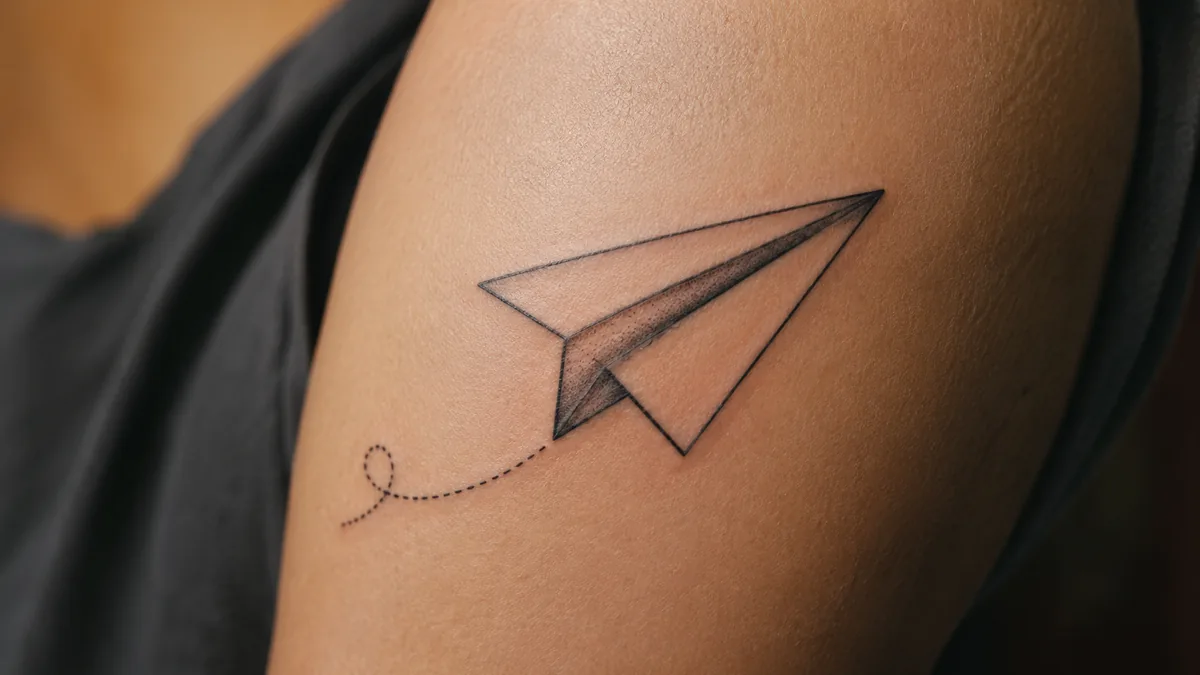
A paper airplane tattoo is one of those simple designs that carries a lot of weight. it represents freedom, movement, and the act of letting go. People get it to mark a transition, celebrate a journey, or remind themselves to keep moving forward even when the destination isn’t clear yet.
It reads clean from across the room, works in multiple styles, and holds up well over time when placed right. Here’s everything you need to know about what it means and how to wear it well.
Core Symbolism: What a Paper Airplane Tattoo Actually Means
The paper airplane is universally read as a symbol of freedom, hope, and forward motion. It’s handmade, imperfect, and it still flies. That’s the core of it. People connect it to dreams that feel simple on the surface but take real courage to launch. The act of throwing a paper plane, releasing it, committing to wherever it goes, is built into the meaning.
It also carries nostalgia. Childhood. A time when anything felt possible with just a sheet of paper and an open window. A lot of people get this tattoo after major life changes because it represents starting fresh without overcounting the cost. Letting something go and watching it fly.
Journey, Adventure, and Wanderlust
It's a folded piece of paper launched with intention, that's the whole tattoo.
Travel-minded people claim this one hard. The paper airplane sits comfortably alongside compass roses, coordinates, and world map tattoos as a symbol of wanderlust and a restless spirit. But unlike those designs, it has a scrappy, homemade energy. It says you’ll figure it out as you go, not that you’ve planned every stop.
For a lot of clients it represents a specific journey, a move to a new city, a gap year, a period of life where they took a risk and flew. The tattoo locks that memory in. It doesn’t need to be literal travel either. Career pivots, relationship changes, personal growth. Any leap counts.
Childhood Innocence and Nostalgia
Fold a piece of notebook paper, crease it sharp, and throw it across the room. That’s a universal childhood experience for millions of Americans. The paper airplane tattoo taps directly into that memory. It’s innocent, low-stakes fun from a time before adult pressure set in. People get this tattoo when they want to stay connected to that version of themselves.
This reading is especially common when the design includes small details like ruled notebook lines or a number two pencil alongside it. Those elements push the nostalgia angle hard. The tattoo becomes a tribute to simplicity. A reminder that joy doesn’t have to be complicated to be real.
Design Variations Worth Knowing
The classic single paper airplane in flight is the most common. Clean geometric folds, straight lines, minimal shading. Fine line works great here because the shape is already bold enough to read without thick outlines. Some clients want a trail behind it, a dotted flight path that curves or loops, adding movement and a sense of play. That reads well even at smaller sizes.
Other variations include multiple planes in formation, a plane mid-fold with origami-style line work, or a plane trailing stars and planets for a dreamy, cosmic feel. Watercolor splashes behind the plane add color without complicating the form. Geometric versions use precise sharp triangles and negative space. Illustrative styles add shadows and dimension. All of them hold, as long as the artist can execute fine detail cleanly.
Black and Grey vs. Color
Black and grey is the most timeless choice for a paper airplane tattoo. A crisp fine line piece with minimal shading reads sharp, stays clean as it heals, and ages gracefully. The simplicity of the design doesn’t need color to land the meaning. A solid black outline with light whip shading on the folds gives it dimension without overcomplicating it.
Color opens up options though. Soft blues and whites mimic sky. A red or yellow plane pops against skin and leans into the childhood nostalgia angle. Watercolor-style work blurs the edges in a way that feels intentional on a plane that’s already in motion. Just know that saturated colors, especially yellows and pinks, will need a touch-up faster than solid black ink, particularly in high-wear zones like hands and wrists.
Best Placements and How It Ages
The inner wrist is the most popular spot for this design, and it makes sense. Small, visible, personal. The forearm works well for slightly larger pieces, especially if you’re adding a trail or flight path. Behind the ear and on the collarbone are clean options for minimalist versions. The ribcage gives you room to go bigger without sacrificing detail, though that placement is spicy and needs aftercare respect.
Avoid fingers and the outer hand for fine line work. Those are high-wear zones and fine lines blow out faster there, especially with thin geometric shapes. The inner bicep and ankle are solid middle ground, low-wear, not too exposed, and they heal nice. A paper airplane in fine line will stay crispy on the inner arm for years if the artist hits the right depth and you keep it out of the sun.
Who Gets This Tattoo and How to Make It Personal
This one cuts across demographics hard. College grads, people in recovery, travelers, artists, parents memorializing their kid’s childhood, people marking the end of a hard chapter. The design is simple enough that almost anyone can attach their own meaning to it. That’s a feature, not a vague cop-out. It’s a blank slate with forward motion built in.
To make it personal, think about what the flight means to you. Add a date in small text along the flight trail. Use notebook paper lines in the fold design if nostalgia is the point. Pair it with coordinates of a place that changed your life. Some clients add a name in the trail, turning it into a tribute piece. Talk to your artist before you finalize anything. A good artist will find the detail that makes the design yours.
Finding the Right Artist for This Design
Fine line and geometric artists are your best bet for a paper airplane tattoo. Look at healed photos, not just fresh work. Fresh tattoos always look sharp. You want to see how an artist’s fine lines settle after the skin closes up. Clean, consistent line weight with no blowout is what you’re after. If their healed work looks muddy, keep looking.
Bring reference images but stay open to the artist’s input on sizing and placement. A paper airplane that’s too small for the placement will lose its crisp folds over time as the lines spread slightly. Your artist will know the minimum size that holds in the zone you want. Trust that conversation. It keeps the piece reading strong five years from now, not just on day one.









