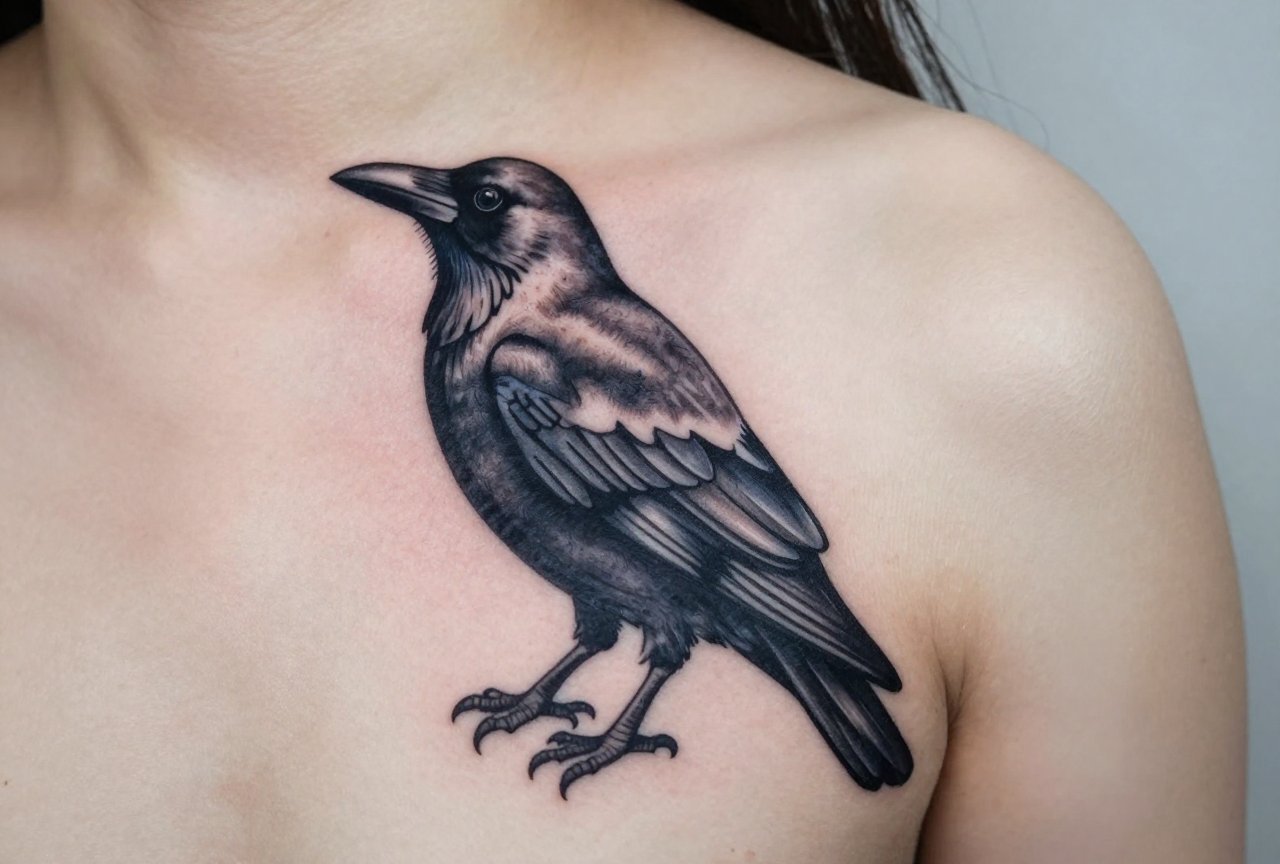
A realistic crow tattoo isn’t some gothic cliché slapped on because it looks cool on Pinterest. Done right, it’s a portrait of one of nature’s most intelligent, complicated birds, every feather catching light differently, that heavy beak catching shadow, those pale eyes that seem to calculate. I’ve tattooed crows that took six hours and crows that took two, and the difference is always in how well the artist understands what makes a crow look alive versus decorative. This guide breaks down what actually matters if you’re serious about getting one.
Origins & History
From Myth to Skin
Crows carry weight in nearly every culture, and that history bleeds into why people want them rendered realistically rather than stylized. Norse mythology had Huginn and Muninn, Odin’s thought and memory, flying across the world each dawn to report back. Celtic tradition saw them as messengers between worlds. In my chair, I’ve heard clients reference everything from Edgar Allan Poe to their grandmother’s superstitions about crows counting the dead. The realistic style honors that gravity. You’re not getting a cartoon bird; you’re getting something that could land on a telephone wire and fool the neighbors.
The realistic tattoo movement itself grew from portrait work in the 1990s and early 2000s, when artists started pushing what black and grey could do with wildlife. Bob Tyrrell and Nikko Hurtado changed how we approached animal fur and feathers, building texture through needle grouping and ink saturation rather than bold outlines. Crows became a natural subject because their all-black plumage is actually a nightmare to render: pure black looks flat, but real crow feathers shimmer with purple, green, and blue in sunlight. That challenge attracted serious artists.
Why Crows Specifically
We see this a lot in shops, someone comes in wanting a raven or crow because they “love the symbolism,” but they haven’t looked closely at the actual bird. Crows have thicker, straighter beaks than ravens. Their tail feathers fan out differently in flight. A good artist will know this. I’ve had to gently correct clients who brought raven reference photos but asked for a crow. The tattoo lasts forever; the ten minutes of research doesn’t.
Key Characteristics & Motifs
Realistic crow tattoos live or die in the details. Here’s what separates the memorable ones from the muddy ones:
- Feather texture: Individual barbs visible, not smooth shading. I use magnum needles for the soft body feathers and tighter groupings for the primaries, the long flight feathers that read as “structure” from a distance.
- Beak architecture: That heavy, slightly hooked bill catches highlight on top and drops to deep shadow underneath. Getting the beak wrong makes the whole bird look like a clip-art raven.
- Eye placement and color: Crows have pale irises, blue-grey in young birds, dark brown in adults. The eye sits forward on the head, giving them that assessing, almost human gaze. I tell clients: spend your detail budget here.
- Background context: Some pieces float the bird alone; others set it against bare branches, moonlight, or storm clouds. The background determines whether your crow reads as solitary or ominous.
- Dynamic vs. static poses: Wings spread in flight? Hunched on a branch? Head cocked in curiosity? Each tells a different story and affects how the tattoo ages.
Line work in realistic crow tattoos is minimal and strategic. We’re not outlining the whole bird in black. Instead, we use “found edges”, places where shadow naturally creates boundary. The rest is built through value shifts: pushing some areas to true black, leaving others in grey wash, occasionally hitting near-white highlights for feather sheen.
Color vs Black and Grey
Black and Grey: The Standard
Most realistic crow tattoos I do are black and grey, and for good reason. Crow feathers in nature are already playing in that value range. The trick is making black look alive rather than dead. I build up layers: a base of dark grey wash, then deeper blacks for the feather groups that sit in shadow, then selective highlights, sometimes skin tone, sometimes a touch of white ink, to suggest that iridescent sheen. White ink on black and grey is controversial; some artists love it, others say it yellows or falls out. In my experience, it works for highlights that read as “light catching feather” but fails if you try to make it read as “white feather.”
Color Accents and Full Color
Full color realistic crows are rare but striking when done well. The purple-green iridescence of real crow plumage can be rendered with blues, violets, and deep emeralds worked into the black. More commonly, I see clients asking for color in the background, a blood-red moon, amber sunset, electric blue storm, while keeping the bird itself in black and grey. This creates depth and narrative without fighting the crow’s natural darkness.
Color realism demands a different artist skillset. Not every black and grey specialist transitions well. The saturation levels, color theory for skin undertones, and how pigments fade relative to each other, it’s a separate education. Ask to see healed color work, not just fresh photos.
Best Placements
Crow tattoos need room to breathe. The bird’s proportions, long wings, substantial body, that heavy beak, compress poorly into tiny spaces. Here’s where they actually work:
- Upper arm/shoulder: Classic. The deltoid curve becomes the bird’s breast; the wing can extend toward the elbow or sweep across the shoulder cap. I’ve done crows here that look like they’re perched on the muscle itself.
- Thigh: Expansive canvas for a crow in flight, wings fully spread. The muscle movement adds life, when you walk, the bird seems to adjust.
- Chest, off-center: A crow descending toward the heart, or rising from it. The sternum gives vertical space; the bird’s body follows the pectoral line.
- Forearm: Riskier for large realism. Works for a single crow head in profile, or a smaller bird with simplified background. The frequent sun exposure here means faster fading, something I warn clients about directly.
- Back: The full showpiece. Scapula to scapula, a crow with wings spread wide, every feather rendered. I’ve spent 15+ hours on these. The skin holds detail well, but sitting through it tests your commitment.
Hands, feet, neck, avoid for realistic crows. The detail required won’t hold, and the symbolism shifts from “thoughtful portrait” to “prison aesthetic” in many contexts. That’s not judgment; it’s cultural reality.
Who It Suits
There’s no personality test for crow tattoos, but I’ve noticed patterns in my chair. People drawn to realistic crows often have a complicated relationship with darkness, not depressed, but unafraid of it. They tend to be observers, the ones who watch before joining. The crow as trickster, as survivor, as memory-keeper: these resonate.
That said, I’ve tattooed crows on cheerful extroverts who just think they’re beautiful birds. The meaning is yours to assign or ignore. What matters is that you connect with the image enough to live with it. A realistic crow is not subtle. It reads as serious, sometimes intense, occasionally threatening to people who don’t know you. Consider your professional environment, your family, your own comfort with being perceived a certain way.
Modern Variations
Neo-Traditional and Realism Hybrids
Some artists are pushing boundaries, realistic crow heads on decorative mandala bodies, or crows rendered with photorealistic accuracy but placed in impossible compositions: emerging from geometric shapes, dissolving into smoke or clock gears. These work when the realism is committed, not half-hearted. A realistic bird head on a cartoon body looks like a mistake, not a style.
Multiple Crows and Narrative Scenes
A murder of crows, yes, that’s the real collective noun, spread across a larger piece creates narrative tension. One bird watches the viewer; another takes flight; a third picks at something unseen. I’ve done pieces where the crows tell a story of descent and ascent, mirroring the client’s own history. This demands an artist who thinks compositionally, not just technically.
Choosing an Artist
This is where I get passionate. A realistic crow tattoo will be on your body for decades. The artist’s Instagram matters less than these factors:
- Healed work in their portfolio: Fresh tattoos look sharper than healed ones. Ask to see crows or similar birds at one year, not one week. If they can’t show you healed pieces, they haven’t been doing this long enough.
- Understanding of bird anatomy: Ask about the difference between crow and raven beaks. If they can’t answer specifically, they haven’t studied.
- Needle groupings and approach: A confident artist can explain their process, what needles for feathers, what for smooth beak, how they build depth. Vague answers suggest they’re winging it.
- Shop culture and hygiene: Real shops have autoclaves, single-use needles, and artists who glove up without you asking. The vibe matters too, do you want to spend six hours with this person?
- Price realism: A detailed realistic crow takes time. Quotes that seem too low often mean rushed work, or an artist building a portfolio on your skin. Quality black and grey realism runs $150-400+ per hour in most US markets. Large pieces are multi-session investments.
I tell clients: travel for the right artist if you need to. A crow tattoo is not a spontaneous Friday night decision. Save, research, consult, wait. The bird will still be there when you’re ready.
Final Thoughts
Realistic crow tattoos occupy that space between nature documentary and personal mythology. They’re technically demanding, emotionally loaded, and visually arresting when done well. The best ones I’ve seen, and the best I’ve done, capture not just what a crow looks like but what it feels like to be watched by one: that intelligence, that ancient patience, that slight menace.
Take your time with this decision. Study real crows. Watch videos of them in flight, in rain, in morning light. Bring reference that moves you, not just what looks cool online. And find an artist who gets excited by the challenge, not just the deposit. The result will be something that ages with you, sometimes literally fading, but never losing the weight of what you chose to carry.
Frequently Asked Questions
How long does a realistic crow tattoo typically take to complete?
A detailed crow head or small perched bird runs 2-4 hours. Full crows with background, or large flight pieces, take 6-15 hours across multiple sessions. I schedule multi-session work to let the skin recover between sittings, which actually produces sharper detail than powering through in one marathon.
Will a realistic crow tattoo fade badly over time?
Black and grey holds well if properly saturated, but the fine feather details soften after 5-10 years. Sun exposure is the killer, UV breaks down ink particles. I tell every client: SPF on your tattoo, always. Touch-ups every few years keep the realism crisp, especially on high-movement areas like shoulders and arms.
What’s the difference between a crow and raven tattoo, and does it matter?
Ravens are larger with heavier, more curved beaks and wedge-shaped tails in flight. Crows have straighter, slimmer beaks and fan-shaped tails. Most people won’t know the difference at a glance, but if the symbolism matters to you, Norse ravens versus your personal crow encounters, getting the anatomy right honors your intention.
How painful is getting a realistic crow tattoo on the upper arm or thigh?
Upper arm outer muscle is manageable for most people, I’d call it a 4/10. Inner arm and ditch (inner elbow) spike to 7/10. Thigh varies wildly: outer thigh is fatty and tolerable, inner thigh near knee is brutal. Realism requires longer sits than simple designs, so pain management becomes part of the planning. Bring snacks, hydrate, don’t drink alcohol the night before.
Related Style Guides
- Realistic Jaguar Tattoos: Complete Style Guide
- Realistic Portrait Tattoos: A Working Artist s Guide
- Traditional Lady Tattoos: A Working Artist s Guide
- Explore more