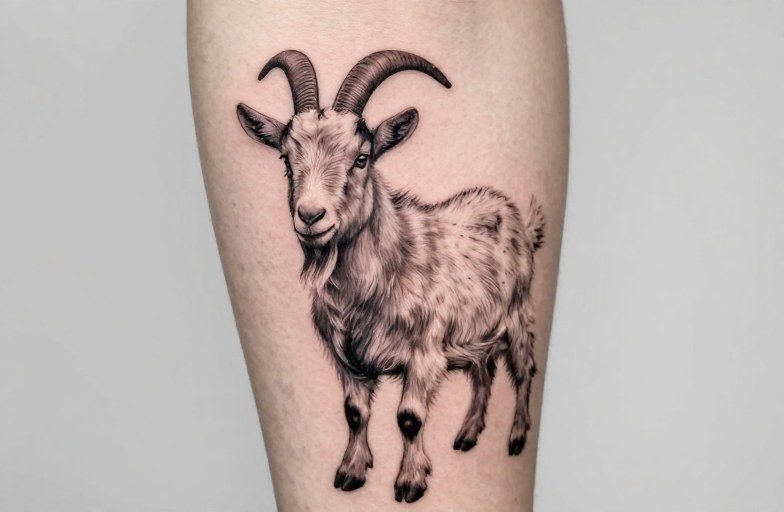
A realistic goat tattoo renders the animal with photographic accuracy, fine fur texture, accurate horn curvature, and natural eye shine, rather than stylizing or simplifying the form. The style demands technical precision in both linework and shading, and it works best when the artist understands caprine anatomy: the hollow behind the shoulder blade, the way beard hair differs from coat hair, how the pupils sit horizontally in the eye. Done well, these pieces carry weight without needing symbolism tacked on.
Origins & History
Realistic animal portraiture in tattooing grew from the broader photorealism movement that took hold in the 1970s and 1980s, when artists began translating airbrush and hyperrealist painting techniques into skin. Goats specifically entered the mix through several channels, agricultural heritage, astrological interest in Capricorn, and the animal’s recurrence in occult and alchemical imagery.
From Farm to Skin
Goat tattoos were uncommon in early American traditional work, which favored more iconic, readable imagery. The shift toward realism allowed for subtler personal connections, an animal you actually raised, a specific breed with distinctive horn shape, a particular expression caught in a photograph. Some trace the Capricorn goat to Babylonian and later Greek associations with the sea-goat, though the realistic style strips away those mythic elements to focus on the living animal itself.
Occult and Counterculture Threads
- Baphomet imagery, often linked to 19th-century occultism, influenced stylized goat depictions but rarely the photorealistic approach
- The realistic style instead connects to wildlife art traditions, particularly the detailed work of 20th-century illustrators like Carl Rungius
- Contemporary popularity surged alongside interest in heritage breeds and back-to-the-land movements
Key Characteristics & Motifs
What separates a realistic goat tattoo from a generic animal piece is attention to breed-specific detail and the particular challenges of caprine anatomy. Fur texture varies enormously between a cashmere’s fine undercoat and a Boer’s short, glossy hair. Horns present their own complexity, growth rings, the slight translucency at the tips, the way light catches the curved surface.
Breed-Specific Markers
Alpine goats carry upright ears and a straight facial profile; Nubians show the distinctive Roman nose and long, pendulous ears. Saanens are white with pink skin showing through thin hair on the nose. These details matter because they make the tattoo specific rather than generic. Artists working from reference photos need to understand what they’re seeing, interpreting a Swiss breed’s markings versus misreading shadow as pattern.
Common Compositional Choices
- Head-and-shoulders portraits emphasizing horn architecture and eye contact
- Full-body standing poses showing the characteristic slope from withers to rump
- Close-up muzzle studies capturing the rectangular pupil and the mobile upper lip
- Young goats (kids) with softer horn buds and finer, downier coat texture
Linework & Technique
Realistic goat work relies heavily on smooth graywash transitions rather than hard outlines. The exception comes with horn definition, where a tighter line helps separate the horn from background and establishes the spiral or curve. Fur demands a combination of techniques: whip shading for directional flow, stippling for texture variation, and careful negative space to suggest highlight.
Needle Selection and Approach
Round shaders build the soft transitions in the face and neck. Magnums or curved mags cover larger areas like the body and background. For fine beard hair and eyelashes, a tight 3-round liner or even a single needle provides the necessary control. The direction of needle movement should follow actual hair growth, down the neck, forward on the chest, radiating from the spine on the flanks.
Color vs. Black and Gray
Black and gray dominates realistic goat work for good reason: it ages cleaner, and goat coloration often reads as value (light to dark) rather than hue. Color pieces work best on specific breeds, the brown and white patches of a Toggenburg, the golden tones of a Guernsey golden goat. Even then, saturation must stay restrained; overly vivid goat tattoos tend toward the illustrative rather than realistic.
How It Ages
Goat tattoos age predictably based on placement and the density of detail packed into the design. The finest fur texture, rendered with single-needle stippling, will soften within three to five years. This isn’t failure, it’s the nature of skin. Planning for this means building contrast at the structural level, not just the surface detail.
High-Risk Placements
- Hands and fingers: constant use and sun exposure blur fine detail fastest
- Inner bicep and thigh: rubbing and moisture retention affect healing and long-term clarity
- Feet and ankles: similar issues, compounded by shoe friction and thinner skin
Placements That Hold Detail
The outer upper arm, calf, and upper back provide stable skin with moderate sun exposure and minimal distortion from movement. The chest works for larger pieces but requires the artist to account for pectoral movement, what reads as a straight horn line at rest may curve when the muscle flexes. Ribs and stomach demand similar foresight; the goat’s body should align with the body’s natural geometry rather than fighting it.
Common Mistakes to Avoid
Most failed realistic goat tattoos stem from three sources: poor reference material, wrong scale, and misunderstanding how fur reads on skin. A blurry phone photo of a pet goat won’t yield the anatomical accuracy the style demands. Artists need multiple angles, clear lighting, and ideally some understanding of what a healthy goat looks like versus one with structural faults.
Reference and Anatomy Errors
Goats are not deer with different horns. The neck attaches lower and more horizontally. The chest is narrower. The tail is short and points upward. Horns grow from the top of the skull, not the sides, and their curvature follows specific patterns by breed. Artists unfamiliar with livestock anatomy often place horns too far back or give the face a cervid elongation that reads as wrong even to viewers who can’t articulate why.
Technical Pitfalls
- Overworking the skin trying to achieve photographic fur texture in a single session
- Insufficient contrast, leaving the piece muddy as finer details fade
- Backgrounds that compete rather than recede, realistic animal work needs atmospheric depth
- Scaling the piece too small; a goat head below palm-sized loses the eye detail that makes it lifelike
Modern Variations
Contemporary realistic goat work has branched in several directions without abandoning the core commitment to accuracy. Some artists incorporate environmental context, rocky terrain, specific vegetation, weather effects, that anchors the animal in a particular place and season. Others combine the realistic goat with graphic elements: geometric framing, ornamental borders, or controlled areas of abstraction that contrast with the photographic rendering.
Neo-Traditional Hybrids
A growing approach maintains realistic goat anatomy while employing limited, deliberate color palettes and bold compositional structure borrowed from neo-traditional work. The goat remains recognizable and accurate, but the surrounding treatment, perhaps a decorative moon, stylized florals, or a held banner, provides visual rhythm that pure realism sometimes lacks.
Multi-Session Large Scale
Full-back or torso pieces treating the goat as wildlife art rather than portrait have gained traction. These require the same anatomical precision but at a scale where every hair can be rendered with appropriate needle groupings. The commitment is significant, forty to sixty hours over multiple sessions, but the result carries the impact of a museum diorama translated to skin.
Final Word
A realistic goat tattoo succeeds when the artist respects both the technical demands of photorealism and the specific subject’s anatomy. It’s not a design that forgives shortcuts. The best pieces come from artists who have studied reference material carefully, planned for how detail will settle over years, and sized the work appropriately for the placement. If you’re drawn to this subject, invest in finding an artist whose animal portfolio demonstrates genuine understanding of fur rendering and horn structure, not just general technical skill. The difference between a goat that looks alive and one that looks like a fuzzy symbol is in the specifics.
Frequently Asked Questions
How big should a realistic goat tattoo be to hold detail?
For a head portrait, plan on at least palm-sized to preserve eye detail and horn texture. Full-body pieces need significantly more space, think dinner plate minimum, to avoid muddying the anatomy.
Do realistic goat tattoos work in color, or is black and gray better?
Black and gray ages more predictably and suits most goat breeds. Color works for specific breed markings but requires a lighter touch; oversaturated color pushes the piece toward illustration rather than realism.
What’s the most challenging part of tattooing a realistic goat?
The horns and the fur texture demand opposite approaches, smooth gradients for horn surface versus directional, varied techniques for coat. Balancing these without visual confusion separates strong pieces from mediocre ones.
How do I find an artist who can actually execute this style well?
Look for a portfolio with multiple realistic animal pieces, not just one or two. Ask specifically about their experience with fur texture and whether they work from multiple reference angles rather than a single photo.
Related Style Guides
- Realistic Graveyard Tattoos: Complete Style Guide
- Realistic Michael Myers Tattoos: Complete Style Guide
- Realistic Patch Tattoos: Complete Style Guide
- Explore more