
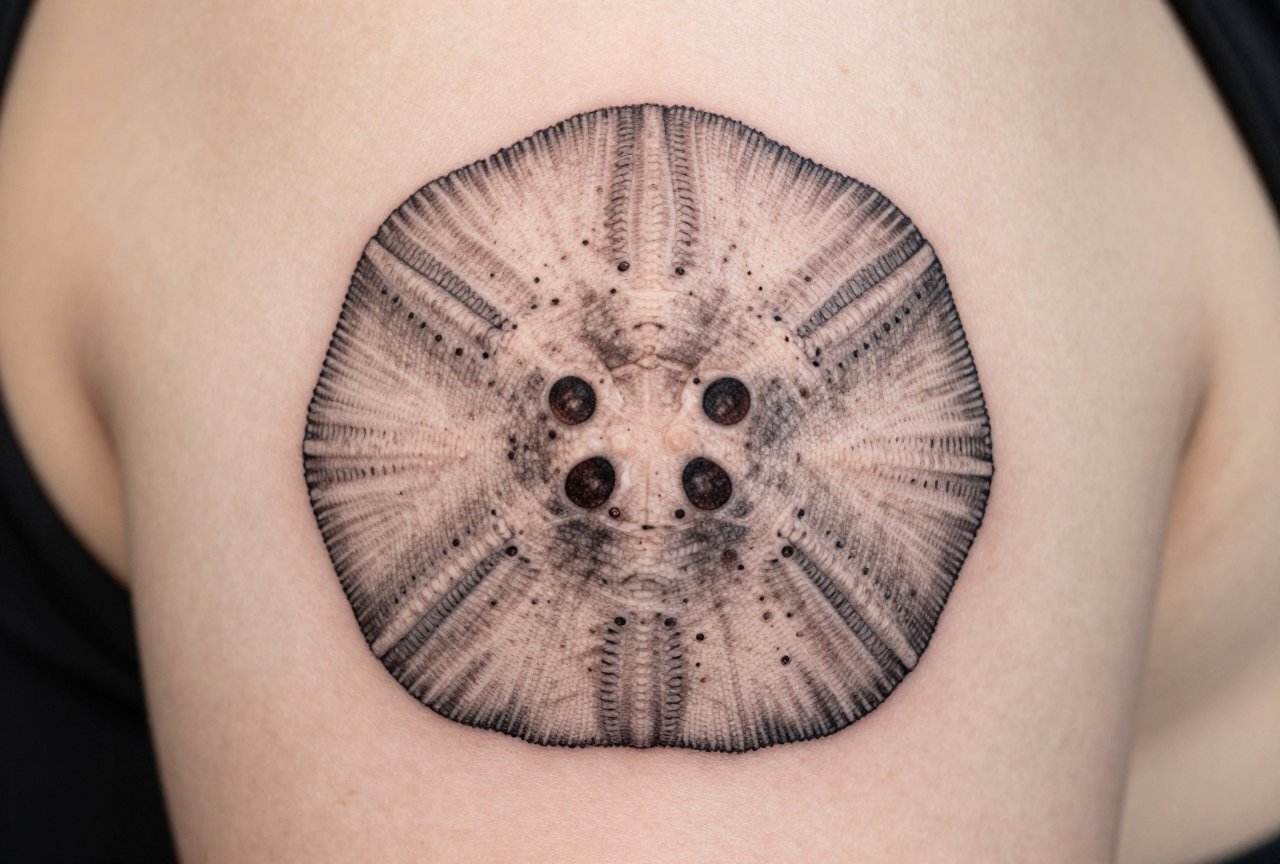
A sand dollar tattoo means resilience, transformation, and quiet faith. People get it to mark survival through hard times, to honor coastal roots, or to carry a private spiritual symbol. The five-pointed pattern inside the shell reads like a natural mandala, and that geometry hits different once you know the old sailor legend about it representing the Star of Bethlehem.
Symbolism & History
I’ve tattooed dozens of these over the years, and the story clients bring always matters more than the image itself. The sand dollar is a dead thing that once lived, a skeleton washed clean by waves. That alone carries weight.
The Legend of the Doves
Break open a sand dollar and you’ll find five tiny fragments that look like doves. The old story says these represent the Holy Spirit, peace, and resurrection. I’ve had clients who grew up Catholic and remember finding these on beach vacations, pressing them into palm fronds at Easter. Others just love the metaphor: something broken that releases something beautiful. Either way, the image works. I usually suggest keeping the internal pattern visible in the design, not just the round shell exterior. That five-petal “flower” is where the meaning lives.
Pagan & Natural Interpretations
Not everyone wants religious baggage. The fivefold symmetry maps neatly onto earth, air, fire, water, and spirit. I’ve had Wiccan clients request sand dollars with moon phases tucked into the petals. The beach itself reads as liminal space, between worlds, and the sand dollar is the creature that survives that threshold. A dead thing that becomes treasure. That’s the thread I see most: transformation through difficulty.
Common Variations & Styles
Style changes the meaning more than people expect. Here’s how I’ve seen it play out in shops:
- Blackwork line: Clean, graphic, holds up forever. The geometric interior reads almost technical, architectural. I did one on a forearm last year for an engineer who loved the math of natural forms.
- Soft black and grey: Looks like wet sand, weathered bone. The shading mimics how actual sand dollars bleach and crack. This ages beautifully if your artist understands negative space.
- Watercolor splashes: Popular, tricky. The color needs to frame the structure, not replace it. I’ve seen too many where the blue and teal swallow the shell entirely. Five years later? Blue blob. Ask your artist how they’ll preserve the outline.
- Dotwork/stipple: Perfect for the sandy texture. Takes longer, sits differently on skin. I love this for upper backs and shoulders where the dots can breathe.
- Minimalist single needle: Tiny, delicate, often behind ears or on wrists. The meaning becomes private, almost hidden. I’ve done these for people who want the symbol without the conversation.
Some clients add elements: a broken edge with doves flying free, ocean waves wrapping around, a child’s hand holding the shell. One woman I tattooed had me incorporate her grandmother’s handwriting, “found on Sanibel, 1987,” curved along the rim. That’s the stuff that lasts.
Best Placements
Where you put it changes how you see it, how it wears, and who gets to ask about it.
Visible vs. Hidden
Forearms and collarbones invite questions. Ribs, hips, upper thighs keep it yours. I’ve noticed people who’ve survived something heavy often choose ribs or sternum, near the heart, under clothing. The beach people go for ankles, feet, shoulders, places that see sun, that feel exposed.
How Placement Affects the Design
The sand dollar is round. That sounds obvious, but it matters. Rounds fight against the body’s long muscles. On a forearm, I usually let it float or break the circle with wave elements. On a shoulder cap, it nests perfectly. On a spine, the symmetry does something satisfying, almost ceremonial. Small ones on fingers or behind ears lose the interior detail, so we simplify to the five-petal core. That’s still readable, still meaningful, but it’s a different tattoo than a palm-sized piece where every dove-shaped fragment can be shaded distinct.
Healing reality: feet and ankles are miserable. Sand, salt, friction from shoes. I warn people. The tattoo itself is easy. The two weeks after? That’s where placement matters.
Who Chooses This Tattoo / Personal Meanings
In my chair, the sand dollar tends to find specific people:
- Coastal transplants: Grew up near water, moved inland, need the reminder. Often paired with coordinates or a specific beach name.
- Grief survivors: The broken shell releasing doves hits hard after loss. I’ve done memorial sand dollars with dates inside the petals, ashes-infused ink once, though that’s its own conversation.
- Recovery stories: Sobriety, illness, divorce. The “washed clean” narrative. One guy told me the sand dollar was the only thing that survived his house flooding; he found it in the debris, intact.
- Spiritual seekers: Not necessarily Christian, but drawn to the natural mandala, the meditation object. Often combined with other sacred geometry.
- Minimalists: Want meaning without tribal flash or trendy script. The sand dollar reads as nature, not trend.
What I tell clients: the meaning doesn’t need to be legible to anyone else. I’ve tattooed symbols I didn’t understand until the person explained, and that explanation was between them and their skin. The sand dollar carries enough collective resonance that strangers will project their own assumptions, and that’s fine. Your reason is the one that matters.
Similar Symbols
People often come in considering a few options. Here’s how I talk them through:
- Nautilus shell: Growth, expansion, golden ratio. More intellectual, less spiritual. The spiral moves; the sand dollar rests.
- Sea turtle: Longevity, journey, protection. Bigger, more narrative. Less ambiguous than the sand dollar.
- Starfish: Regeneration, the “one lost limb” story. More whimsical, less solemn. I see starfish on younger clients, sand dollars on people who’ve actually lost something.
- Anchor: Stability, often military or family connection. Heavier, more literal. The sand dollar is lighter, more open to interpretation.
- Lotus: Similar rebirth narrative, but Eastern, more common, sometimes feels like a tattoo shop cliché. The sand dollar is less expected, more personal for coastal people.
Sometimes we combine: sand dollar with anchor rope, sand dollar as moon in a night sky, sand dollar inside a larger mandala. The symbol plays well with others because its shape is so contained, so complete.
Final Thoughts
I’ve watched this design trend and fade and return over fifteen years in shops. It never disappears because the meaning is too specific, too grounded in real experience. People don’t get sand dollar tattoos because they saw a celebrity with one. They get them because they found a shell on a hard day, because their mother collected them, because the broken-doves story got them through something.
The best ones I’ve done aren’t the most technically perfect. They’re the ones where the person sat in my chair with a story already written, and we just made it visible. If you’re considering this, bring the object if you have it, or a photo of the beach, or just the words. A good artist will know how to weight the line work, how to let the interior pattern breathe, how to place it so you see it when you need to and hide it when you don’t.
Meaning in tattoos isn’t automatic. It’s built by what you bring and what you carry forward. The sand dollar gives you a solid foundation: natural geometry, personal history, quiet resilience. What you build on that is yours.
Frequently Asked Questions
Does a sand dollar tattoo always have religious meaning?
Not at all. The Christian legend is well-known, but plenty of people choose it for natural, personal, or memorial reasons. The fivefold symmetry appeals to spiritual seekers of all kinds, and many clients simply connect it to beach memories or survival through hard times.
How well does a detailed sand dollar tattoo age over time?
The interior pattern needs clean lines and smart spacing to hold. I’ve seen poorly done dotwork blur into grey mush after a decade. Ask your artist about line weight and negative space. Simpler designs with strong outlines age much better than hyper-detailed ones with no breathing room.
Can I get a realistic sand dollar tattoo in color?
Real sand dollars are pale, almost white, so color usually means adding ocean blues, sunset tones, or watercolor backgrounds. It works if the color supports the structure rather than replacing it. I generally steer people toward black and grey with subtle blue accents for longevity.
What’s the average size for a sand dollar tattoo that keeps the detail?
Palm-sized or slightly larger, about 2.5 to 3 inches, preserves the interior pattern. Smaller than that and we simplify to the basic five-petal shape. I’ve done tiny ones behind ears, but those read as abstract flowers to most viewers, which may or may not matter to you.
Related Tattoo Meanings
- Sukuna Tattoo Meaning: Power, Duality Cursed Energy
- Symbolic Religious Tattoo Meaning: Faith, Protection Personal Belief
- Skull Roses Tattoo Meaning: Life, Death Everything Between
- Explore more









