
Meaningful side tattoos for women’s ribs work best when the symbol, placement, and line weight agree. I’ve seen people choose a rib placement first, then force an idea onto skin that can’t support it. You’ll avoid that mistake by building your tattoo in order, from meaning to healing. Start small, but don’t think small!
- Start with a symbol: The Symbol Ladder
- Choose side-body linework: The Fine-Line Filter
- Map a quote along the ribs: Which words will still matter?
- Pick a floral design: The Stem and Space Rule
- Place a dragon beneath the rib curve: The Flash-to-Skin Method
- Match spine quotes with side ink: The Echo Method
- Keep negative space around fine details: The Open-Skin Rule
- Plan a constellation across your ribs: The Three-Point Orbit
- Select lettering that follows your body: Strong Type over Tiny Script
- Build a memorial tattoo with healed lines: The Healed-Image Test
- Balance pain, healing, and rib placement: How much can your first session handle?
1Start with a symbol: The Symbol Ladder

Begin with one symbol that already carries weight for you. An intricate symbol can represent a birth month, a person, a difficult season, or a promise you’ve made to yourself. Ask what the image means before you show the reference to your artist.
I’d skip collecting five unrelated icons because they look cute together. Your ribs have a long, curved surface, but that doesn’t mean every inch needs ink.
Write three words about the memory, then find one shape that connects them. These meaningful tattoo ideas can help you compare directions without borrowing someone else’s story.
Keep the visual language consistent. Small stars with black ink can look crisp and timeless, while soft gray shading may make the result more ethereal. If you want more contrast, ask for open skin between the marks instead of pale color that may fade unevenly.
Give your artist room to adjust the spacing to your ribs. Skin moves when you breathe, twist, and sit, so a design that looks balanced on paper may need a graceful curve in real life. I’d rather see three well-spaced stars than a dense cluster that loses its message later.
Write the story in plain language before you finalize the symbol notes. You don’t need a dramatic explanation. “This reminds me to keep going” may be more honest than a complicated meaning you’ll eventually stop using.
Compare symbols by emotional pull, not popularity. A moon may feel sacred to one person and purely decorative to another. The right choice is personal, meaningful, and strong enough to remain yours when trends change.
2Choose side-body linework: The Fine-Line Filter
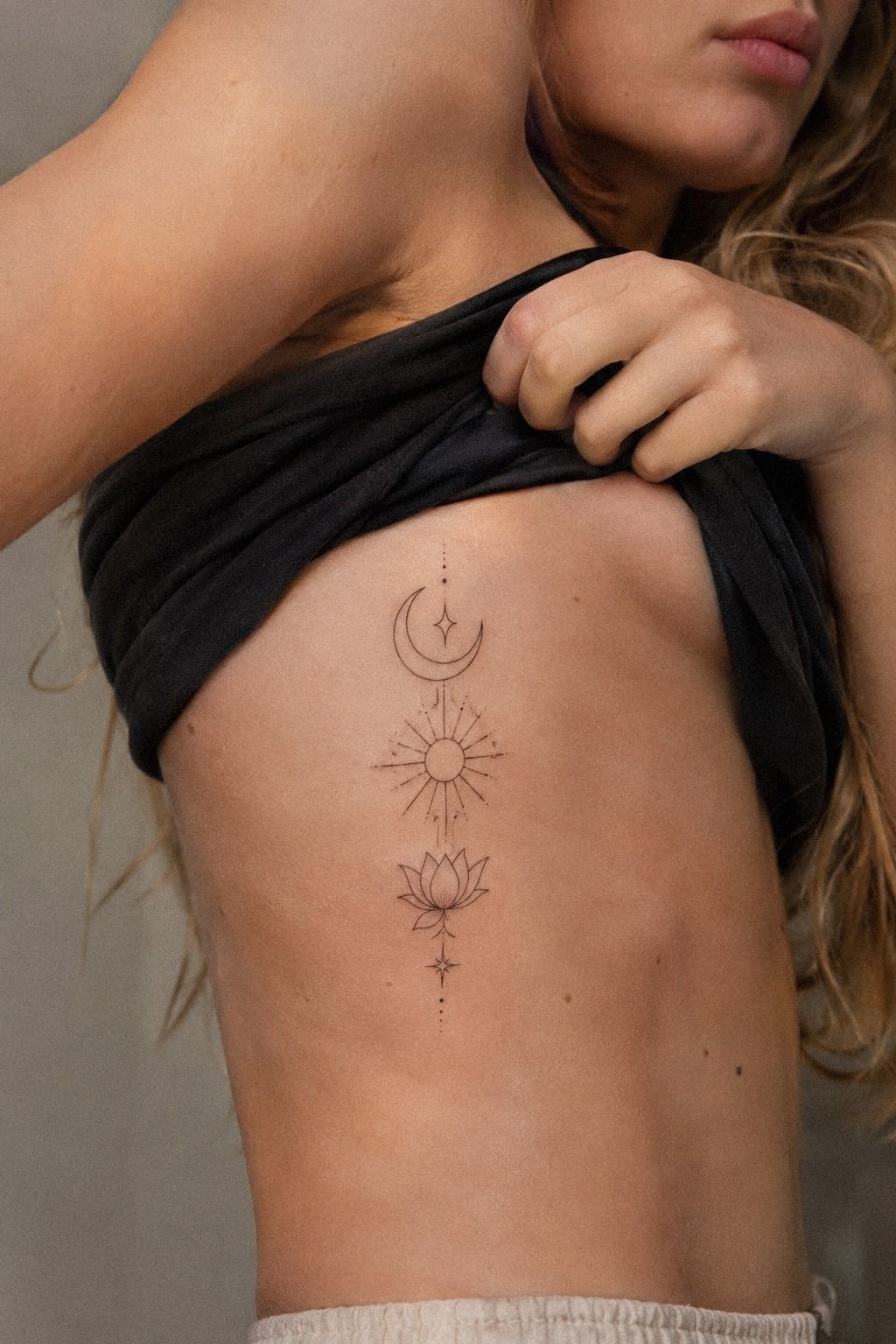
Side-body linework can feel delicate, sleek, and understated, but it needs discipline. Choose one main line, one supporting shape, and one small detail. Your artist can then keep the piece expressive without turning every curve into visual noise.
Look for healed examples, not only fresh work. A single-needle tattoo may look impossibly crisp on day one, yet very fine lines can widen as they settle. You’ll want an artist who shows healed examples in ordinary lighting and explains how your skin may respond.
Fresh ink is persuasive. Your better test is whether the design still reads after the surface has settled, especially where the ribs flex and clothing rubs. Ask for a stencil preview, then take a few slow breaths before approving the angle.
For a personal touch, hide a tiny initial, date, or repeated curve inside the larger motif. A hidden initial can stay private without being obvious to everyone who sees your side-body tattoo references.
Don’t shrink the detail until it becomes a blur. Delicate should feel intentional, not fragile.
Your artist may recommend a line-weight plan before finalizing the stencil. That plan can show which marks should stay sharp, which details need more width, and where the design needs a visual pause.
I’d also compare the curve of your ribs with the direction of the design. A flowing motif usually reads more naturally when its movement follows your body instead of fighting it. You’re choosing a composition, not simply placing a flat drawing on skin.
3Map a quote along the ribs: Which words will still matter?

A short quote works best when the wording has a natural rhythm and the placement supports its shape. Choose language that feels meaningful, elegant, and easy to read rather than impressive for one emotional moment.
Read the quote aloud while standing and sitting. Your ribs expand as you breathe, so a phrase that feels balanced on paper may need different spacing across the body.
I’d avoid squeezing a long passage into a narrow line. A concise phrase can feel more powerful, while too many words may become difficult to read as the tattoo settles. Let the message stay clear.

4Pick a floral design: The Stem and Space Rule

An empowering floral tattoo can be feminine without becoming complicated. Start with the flower, stem, and one supporting detail. That structure keeps the design flowing and vibrant while giving your artist enough room to preserve the lines.
Think about what the flower represents before choosing its species. A wildflower stem might suggest independence, while a rose, lotus, or poppy may connect to a specific memory. The strongest choice isn’t always the most recognizable one.
Keep the leaves separated from the central bloom. A negative-space gap lets each shape remain readable as the tattoo settles. If every leaf touches the stem and every petal touches another petal, the design can lose its rhythm.
Ask whether the petals should be open, shaded, or outlined. A petal structure with clear separation may age more cleanly than a dense botanical study squeezed into a narrow area. Your tattoo can be ornate without becoming crowded.
Your budget matters here, too. Ask whether the price reflects a short session, a minimum fee, or an hourly rate.
A slightly larger stencil may offer better value if it protects the line spacing. Don’t cut the design down so far that it stops feeling like the idea you wanted!
A tattoo estimate should explain what affects the price, including detail, size, revisions, and session length. You can compare rib tattoo references before your consultation, but the final decision should follow your body and your meaning.
5Place a dragon beneath the rib curve: The Flash-to-Skin Method

A fierce dragon can feel powerful, protective, or rebellious, but the pose must match the limited space beneath the rib curve. Compare posture, wing shape, claws, and body direction before anything reaches your skin.
Choose the silhouette before the texture. A dragon outline may include scales, smoke, and sharp teeth, yet those details won’t matter if the body shape becomes unreadable. Your artist should be able to reduce the design to a clear outer contour that still feels bold from several feet away.
A dragon silhouette should have one obvious direction. Is it rising, curling, guarding, or moving forward? That answer will help your artist decide where the head, spine, wings, and tail should sit.
I’d avoid placing the dragon so low that the tail disappears into your waistline. That position may look dramatic while seated, but you’ll lose the full story when you stand. Ask for a stencil that follows the ribs and check whether the head, spine, and tail remain visible during normal movement.
You can make the piece more personal with one symbolic accent, such as a flower in the claw or a small star near the wing. Keep that detail crisp.
If you’re drawn to distinctive side tattoo ideas, look for references where the main silhouette remains readable instead of designs packed with every possible flourish. That restraint makes the final tattoo feel iconic.
A dragon doesn’t need to look aggressive to feel fierce. A calm eye, folded wing, or protective posture can create a more meaningful story. Choose the emotional direction before you approve the final contour.
6Match spine quotes with side ink: The Echo Method

If your quote connects to endurance, recovery, or faith, a rib line can make the message feel private rather than performative. The curve guides the eye, while the placement lets you decide how visible the words should be.
Think about how the side tattoo will relate to other ink on your back. A healed lettering sample can show whether the line weight will sit comfortably beside spine tattoos or remain visually separate.
You don’t need matching fonts. Repeating one element, such as spacing or letter height, may be enough.
A spine quote and a rib quote don’t need to compete. One can be bold and direct, while the other stays understated. The collection will feel more intentional when each phrase has a different job.
I’d skip placing two long quotes too close together. They can compete, especially if both use dark lettering.
Give your ribs one clear statement and let the rest of your tattoos support it. If you’re planning a larger collection, back tattoo references can help you think about movement across the body.
Repeat a small detail if you want a connection. Matching letter height may be enough, or you could echo one curve, dot, or opening in both designs. Subtle repetition often feels more polished than identical lettering.
Read your chosen words during an ordinary week, not only during an emotional moment. Your first tattoo should survive changes in mood and circumstance.
If you still want the phrase after you’ve lived with it for a while, that’s a strong sign. If you’re already tired of explaining it, pause.
7Keep negative space around fine details: The Open-Skin Rule

Edgy, dainty work can coexist when the open skin is doing some of the visual work.
Give every major mark enough room to remain distinct. A minimalist tattoo can still feel intricate when the spacing is deliberate.
I’d rather see one expressive detail surrounded by open skin than a crowded design that loses its meaning. Keep it honest!
8Plan a constellation across your ribs: The Three-Point Orbit

A constellation becomes more interesting when it has a reason to exist. Choose a central point, two supporting points, and one interruption. That could be a moon, initial, tiny flower, or star connected to a specific memory.
A fine-line constellation needs a clear visual hierarchy. Your artist can vary the size of the stars, but each dot should have enough room to stay distinct. If you ask for too many tiny points, the design may lose its crisp quality.
Think of the constellation points as a sentence. One point begins the thought, another changes its direction, and the final point gives it an ending. You don’t need a scientifically accurate map to create a symbolic story.
I’d avoid copying a real constellation unless you know why it matters to you. A symbolic arrangement can be more personal than a technically accurate one. Three stars might represent siblings, a curved line might suggest a journey, and an open circle might mark a promise still unfolding.
Place the brightest point where your ribs naturally curve outward. That gives the tattoo a graceful center and keeps the movement from feeling flat. You can compare constellation tattoo references before your consultation, but bring your own explanation.
Your artist needs the story behind the shape to edit it well.
A constellation can stay minimal while still feeling sacred or haunting. Leave enough open skin around it so the pattern feels deliberate instead of scattered.
9Select lettering that follows your body: Strong Type over Tiny Script

Short lettering can look sharp when the word has enough width and the placement supports its shape.
Ask your artist to test the letter spacing across your natural curve. Tiny script may look romantic at first, but it can become difficult to read when the letters are forced too close together.
A bold word can feel daring without becoming loud. Choose a type style that matches the message, then leave enough room for each letter to remain clear.
10Build a memorial tattoo with healed lines: The Healed-Image Test

A memorial tattoo can be haunting, powerful, or quiet. It doesn’t need a crowded collage to carry emotional weight. One flower, initial, date, or small symbol may say more than a design trying to include an entire biography.
Choose a healed memorial reference that resembles your skin tone and the style you want. Your artist can explain how contrast, placement, and line weight may affect the result. If the memorial includes handwriting or a portrait detail, ask whether the design needs more space to stay readable.
Decide on the focal point before adding secondary details. The eye should know where to land, whether that’s a name, a flower, a date, or a small symbolic object.
I’d skip squeezing too much information into one tiny tattoo. The value of a memorial tattoo comes from the meaning you’ll continue to recognize, not from the number of details included. If you’re comparing memorial tattoo ideas, look for designs with a clear focal point.
Aftercare is part of the design process. A consistent aftercare routine supports the result while the surface heals. Your artist may tell you to wash gently, moisturize as directed, and avoid sun and swimming.
The surface usually heals in about two to three weeks, while the tattoo can continue settling for roughly two to three months. That healing window requires patience. Don’t judge the final clarity while the skin is still changing.
11Balance pain, healing, and rib placement: How much can your first session handle?

Rib placement can feel more intense because the skin is close to bone and moves with every breath. A rib placement stencil lets you test the design while standing, sitting, and breathing normally before you commit.
You’ll notice whether the edge catches on clothing or whether the piece twists when you raise your arm. Your artist can also discuss whether the session length should be short or longer, depending on the size and detail. It’s worth asking for an honest estimate before you book.
Here are useful US reference points:
The ribs, feet, hands, and sternum are commonly sensitive areas, while the forearm, thigh, and shoulder are often more tolerable. That doesn’t mean you can’t choose ribs for a first tattoo. It means you should plan honestly, follow aftercare, and avoid scheduling the appointment when you’re rushed.
Ask what the total cost includes. A shop may quote a minimum, an hourly rate, or a flat price based on the tattoo estimate.
Compare the artist’s healed work and communication, not only the lowest number. The cheapest appointment isn’t always the best value.
Plan an aftercare plan before the appointment. Have loose clothing available, leave time for rest, and don’t schedule a demanding activity immediately afterward. Small decisions can make the first evening easier.
A shop minimum may apply even when your tattoo takes less than an hour. Ask whether deposits, revisions, and touch-ups are included. Clear pricing gives you more control over the decision.
The Rib Stencil Check
A stencil should answer practical questions before the needle starts. Does the design follow your natural curve?
Can you read the lettering while standing? Does the focal point stay visible when you sit?
Use a stencil test to check clothing friction, arm movement, and privacy. I’d also look at the design in ordinary lighting instead of judging it only under a bright lamp. Small adjustments can make a major difference.
Notice clothing friction around the lower edge and side seam. You don’t want a beautiful design positioned where every movement constantly irritates the healing skin.
Check body movement by raising your arm, twisting gently, and taking several deep breaths. If the design suddenly looks compressed or tilted, your artist may be able to rotate or widen it.
Your artist may shift the stencil by a few centimeters. That doesn’t mean the original idea failed. It means the design is being adapted to your body rather than copied from someone else.
What Makes a Reference Worth Keeping?
A useful reference shows the line weight, scale, and placement you’re considering. It doesn’t have to be an exact design to copy. Bring several examples, then explain what you like about each one.
I’d label each reference with a note such as line-weight preference, “I like this curve,” or “I want less shading.” That makes the consultation more precise and helps your artist understand the goal.
Pay attention to healed examples, skin tones, and comparable sizes. Healed work tells you more than fresh work because it shows how the artist handles spacing and contrast over time.
Keep a small reference folder with your strongest examples and your own notes. You’ll spot repeated preferences more easily when the references are side by side.
The best reference clarifies a decision. It shouldn’t pressure you to reproduce someone else’s tattoo. Use it to explain mood, scale, movement, or texture, then let your artist create a version that belongs to you.
Fine Lines or Lasting Clarity?
Fine lines can look sleek and expressive, but they need enough room to remain distinct. Heavier lines may offer stronger contrast, while thinner lines can create a lighter visual effect. Neither choice is automatically better.
Ask how the line-weight range will work with your chosen size. If the design contains tiny dots, dense shading, and lettering, your artist may recommend simplifying one element. That can protect clarity without removing the meaning.
Consider contrast when you compare delicate and bold options. A crisp outline may read more clearly than pale shading, while a controlled gray wash can create an ethereal effect without making the tattoo heavy.
The right choice depends on your priorities, budget, and tolerance for future touch-ups. A more minimal design may cost less initially, while a larger composition may offer better long-term readability. Ask what feels worth it before you decide.
Discuss a touch-up plan before booking. Some artists include a short follow-up, while others price it separately. Knowing the policy helps you judge the full commitment.
Before You Book: Budget, Timing, and Aftercare
Set a realistic budget before you fall in love with a specific artist. Include the shop minimum, hourly rate, deposit, transportation, and possible touch-up cost. Knowing the full price makes the decision calmer.
A shop minimum may apply even when the tattoo takes less than an hour. Ask whether the deposit is included in the final cost and whether the artist charges separately for revisions. Clear answers are part of a good consultation.
Ask about the deposit policy in writing. You’ll want to know whether the deposit transfers when you reschedule, how much notice the artist needs, and whether revisions are included before the appointment.
Choose a date when you won’t need to rush afterward. Wear clothing that won’t press against the placement, follow the artist’s cleaning instructions, and plan for the surface to look different while it heals.
Build a realistic healing schedule around work, travel, swimming, exercise, and sun exposure. Your tattoo deserves time to settle, and you’ll feel less anxious when you’ve planned for that pause.
If you’re still comparing artists, review meaningful tattoo references and rib tattoo references. Look for clear communication, healed results, and a style that matches your idea.
My Honest Rule for a First Rib Tattoo
I’ve changed my mind about first tattoos more than once. At first, I thought the strongest piece had to include a full story, several symbols, and a hidden message only I could decode. Then I realized a small, sharply chosen image could carry the same emotional weight without asking the skin to hold an entire biography.
My strongest advice is to choose the idea you’d still recognize if the trend disappeared tomorrow. It doesn’t have to be classic or quiet.
It can be edgy, vibrant, or wonderfully strange. But the image should connect to something you’ve lived, valued, survived, or promised yourself.
A meaningful symbol doesn’t need to be obvious to anyone else. It only needs to make sense when you see it in the mirror or feel the curve beneath your hand.
I’d also put healed evidence above polished presentation. Fresh tattoos look persuasive because the black ink is crisp and the skin is still flushed. Healed examples reveal whether the artist understands spacing, line weight, and placement.
Don’t let anyone rush your decision because the design looks good on someone else. Your skin tone, body curve, pain tolerance, and personal history all matter. I’d rather you take another week to edit the stencil than spend years explaining why the tattoo doesn’t feel like yours.
You can browse unique side tattoo ideas for direction, but let your final design become more personal than the reference. The best tattoo often starts with a familiar idea and ends with a detail only you would choose.
What People Always Want to Know
How much do meaningful side rib tattoos usually cost?
A typical US rib tattoo may cost about $100 to $300, depending on size, placement, detail, artist, and region. A minimum shop fee may sit around $50 to $100, while hourly rates often run about $100 to $250.
Bring your reference and ask for a written estimate before booking. Your artist may price a short session, a minimum, or an hourly appointment. That makes it easier to decide whether the tattoo is worth the cost.
Are side rib tattoos a good idea for a first tattoo?
Yes, they can be a strong first choice if you’re prepared for a more sensitive placement and careful aftercare. Clean linework can age well when the design has enough breathing room and the artist shows healed work.
Choose a symbol you understand, then test the stencil while standing and moving. You’ll feel more certain before the needle starts. If the design still feels right after a quiet week, it may be worth it.
How do I choose a tattoo artist for a rib design?
Look for a portfolio with clear linework, healed examples, and work on skin tones similar to yours. A healed portfolio tells you far more than fresh work.
Check the studio’s hygiene practices, ask about the artist’s specialty, and make sure they listen to your placement concerns. Your consultation should feel clear, not rushed. Compare the full value of the experience, not only the price.
These ribcage tattoo references can help you identify styles worth discussing.
How much do rib tattoos hurt?
Rib tattoos are often more painful than tattoos on the forearm, thigh, or shoulder because the area is close to bone and moves as you breathe. Rib sensitivity can still be manageable when the session length and design are realistic.
Feet, hands, and sternum are also commonly sensitive zones. Tell your artist if you need a pause, and don’t treat discomfort like a test you have to win. Planning well is more useful than trying to prove anything.
How long does a rib tattoo take to heal?
The surface usually heals in about two to three weeks, while complete settling may take roughly two to three months. Gentle aftercare supports the result during that period.
Wash as directed, moisturize with the product your artist recommends, and avoid direct sun and swimming while the skin heals. Don’t pick flakes or judge the final look too early.
What’s the best placement for a side rib tattoo?
A vertical side placement or a design tucked beneath the rib curve can work well, depending on your visibility preference and body shape. A clear stencil will show whether the design flows with your movement.
Your artist can help you compare privacy, clothing friction, pain, and how fine lines may age. Choose the position that still feels right when you sit and breathe.
That’s the best value for a first tattoo. You can also compare side tattoo placement ideas before your consultation.
Where I’d Start First
If I had to pick one step, I’d start with the symbol. A striking image gives every later decision a reason, from line weight to placement. Don’t book until the meaning survives a quiet week.
Then bring your artist a clear reference, an open mind, and enough time to get the curve right. Your first tattoo idea should feel personal before it feels polished.
Browse small tattoo references for scale, then make the final choice unmistakably yours. Worth it!