The spiderweb tattoo has a reputation. Most people see one and immediately think prison, danger, or at least something heavy. That read isn’t wrong, but it’s not the whole picture either. This design carries a stack of meanings depending on where it’s placed, how it’s drawn, and who’s wearing it.
The core idea running through all of it is entrapment and time. A spider builds its web to catch things. When that image goes on skin, it usually means the person has been caught somewhere, or has caught others, or is working through a phase they couldn’t escape. It’s a loaded piece. Here’s what it actually means.
The Core Symbolism: Entrapment and Time
At its most basic, a spiderweb tattoo represents being trapped. The web catches whatever flies into it, so wearing one signals that you’ve been stuck somewhere, physically, mentally, emotionally, or socially. Some people get it to mark a period in their life when they couldn’t move, couldn’t leave, couldn’t break free. The web is the situation. Wearing it means you lived through it.
Time is the other big read. Spiders build their webs slowly, thread by thread. Some wearers use the tattoo to represent time served, patience, or a long stretch of waiting. In that sense it’s not just about being trapped but about enduring. About sitting in something difficult for as long as it took.
Prison Culture and the Elbow Web
A spiderweb doesn't just catch prey, it marks territory.
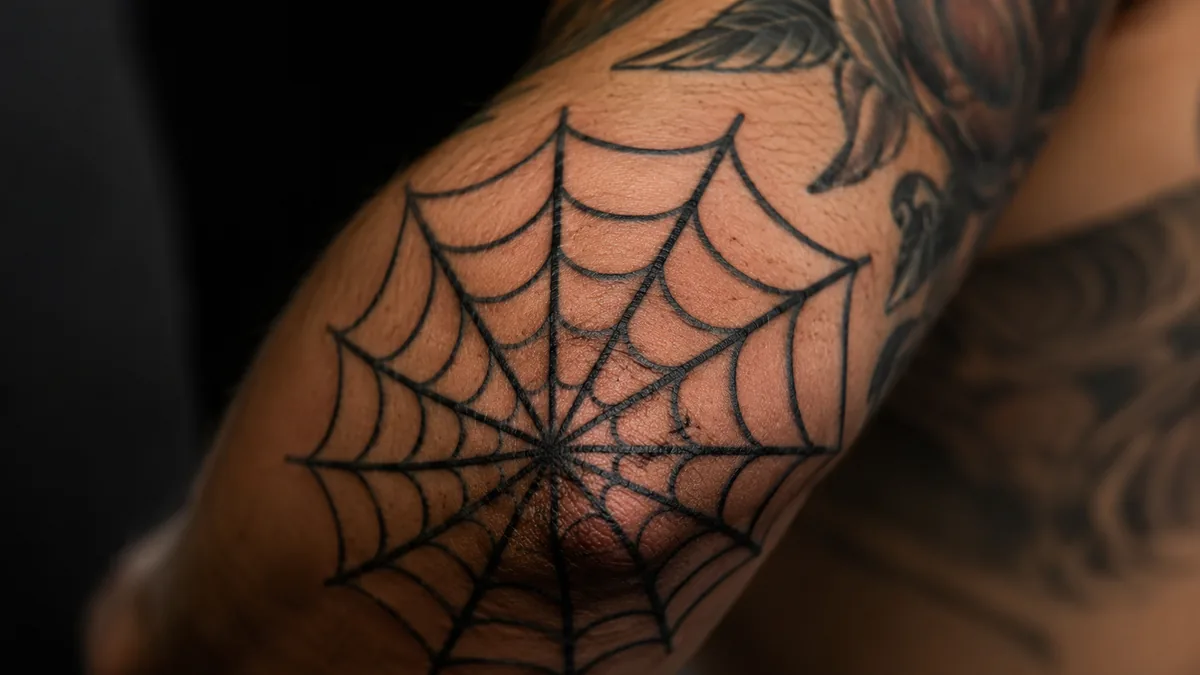
The most historically grounded meaning of the spiderweb tattoo comes from prison culture, specifically American and European carceral tattooing that goes back at least to the mid-20th century. The elbow spiderweb was one of the clearest signals: it meant the wearer had done time. The elbow sits on the joint, and the idea was that you’d rested your elbows on a prison table long enough to grow a web. Time served, visually encoded.
Some readings went further, suggesting each ring of the web represented a year inside, though that wasn’t universal. White supremacist groups adopted the elbow web with specific racist meaning in certain prison systems, which is a real and documented history. That association has faded significantly outside those circles, but it’s worth knowing if you’re a client asking about cultural context. Most people wearing them today have no connection to that history at all.
Street-Level and Gang Associations
Outside prison walls, the spiderweb tattoo picked up additional street-level meaning in the 1970s through 1990s, particularly in the US. In some gang contexts, a web on the neck or throat was read as a sign that the wearer had committed violence, specifically that they had caught someone in their web. That meaning was never universal and varied heavily by region and crew.
By the 2000s and especially now, that association has diluted substantially. Most people in a tattoo studio today getting a spiderweb have zero gang connection. The design has moved far enough into mainstream tattoo culture that the street readings rarely apply unless there’s additional context. Placement and execution matter more than the symbol alone at this point.
Personal Reinvention and Breaking Free
Here’s where it gets interesting. A lot of people get the spiderweb not because they’re still trapped but because they got out. The web becomes a marker of something they survived, a relationship, an addiction, a job, a city, a version of themselves. Wearing the thing that once held you down is a way of owning it instead of hiding from it. That flip in meaning is common and totally legitimate.
Some clients add a spider to the design, and placement matters there. A spider sitting at the center of the web reads differently than one crawling away from it. The first suggests control or patience, still in the trap or running it. The second suggests movement, escape, forward momentum. If you’re designing one to mark personal growth, talk to your artist about where that spider lands.
Design Variations and Styles
Traditional bold-line spiderwebs are the most readable from a distance and they hold up the best over time. Thick black outlines, clean geometry, solid black fills in alternating sections. They read crispy and stay that way for decades in low-wear zones. Neo-traditional versions add color, shading, and decorative elements like roses or skulls woven into the web. Those look great fresh and photograph well, but the fine details need touching up more often.
Fine line spiderwebs are popular right now, especially in black and grey with subtle whip shading to give the web depth. They look delicate and dimensional. The trade-off is that fine lines in high-wear areas like hands, elbows, and necks can spread over time and lose crispness. A skilled artist will compensate with slightly heavier lines than you’d expect so the piece heals clean and stays legible as the skin ages.
Placement, Pain, and Long-Term Aging
The elbow is the classic placement and still the most common request. It’s a high-wear, creasing zone, which makes fine detail a bad choice there. Bold traditional geometry heals solid and stays readable on an elbow for life. The knee is similar, same logic applies. Neck webs, especially on the side or throat, are visible, spicy to sit through, and age reasonably well since neck skin is relatively stable.
Chest placements are increasingly popular because they offer a large flat canvas for elaborate webs with added elements. The chest heals nicely, sees less sun than forearms, and doesn’t crease the way joints do. Hands and fingers are the riskiest placement for longevity. Saturated black holds better than fine line on hands, but any hand tattoo needs touch-ups. Be honest with clients about that upfront so they’re not surprised when the lines soften after a year.
Color vs. Black and Grey
Most spiderweb tattoos are done in straight black. The design is geometric and graphic by nature, and black maximizes that contrast. A solid black-filled web with clean open sections reads from across the room, ages predictably, and doesn’t require complicated color theory to execute well. Black and grey versions with light whip shading add dimension and make the web look three-dimensional against the skin.
Color webs exist and they can look great when the color serves a purpose. Purple, red, or green webs with a colored spider or background element give the piece a specific mood or tie it to another tattoo in a sleeve. The risk with color is that pale yellows and lighter tones fade faster than black and need refreshing. If a client wants color, push toward saturated mid-range tones and avoid anything near white or pale pastel unless they’re committed to maintenance.
Making It Personal
Spiderweb tattoos attract a wide range of people now. You get people with genuine personal history connected to the imagery, people drawn to the aesthetics of bold geometric blackwork, and people who just love the classic Americana tattoo catalog. All of those are valid starting points. The symbol is versatile enough that the same design can carry completely different weight for different wearers.
To make it personal, think about what the web means to you specifically and let that drive the design choices. Adding a significant date in the web rings, incorporating an animal other than a spider, or integrating the web into a larger sleeve concept can shift it from a flash pick to something that actually belongs to you. Talk to your artist about what you want it to say. A good artist will build the design around that instead of pulling a template off the wall.