
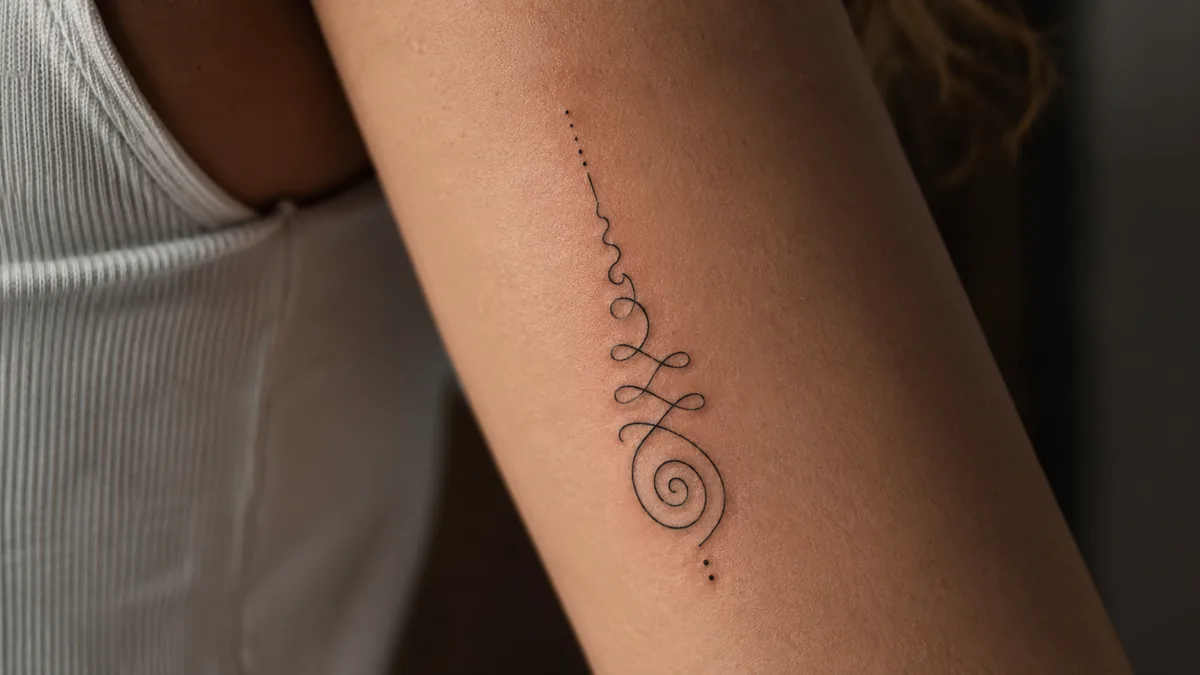
The unalome is one of those tattoos that actually means something. It’s not just a pretty line drawing. The symbol represents the path to enlightenment: the messy, looping, backtracking journey of being human, and the moment it finally straightens out.
the unalome shows that struggle isn’t a detour. It’s the whole point. That resonates with a lot of people, which is why this symbol has gone from temple walls to tattoo skin and stayed there.
What the Unalome Actually Means
The unalome is a Buddhist and Hindu symbol. The spiral at the base represents the mind at the start of life: unfocused, confused, spinning in circles. The line rises up through twists and loops, showing the trials and missteps of the human experience. Then it straightens. That straight stretch near the top is spiritual awakening, clarity, moving with purpose.
The dots or small marks at the top, sometimes a lotus flower or a simple series of dots, symbolize the moment the soul dissolves into the universe. Nirvana in Buddhist terms. Liberation, or moksha, in Hindu tradition. Exact imagery varies, but that arc from chaos to peace is the constant.
Cultural and Historical Background
The chaos at the base is not a flaw, it is the whole point.
The unalome comes from Theravada Buddhist tradition, originating in Southeast Asia, particularly Thailand, Cambodia, and Myanmar. In Thailand it appears in Sak Yant tattooing, a sacred practice performed by monks and trained masters using bamboo or steel rods. These tattoos are believed to carry protective and spiritual power. The unalome within Sak Yant work is not decorative. It’s a deliberate spiritual marking.
Hindu iconography also uses the unalome, associating the spiral with the third eye of Shiva. The meaning stays similar: rising consciousness, the path from ignorance to divine understanding. Western tattoo culture adopted the symbol heavily in the 2010s. If you’re getting it purely for aesthetics, that’s your call. But knowing the roots gives the piece real weight.
Design Variations You’ll See in the Shop
The classic version is just the symbol alone: spiral, rising line, loops, straight finish, dots. Clean and minimal. A lot of clients add a lotus flower at the top, which pairs well thematically since the lotus also represents rising through difficulty. Some designs extend into a full scene with leaves, moons, or ornamental linework framing the central symbol.
You can run it vertical or horizontal, though vertical is the traditional orientation. Feminine designs often incorporate fine line florals or mandalas. Masculine takes tend to be bolder, with heavier line weight and geometric framing. Geometric unalomes with sharp angles and precision dotwork are popular right now and hold well in black and grey. The symbol is versatile enough to carry a range of aesthetics without losing its meaning.
Fine Line vs. Bold: How Style Affects Longevity
Fine line unalomes look incredible fresh off the machine. Crispy, delicate, reads like a drawing on skin. The problem is that fine line work, especially on high-wear zones, can blur, spread, or fade significantly within five to eight years. The spiral and the tight loops at the base are the first parts to lose definition. If your artist isn’t placing needles with serious precision, blowout is a real risk.
Bold line unalomes age dramatically better. The saying holds: bold will hold. A design with 1.5 to 2mm line weight on a low-wear zone can stay legible for fifteen-plus years with decent aftercare and sunscreen habits. Black and grey with whip-shaded fill in the lotus or background elements gives the tattoo contrast that reads from across the room and doesn’t disappear as the skin matures.
Best Placements on the Body
The spine is the most requested placement for unalomes, and it makes sense visually. The vertical line of the symbol echoes the spine itself, and the meaning maps well. It runs long, it’s symmetrical, and it’s a strong statement piece. The ribcage and sternum are close seconds. Forearm placements, both inner and outer, stay visible and tend to heal nice on most skin types.
Stay away from high-friction zones if you want the fine line version to last: inner wrist, side of the hand, behind the knee, or the foot. Those areas flex constantly and chew through delicate work fast. Ankle and foot placements are spicy for pain and notorious for fading. The shoulder blade and upper arm are solid mid-tier choices, low wear, usually consistent skin texture, and easy for the artist to work on flat.
Color vs. Black and Grey
Most unalomes are done in solid black or black and grey, and that tradition makes sense given the symbol’s origins in ink-heavy Sak Yant work. Black saturates well in this style, and the simplicity of the linework doesn’t compete with itself. A fully black unalome with clean, confident lines is timeless. It doesn’t date the way certain color trends do.
Watercolor-style unalomes with muted purples, blues, and pinks have been popular for years, especially when paired with a lotus. The watercolor wash can look stunning fresh but fades unevenly and tends to look patchy within a decade. If you want color, talk through longevity with your artist. A few saturated color accents in specific spots, rather than a full watercolor flood, hold better long term and keep the piece looking intentional.
Who Gets This Tattoo and How to Make It Personal
People who get unalomes usually have a personal story that fits the symbol. Recovery, grief, mental health struggles, coming out of a rough chapter. The tattoo works because the meaning is specific enough to resonate and open enough to carry individual experience. When someone tells you what their unalome represents to them, it usually lands without explanation needed.
To make it yours, you don’t need to overload the design. A meaningful date worked into the dotwork at the top, a specific flower that holds personal significance replacing the generic lotus, or your artist’s custom linework style applied to the form, that’s enough. Talk to your artist about the story behind yours. A good tattooer will use that context to make choices that feel built for you, not pulled off a flash sheet.









