
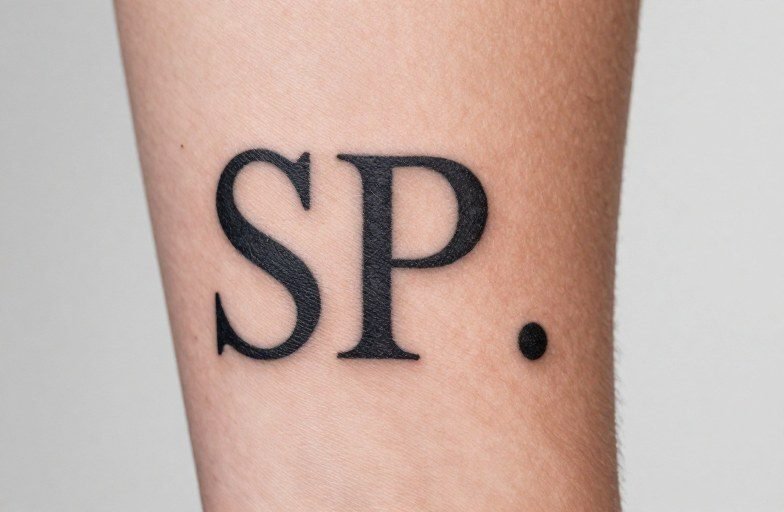
SPQR stands for Senātus Populusque Rōmānus, “The Senate and People of Rome.” On skin, it typically signals Roman identity, civic pride, or resistance against oppression, though modern wearers often layer personal meanings onto the historical acronym. The four letters have outlasted the empire itself, showing up on everything from ancient water pipes to contemporary tattoo flash.
Religious & Spiritual Angles
Romans didn’t separate church and state, so SPQR carried implicit spiritual weight. The phrase invoked both governing bodies and divine favor, since Roman religion centered on proper ritual and public duty rather than private belief.
State Religion and Public Ritual
SPQR appeared on official dedications to gods, marking offerings paid for by the collective will of Senate and people. For some modern wearers, this creates a connection to civic paganism or reconstructed Roman practice, treating the tattoo as a mark of participation in something larger than oneself, not necessarily worship of specific deities.
Christian Recontextualization
Early Christians in Rome faced persecution under that same SPQR authority. Some believers now use the letters ironically or redemptively, acknowledging the tension between imperial power and subjugated faith. The acronym becomes a historical anchor for conversations about state violence, religious minority status, and survival.
Personal & Modern Meanings
Contemporary SPQR tattoos rarely reference ancient governance directly. Instead, wearers adapt the letters to personal codes and subcultural signals.
Stoicism and Self-Discipline
The Roman revival in self-help circles, Marcus Aurelius on Instagram, Ryan Holiday’s books, has pushed SPQR toward Stoic branding. The tattoo functions as a visual shorthand for emotional control, endurance, and rationality. This usage sometimes annoys classical historians, since Stoicism predates and outlasts the specific SPQR formulation, but the association persists in tattoo culture regardless.
- “Small Steps” codes: Some wearers claim SPQR as a personal acronym, “Strength, Perseverance, Quality, Resilience” or similar backronyms. This is common with military and fitness communities.
- Pop culture hooks: The Heroes of Olympus series by Rick Riordan stamped SPQR onto demigod characters, creating a generation of readers who associate the letters with hidden identity and magical lineage.
- Political positioning: Far-right groups have occasionally adopted Roman imagery, but SPQR specifically remains more broadly distributed across the political spectrum, partly because its meaning is diffuse enough to resist singular ownership.
Marking Belonging
Some friend groups or units get matching SPQR pieces as membership markers, similar to how military platoons share insignia. The historical weight gives the gesture gravity without requiring invented symbolism.
Mythology & Folklore
Roman mythology and SPQR intersect through origin stories and founding legends that still circulate in tattoo imagery.
Romulus, Remus, and the She-Wolf
The famous twins and their lupine nurse appear alongside SPQR in composite designs, linking the governmental acronym to Rome’s mythic beginnings. This pairing works visually because both elements read instantly as “Roman” even to viewers with minimal historical knowledge. The wolf adds narrative drama; the letters add institutional weight.
Legion Folklore and the Mark of Service
Historical legionaries were sometimes tattooed or branded with ownership marks, though direct evidence for SPQR specifically as a military tattoo is thin. The idea persists in folklore: that Roman soldiers carried the republic’s initials on their skin as permanent identification. Modern military veterans sometimes adopt SPQR in conscious parallel to this tradition, whether or not the historical practice occurred exactly as imagined.
Design Tips & Pairings
SPQR presents specific design challenges because four capital letters, even in classic Roman square capitals, can read as bland or corporate without visual intervention.
Lettering Choices
Trajan-inspired serif letterforms feel most historically grounded, but require a tattooer with steady line confidence. The straight verticals and subtle serifs of Roman capitals show every wobble. Sans-serif or blackletter treatments modernize the piece but sacrifice the immediate historical read. Consider:
- Single-needle or fine line: Works for small pieces, but the letters must stay bold enough to hold. Hairline SPQR often ages into indistinct scratches.
- Heavy traditional weight: Thicker lines survive better but can feel more aggressive than intended.
- Incised or carved effects: Mimicking stone inscription adds texture and references the original medium of SPQR marks.
Common Companion Imagery
Eagles, laurel wreaths, gladii, and legionary helmets frame SPQR effectively. The eagle (aquila) specifically connects to military standards and carries visual recognition even separate from the text. Avoid overcrowding, four letters plus one strong image usually outperforms cluttered historical dioramas.
Color versus black and grey matters here. SPQR on stone was monochrome; color introduces modern distance from the source material. That distance isn’t bad, but it should be intentional.
How It Ages on Skin
Lettering tattoos age predictably based on line weight, placement, and sun exposure. SPQR’s compactness helps longevity.
The letters contain no closed loops that trap ink unevenly (unlike B, O, D, P), so the forms stay readable longer. The Q’s tail is the vulnerable point, thin extensions tend to blur first. A well-executed Q with a solid, slightly thickened tail ages better than a delicate flourish.
On high-movement areas like wrists or inner biceps, the straight verticals of S and P may spread slightly where skin flexes repeatedly. The upper chest, outer forearm, and calf offer more stable surfaces. Black ink holds its value; greywash backgrounds behind the letters tend to fade unevenly and require touchup.
Best Placements
SPQR suits locations that echo its historical functions: visible marks of identity, readable at conversational distance.
Forearm and Wrist
The outer forearm carries the Roman association of the gladius arm, the sword hand. Wrist placement reads as personal reminder or public declaration depending on orientation. Inner wrist faces the wearer; outer wrist faces the world. Both work, but the choice signals intent.
Behind the Ear and Collarbone
Smaller SPQR pieces fit here for those who want the reference without the weight of full historical costume. These placements read more as jewelry or whisper than billboard. The letters must stay simple, serif detail gets lost at small scale.
Thigh and Rib
Larger canvas allows for composite designs: SPQR with eagle, with laurel, with architectural elements. The thigh’s stability supports fine detail. The rib’s movement challenges straight lines but offers private placement for personal meaning.
What to Remember
SPQR carries genuine historical weight, but that weight is distributed, civic pride, military folklore, Stoic philosophy, young adult fiction, political signaling. No single meaning dominates. If you’re considering this tattoo, know which thread you’re pulling: the specific Roman context, the modern subcultural reference, or the personal acronym you’ve constructed.
The letters work best with confident, clean execution. Their power comes from recognition, not ornament. A sloppy SPQR looks like a failed logo; a crisp one reads as intentional identity. Choose your tattooer based on their lettering portfolio specifically, not just their general skill. Roman capitals reward precision and punish approximation.
Finally, the acronym’s very commonness in ancient Rome, stamped on everything from aqueducts to trash bins, means it resists preciousness. That’s either its strength or its weakness, depending on what you want your skin to say.
Frequently Asked Questions
Does SPQR always mean the same thing in every tattoo?
No. While the Latin expansion stays constant, wearers layer personal meanings, Stoic philosophy, military identity, fandom reference, or invented acronyms. Context and accompanying imagery usually reveal the specific intent.
Is there historical evidence that Romans actually tattooed SPQR on soldiers?
Direct evidence for SPQR specifically as a military tattoo is limited. Romans did mark certain individuals, slaves, criminals, sometimes soldiers, but the exact acronym’s use on skin is more folklore than established practice.
What’s the best font style for an SPQR tattoo?
Trajan-style Roman square capitals carry the strongest historical resonance, but require clean execution. Sans-serif modernizes the piece. Avoid overly delicate serifs that won’t hold up over years.
Can SPQR be misinterpreted as a political statement?
Occasionally, since Roman imagery has been adopted by various political movements. However, SPQR’s meaning is diffuse enough that most viewers read it as general historical reference rather than specific ideology. Placement and accompanying imagery clarify intent.
Related Tattoo Meanings
- Stag Skull Tattoo Meaning: Symbolism, Design Aging
- Stargazer Lily Tattoo Meaning: Symbolism Style Guide
- Stars Behind Ear Tattoo Meaning: Symbolism Style Guide
- Explore more









