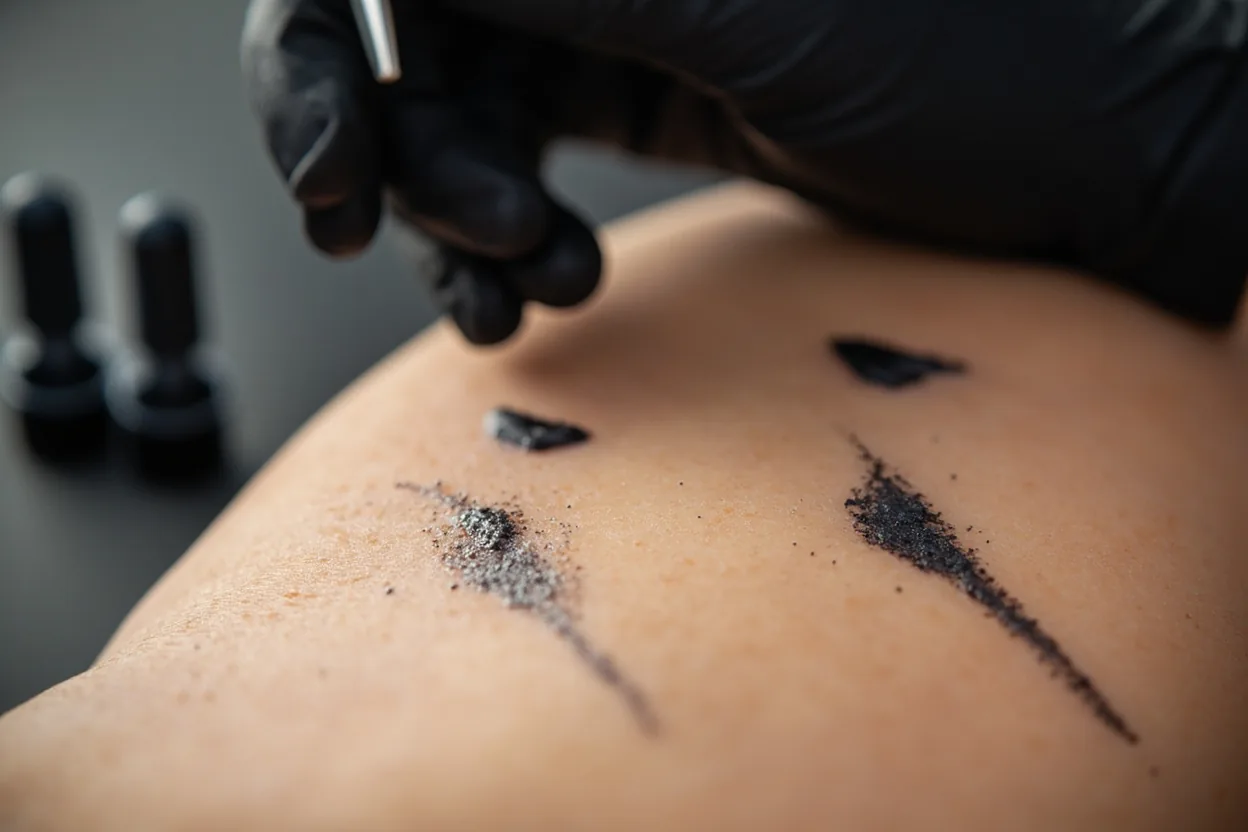
Tattoo blowout is one of the problems people fear most because it can make clean lines look bruised, shadowed, or fuzzy outside the intended design.
Quick answer: Tattoo blowout can look like ink spreading, shadowing, or blurring outside the tattoo lines. It may happen when ink is deposited too deep or the skin/placement is difficult. Options may include waiting, camouflage, cover-up, or laser consultation.
Blowout signs
Do not diagnose every cloudy tattoo as blowout during healing.
| Option | Best use | Keep in mind |
|---|---|---|
| Blue-gray shadow | Possible ink spread | Can show near line edges |
| Fuzzy outline | Line no longer crisp | Wait until healed to judge |
| Localized blur | Specific area affected | Placement may contribute |
| Normal peeling haze | Healing stage | Usually settles |
| Old line spread | Long-term aging | Not always blowout |
A blowout shows up as a blurry, bruised-looking halo around the linework, usually within the first few days of healing. You’ll see it most clearly on fine-line tattoos and single-needle work where the lines are thin enough that any ink spread is immediately obvious. It looks like someone smudged a Sharpie marker outward from the edge of the design.
Common spots are the inner wrist, inner elbow, finger sides, and anywhere the skin is loose or thin. The ink doesn’t hold its lane, so instead of a crispy clean edge you get a soft, blown-out border. It won’t get better on its own. What you see at week two is what you’ve got permanently.
What makes this work on real skin
A blurry tattoo is not a style choice, it is a depth problem.
Some placements are harder to tattoo cleanly because the skin is thin, stretchy, or mobile. Technique still matters, but placement can raise the risk.
A blowout should be evaluated after the tattoo heals unless there are signs of infection or severe reaction.
Skin has layers, and the needle has to deposit ink in the dermis, not the epidermis above it or the subcutaneous fat below it. When the artist goes too deep, ink bleeds laterally through the fatty tissue and spreads beyond the intended line. Thin-skinned areas like the ditch of the elbow or the inner forearm have almost no buffer zone between dermis and fat.
Speed, needle angle, and machine voltage all play into this. A needle moving too slowly at high voltage punches in too much ink per pass. A needle angled too steep drives deeper than intended. That’s why the same design can look perfectly solid on one client and blow out on another depending on skin thickness and artist technique.
Before you book or apply it
If you suspect blowout, document the tattoo in clear light and ask the artist or another experienced professional for an opinion.
- Wait for normal healing to finish before judging blur.
- Do not keep tattooing irritated skin.
- Ask if camouflage or cover-up is realistic.
- Consider a laser consultation for serious cases.
Check your artist’s healed work, not just fresh photos. Fresh tattoos always look sharp. You want to see what their lines look like at six weeks on a real client. Ask specifically about their experience tattooing the placement you want, especially if it’s a high-wear or thin-skin zone like fingers, ribs, or inner arms.
If you’re considering a fine-line or single-needle piece, talk to your artist about line weight. Hairline strokes on loose skin or bony areas are a setup for blowout and fast fading. A good artist will tell you honestly if your placement is risky and suggest a slightly bolder approach that will still heal crisp and read cleanly years down the road.
Mistakes to avoid
Do not aggressively scrub, pick, or self-treat the area.
Do not rush into a cover-up before the tattoo is fully healed and settled.
Safety source note: This guide keeps safety advice conservative and points readers to primary public-health or dermatology sources.
Don’t stretch the skin yourself during the tattoo without your artist’s instruction. Some clients pull their own skin tight thinking they’re helping, but if they do it wrong it distorts the angle the needle enters and can drive ink too deep. Let the artist manage skin tension. That’s part of what you’re paying for.
After the tattoo heals, don’t let it live in the sun without SPF. UV breaks down ink faster in already-stressed skin, and a tattoo that’s borderline on blowout will look significantly worse after one summer of unprotected beach days. Keep it out of heavy friction zones while healing too. A waistband rubbing across a fresh hip piece for eight hours a day will push ink around before it’s locked in.