When someone slides into my chair and asks for a traditional gypsy, I know exactly what they mean. They want that bold, iconic face staring back from their skin, usually a woman with a kerchief, gold coins, maybe a rose or dagger. It’s one of the most enduring images in American traditional tattooing, and it’s been done a million ways by a million artists. But done right, it still hits hard. The gypsy design sits at the crossroads of old-school flash culture and something more personal: luck, travel, freedom, the road. In this guide, I’ll break down what makes this style tick, how it ages, where it works best on the body, and what to look for when you’re picking an artist to put this classic on you forever.
Origins & History
The traditional gypsy tattoo didn’t come from actual Romani culture. Let’s be straight about that. It grew out of American tattooing in the early-to-mid 1900s, when artists like Sailor Jerry, Bert Grimm, and later Ed Hardy were cranking out flash sheets for sailors, soldiers, and carnival workers. The imagery borrowed from romanticized “gypsy” stereotypes, fortune tellers, wanderers, exotic women, which were everywhere in popular culture back then. I’ve got a 1940s flash sheet pinned up in my station that’s basically the DNA of every gypsy tattoo I’ve done: kerchief, hoop earrings, heavy-lidded eyes, maybe a crystal ball.
From Sailor Jerry to Street Shops
Sailor Jerry’s influence looms huge here. His bold lines, limited color palette, and graphic simplicity made the gypsy readable from across a bar. When I tattoo these, I still reference his compositional rules: the face dominates, the accessories frame it, nothing competes for attention. Later artists like Don Ed Hardy pushed the decorative elements, more flowers, more jewelry, more pattern in the clothing. But the bones stayed the same. Walk into any street shop today and you’ll find a gypsy on the wall. It’s that universal.
The Luck and Travel Connection
Sailors got these for protection and safe return. The gypsy was supposed to “watch over” you, almost like a portrait of a guardian spirit. I’ve had clients tell me their grandfather had one from Korea in ’52, or that they want one because they “live on the road.” The meaning got attached after the image existed, which is common in tattooing. We don’t always know why something sticks, but it sticks.
Key Characteristics & Motifs
The traditional gypsy has a language you learn to read. Break it and it stops being traditional. Here are the elements I see and use constantly:
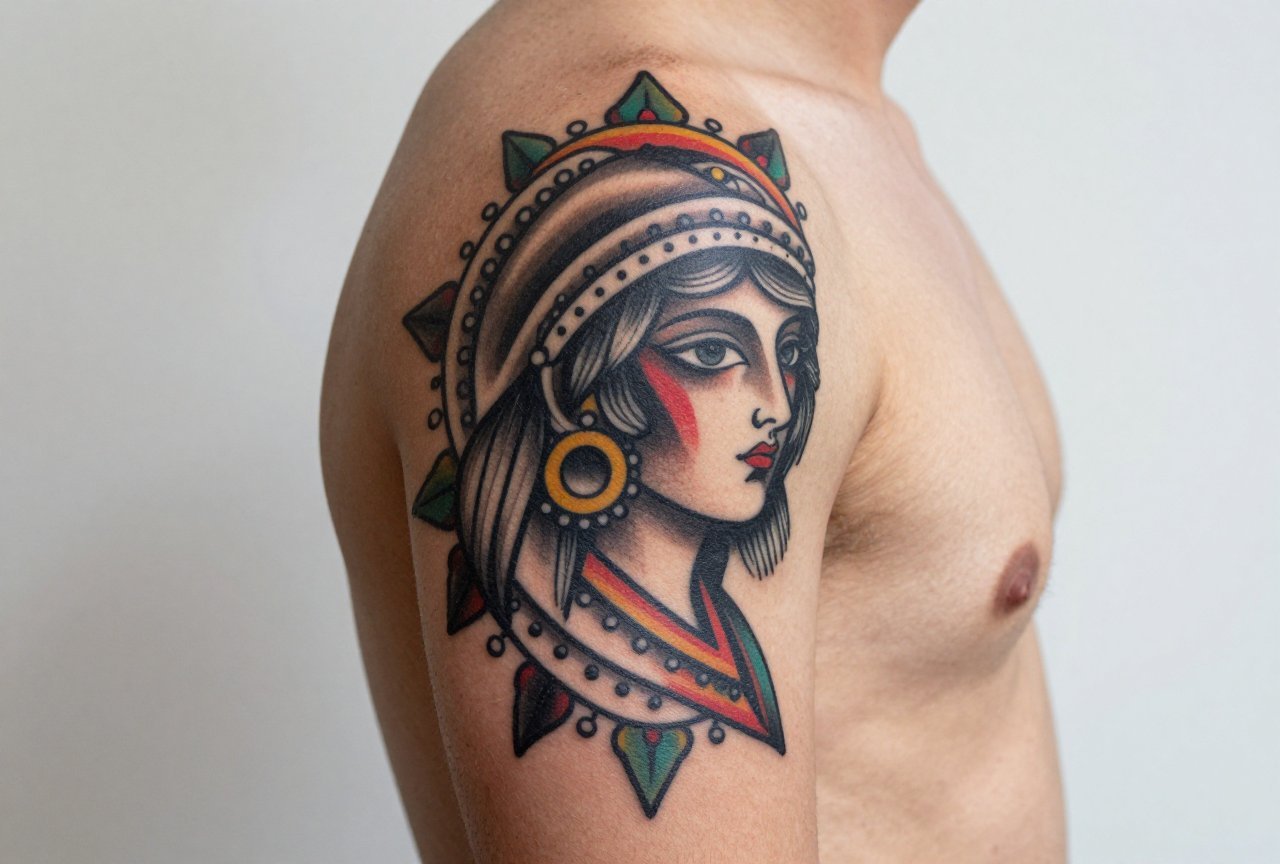
- The face: Usually three-quarter view, heavy eyes, strong brows, full lips. Not realistic, stylized, almost mask-like. The expression is knowing, slightly melancholy.
- The kerchief or headwrap: Tied at the nape or under the chin, often patterned with dots or simple flowers. This frames the face and gives you space to work with color.
- Gold jewelry: Hoop earrings, coins, necklaces. These read as yellow ink and bright highlights. They catch light in a tattoo even years later.
- Accessories: Roses, daggers, crystal balls, playing cards, candles. Each adds meaning, love, danger, fate, risk.
- The banner: Often across the bottom or top with a name, date, or phrase. “Mom” was classic; now I see anything from “Wanderlust” to a child’s name.
Line weight matters enormously. I use a 7 or 9 round liner for the main face outline, drop to a 5 for details, and whip-shade the cheeks and forehead with a magnum. The best gypsies have that carved, woodcut quality. Soft shading kills them. I’ve had to fix pieces where someone tried to make it “pretty” with smooth gradients and lost all the punch.
Color vs Black and Grey
This is where clients freeze up in my chair. “Should I go traditional color or black and grey?” Both work, but they age differently and hit different emotionally.
Traditional Color
The classic palette: red kerchief, green or blue headwrap, yellow gold, rosy cheeks, black hair. It’s loud, proud, and reads from distance. Color saturation is key, I pack that red and green solid because nothing looks worse than a washed-out gypsy at year five. The downside? Color fades. Reds turn pink, greens get muddy. You need touch-ups. I tell clients: budget for a refresh in 7-10 years if you want it singing.
Black and Grey
More subtle, more timeless in some ways. You rely on strong black lines and smooth grey washes for depth. The kerchief becomes a study in pattern and tone rather than color pop. These age gracefully, less fading drama, but they can look flat if the artist doesn’t understand contrast. I’ve done black and grey gypsies that looked like old photographs, and others that looked like unfinished sketches. The difference is in the darks. You need your blacks black.
Best Placements
Traditional gypsy tattoos need room to breathe. The face is the focal point, and faces compress badly on small or curved spots. Here’s where I’ve put them and how they work:
- Upper arm/shoulder: Classic. The cylinder shape fits the portrait orientation. Easy to show, easy to hide. Heals well, minimal friction.
- Forearm: Popular now, but watch the wrist bone. The face can distort when you flex. I place the eyes above the muscle belly, not over the tendon.
- Thigh: Huge canvas. You can go big, add full sleeves of roses, really build a scene. Pain is manageable. One of my favorite spots for a detailed piece.
- Chest: Sternum or pec. The gypsy “watches” outward. I’ve done these for guys who want that guardian feel. Sternum hurts, no muscle padding, just bone and thin skin.
- Calf: Underrated. Good flat surface, heals clean, shows well with shorts. I’ve had repeat clients who started here and moved to bigger pieces.
Hands, neck, and feet? I talk people out of those for this design. Too small, too much distortion, too fast fading. The gypsy needs scale to do its job.
Who It Suits
Honestly? Anyone who connects with it. I’ve tattooed gypsies on 22-year-old women and 60-year-old bikers. The image carries different weight: feminine power, travel spirit, luck, independence, memorial. One of my regulars got one after his divorce, “she’s looking forward, not back,” he said. Another client, a truck driver, wanted the crystal ball version because “someone’s gotta see where I’m going.”
Style-wise, it fits people with other traditional work. It doesn’t play nice with photorealism or fine-line aesthetics. If your arm is all black and grey portraits, a screaming color gypsy will look like a visitor. But if you’ve got anchors, swallows, panthers, she belongs.
Modern Variations
The traditional gypsy isn’t frozen. I’ve seen and done variations that push the format while keeping the bones:
- Neo-traditional: More realistic shading, broader color range, ornate decorative backgrounds. The face might have actual anatomy, not the mask-like classic. Still bold lines, still readable.
- Reversed/male gypsy: Less common, but I’ve done a few. Swaps the gender, keeps the accessories. Reads differently, more fortune teller, less romantic ideal.
- Skull gypsy: The face revealed as a skull, or morphing into one. Memento mori twist. Popular with clients who want the traditional look with darker meaning.
- Pet gypsies: Yes, really. Client’s dog in a kerchief with a crystal ball. Silly, but done with traditional technique. We laugh, but I pack those lines same as always.
The key is knowing what you’re changing and why. I’ve watched artists lose the whole effect by softening the eyes or adding too much detail. The power is in the simplicity.
Choosing an Artist
Not every traditional tattooer does good gypsies. Look at their portfolio specifically for faces. How do the eyes sit? Are they level? Do the features distort when the body moves? I always show clients my healed photos, not just fresh ones. The fresh piece is a lie, swollen, saturated, perfect. Year three is the truth.
Ask about their line setup. If they can’t tell you what needle grouping they prefer for the main outline, that’s a red flag. This design demands confidence. You can’t hide a shaky line in a gypsy face. I’ve redrawn stencils three times to get the eyes right. Good artists do that. Bad ones freehand it and hope.
Shop culture matters too. The best traditional work still comes from street shops where artists do walk-ins daily, not appointment-only studios where they specialize in one aesthetic. You want someone who has done fifty of these, not five.
Final Thoughts
The traditional gypsy tattoo has survived because it works. Bold, readable, packed with meaning, adaptable without losing its core. I’ve been tattooing fifteen years and I still get excited when someone picks this from my flash. It’s a chance to connect with the history of the craft, to put something on skin that will hold up when trends pass. If you’re considering one, do your homework on the artist, think hard about placement and color, and come in knowing what you want it to say. The gypsy’s already watching. Make sure she’s watching over something worth her time.
Frequently Asked Questions
How long does a traditional gypsy tattoo take to heal?
Most of my clients are through the rough part in two weeks, with full settling around four to six. Keep it clean, don’t pick at the scabs, and stay out of sun and pools until it’s done flaking. The face area tends to heal slower if it’s on a spot that moves a lot, like the forearm or chest.
Can I add a banner with text later, or should it be in the original design?
You can absolutely add one later, but I always recommend planning it from the start. The composition changes when you drop a banner in, negative space gets eaten up, and the balance shifts. If you think you might want text, tell me during the stencil phase so I don’t place an accessory right where the banner needs to go.
Why do some gypsy tattoos look blurry after a few years?
Usually it’s line blowout from too deep or too slow needle work, or the artist used a single needle for details that should’ve been bolder. Fine lines in the eyes or jewelry spread under skin over time. I build my gypsies with heavier lines in the features that matter most, so they stay crisp.
Is it offensive to get a gypsy tattoo if I’m not Romani?
I get this question more now than I used to. The traditional tattoo image is a romanticized stereotype, not an accurate representation of Romani people. Most clients I know aren’t claiming that identity, they’re connecting to the tattoo-history meaning of luck, travel, and freedom. But it’s worth knowing the distinction, and if you’re unsure, talk to your artist about adjusting the imagery to be more about the fortune-teller or wanderer archetype generally.
Related Style Guides
- Artistic Tattoo Designs That Actually Work on Skin
- Belly Tattoo Ideas That Actually Work
- Compass Tattoo Design Ideas Shop Wisdom
- Explore more