
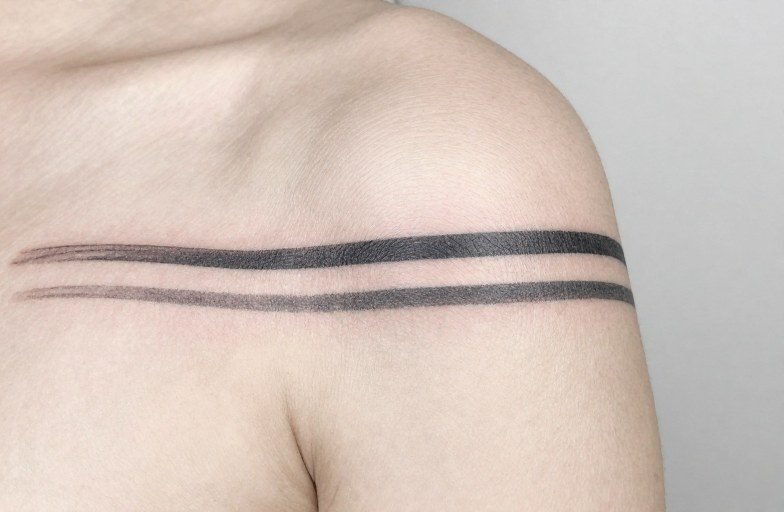
Two parallel stripes tattooed on the body most commonly represent equality, balance, or duality, two forces running alongside each other without hierarchy. The meaning shifts based on placement, color, thickness, and personal context. For some, it marks a relationship or loss; for others, it signals membership in a specific group or movement.
Symbolism & History
Equality and Solidarity Movements
Parallel stripes have long served as visual shorthand for “equal.” The equals sign (=) in mathematics translates directly to body art for many who wear this tattoo as a statement of LGBTQ+ pride, racial justice, or economic equality. Two bold, evenly weighted lines reject the idea that one element dominates another. The design strips away ornament to focus purely on the concept of balance.
Some trace the tattooed equals-sign variation to activist movements of the early 2010s, though parallel lines as symbolic marks appear across many cultures and eras. Sailors historically wore twin stripes on their forearms to indicate rank or specific shipboard roles. Prison tattooing in various regions has used paired lines to denote time served, gang affiliation, or specific convictions, though these meanings vary enormously by location and era, and carrying an unintended symbol remains a real risk.
Duality and Personal Balance
Beyond political readings, two stripes frequently represent internal dualities: mind and body, past and future, logic and emotion. The parallel structure suggests these forces coexist rather than conflict. Thin, delicate lines tend to read as introspective; thick, heavy bands project outward strength. The spacing matters too, tight parallel lines feel unified, while wider gaps create tension or dialogue between the elements.
Common Variations & Styles
The basic two-stripe concept branches into several recognizable forms, each carrying distinct visual weight:
- Minimalist black lines: Single-needle or fine-line work, usually 1-3mm thick. Ages cleanly but may blur slightly over decades as the ink spreads in the dermis. Best for subtle placement on wrists, fingers, or behind ears.
- Thick traditional bands: 5-10mm solid black stripes, often wrapped around a limb like an armband. These hold color longer and resist fading better than thin lines. The bold weight references tribal tattoo traditions and military insignia.
- Color variations: Red and black paired stripes appear in some political contexts; rainbow gradients modify the equality symbol for LGBTQ+ pride. White ink on dark skin creates a scar-like effect that fades unpredictably, often yellowing or disappearing entirely within 2-5 years.
- Broken or fading stripes: One solid line paired with one dotted, fading, or incomplete line. This variation often signals loss, memory, or a relationship where one party has died or departed.
Line tattoos demand precision. A wobbly stripe reads immediately as amateur work, there’s no shading or detail to hide imperfections. Experienced artists map the line path with skin tension in mind, since body movement and muscle flexing can distort straight edges during healing.
Best Placements
High-Visibility Locations
The inner forearm remains the most common placement for two-stripe equality tattoos. The flat surface allows clean, straight lines, and the location invites conversation. Finger stripes, typically running parallel to the bone on the side or back of a digit, have surged in popularity but present specific challenges. Finger skin regenerates rapidly; ink here often drops out partially, requiring touch-ups every 1-3 years. The sides of fingers also blur faster than the backs due to constant friction and oil exposure.
Concealed or Personal Placements
Behind the ear, along the ribcage, or on the upper inner bicep offer privacy. These locations suit memorial or personally significant versions of the design. The ribcage placement demands particular care, breathing moves the skin constantly, making straight lines harder to execute and slightly more prone to distortion during healing. Artists typically stretch the skin taut between their fingers or use a second person to stabilize the area during application.
Armband placement (wrapping stripes around the bicep or forearm) creates a continuous loop. This reads differently than two isolated stripes, the circular form suggests cycles, eternity, or unbroken commitment rather than simple equality or duality.
Who Chooses This Tattoo / Personal Meanings
The stripped-down nature of two stripes attracts specific personality types and life circumstances. People selecting this design often prioritize clarity over ornament, message over decoration.
- Activists and allies: The equals-sign variation functions as permanent political speech, visible in professional settings where larger, more elaborate tattoos might draw scrutiny.
- Couples and close friends: Matching parallel stripes, sometimes with slight variations in spacing or thickness, mark relationships without the cliché of names or dates. The parallel structure literally represents two separate lines running the same course.
- Grief and memorial: One living person, one departed, this interpretation often uses fading techniques or places the stripes on a location associated with the lost person.
- Recovery and balance: People managing bipolar disorder, addiction recovery, or major life transitions sometimes choose two stripes to represent the ongoing work of maintaining equilibrium.
The tattoo’s meaning often remains deliberately private. Its simplicity allows the wearer to offer or withhold explanation as social situations demand, unlike a portrait or text tattoo that broadcasts specific information immediately.
Similar Symbols
Several related designs overlap with two-stripe symbolism, and confusion between them happens regularly:
- Three stripes: Often associated with specific athletic brands, military insignia, or the “three percent” movement in American politics. Adding a third line fundamentally changes the reading.
- Single stripe: Armband traditions in various cultures, or minimalist statements of singular focus. Reads as isolation rather than relationship or equality.
- Parallel chevrons/V-shapes: Military rank insignia, frequently tattooed by service members. The angled form introduces direction and hierarchy absent in horizontal stripes.
- Barcode: While visually similar (parallel lines), barcodes carry distinct critiques of consumerism, identity reduction, or dystopian themes. The specific numerical sequence below the lines usually personalizes the meaning.
Research matters before committing. A design that reads as LGBTQ+ pride in one context might scan as gang marking or military affiliation in another, depending on placement, color, and accompanying elements.
Final Thoughts
Two stripes succeed because they do so little. The design withholds easy interpretation, forcing viewers to ask or wonder. For the wearer, that ambiguity becomes control, meaning shared selectively, or held entirely private. The tattoo works across skin tones, body types, and ages because its power lies in concept rather than execution complexity.
Choose an artist with demonstrated line work in their portfolio. Ask to see healed photos of similar tattoos, not just fresh work. A straight line that looks perfect on day one can reveal slight wobbles once swelling subsides. The commitment is small in size but permanent in presence, exactly the balance the symbol itself represents.
Frequently Asked Questions
Do two stripes always mean equality or LGBTQ+ pride?
No. While the equals-sign variation commonly signals LGBTQ+ pride or general equality politics, two stripes carry multiple meanings including duality, memorial, military affiliation, or personal balance. Context, placement, and color determine the specific reading.
How well do fine-line two-stripe tattoos age?
Thin lines (under 2mm) tend to spread and blur over 10-15 years as ink particles migrate in the dermis. Thicker stripes hold their edges longer. Black ink ages more predictably than colored or white alternatives, which often fade or discolor faster.
Is there a risk of this tattoo being mistaken for a gang or prison symbol?
Yes, depending on placement and region. Parallel lines appear in various prison and gang tattoo systems with meanings that vary by location. Research local conventions, and consider placement carefully if you travel or work in environments where tattoo interpretation carries serious social consequences.
What’s the typical cost for a simple two-stripe tattoo?
Most shops charge a minimum fee ($80-$150 in US urban areas) even for small work, since setup and sterilization costs remain constant. Highly experienced artists specializing in precise line work may charge more. The simplicity of the design means execution quality matters more than artistic complexity.
Related Tattoo Meanings
- Vase Tattoo Meaning: Symbolism, Styles Placement
- Vinland Saga Arrow Tattoo Meaning: Purpose, Direction Will
- Whale Tail Tattoo Meaning: Symbolism, Styles Placement
- Explore more









