There’s a moment in every tattoo shop when someone walks in with a crumpled photo of their abuela’s prayer card, or a drawing they found in an old Lowrider Arte magazine, and asks for a Virgin Mary in that unmistakable Chicano style. I’ve been in that chair hundreds of times. The Virgin Mary drawing Chicano tattoo isn’t just religious imagery, it’s a visual language born in East LA barrios, refined in prison yards, and perfected in shops from San Diego to San Antonio. It’s about faith, sure, but also about family, struggle, pride, and the specific way light falls across a face rendered in smooth black and grey.
Origins & History
From Pachuco Culture to Prison Art
The roots run deep. In the 1940s and 50s, Pachuco culture already had its own visual swagger, zoot suits, caló slang, and a defiant elegance that refused assimilation. By the 1960s and 70s, that aesthetic moved onto skin. I tell clients all the time: Chicano tattooing wasn’t born in shops. It came up in prison yards where artists had to make do with guitar strings for needles and cigarette ash for ink. The Virgin Mary was everywhere because she was everywhere in the homes these men came from, above kitchen tables, on velvet paintings, in the quiet prayers of mothers who waited up nights.
What emerged was a style that borrowed from Catholic iconography, Mexican folk art, and the technical limitations of improvised tools. Single needle work demanded fine lines. No color meant mastering grey wash. The Virgin’s face had to carry emotion with nothing but black diluted to five or six values. That constraint became the signature.
Lowrider Arte & the Shop Era
By the 1980s, magazines like Lowrider and Teen Angels spread these drawings nationwide. Artists like Freddy Negrete and Jack Rudy took what started in yards and brought it into legitimate shops, still single needle, still black and grey, but now with professional equipment and sterile conditions. The Virgin Mary drawing Chicano tattoo became something you could get on the outside without the stigma, though the meaning never softened. In my chair, I’ve tattooed this image on grandmothers and gang members, on college kids reconnecting with roots and on old veterans who did real time.
- 1940s-50s: Pachuco culture establishes visual identity
- 1960s-70s: Prison art develops single needle black and grey technique
- 1980s: Lowrider magazines popularize the aesthetic
- 1990s-present: Fine line refinement in professional shops
Key Characteristics & Motifs
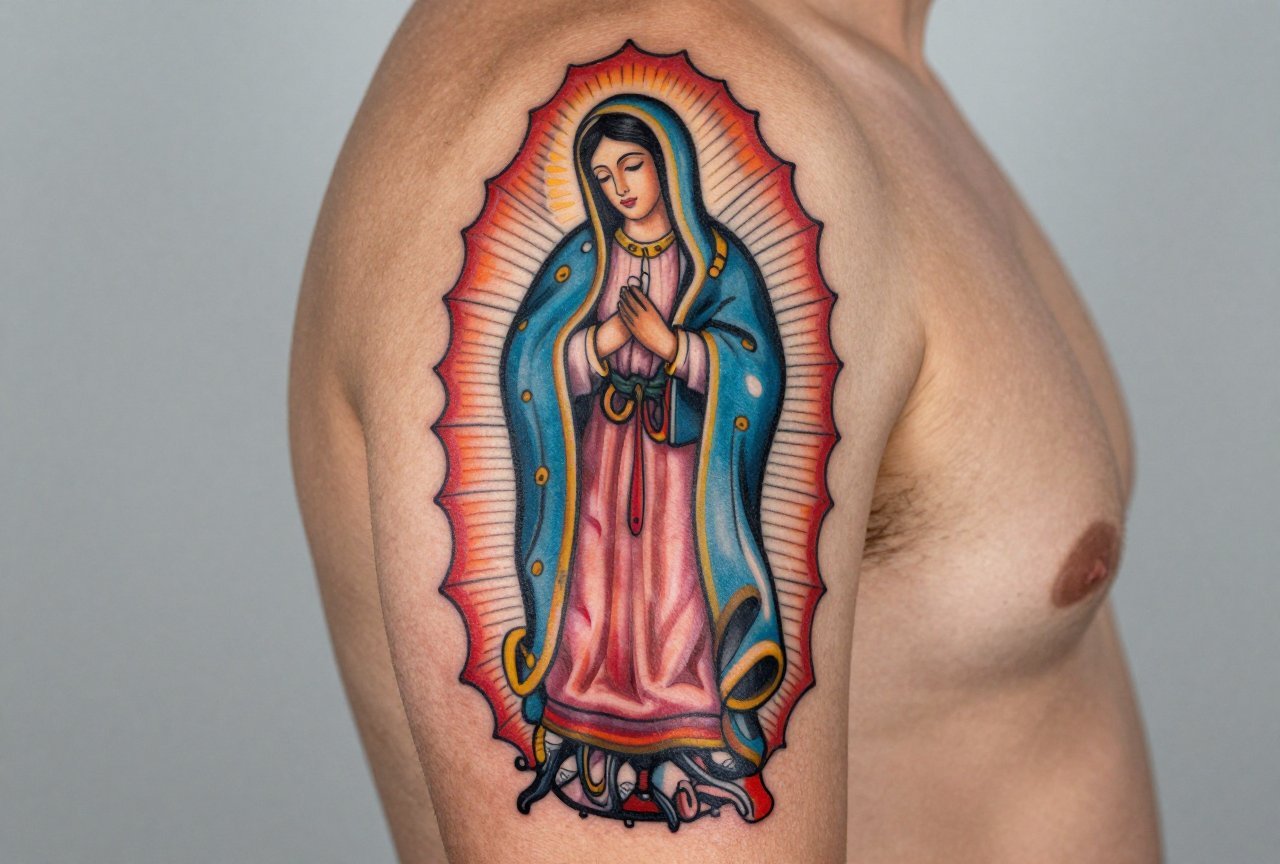
A true Virgin Mary drawing Chicano tattoo has tells. I’ve seen plenty of imitations from artists who think it’s just “Mexican stuff with a praying lady.” It’s not. The face is elongated, almost sorrowful, with eyes that look slightly upward. The hands are long and elegant, often clasped in prayer or holding a rosary. There’s usually a halo, sometimes simple, sometimes ornate with roses or thorns woven through.
The cloak drapes heavy. We see this a lot: artists trying to shortcut the folds with simple shading, and it falls flat. Real Chicano work builds those folds with multiple passes of grey wash, each layer healed and gone back into. The fabric should look like you could grab it. Roses are common companions, rendered with the same fine-line precision. Script banners with names, dates, or prayers arc above or below. Sometimes there’s a figure of Christ, a pair of praying hands, or a set of rosary beads that wraps around the composition like a frame.
- Elongated, sorrowful facial features with upward gaze
- Long, elegant hands in prayer or holding rosary
- Heavy, deeply shaded drapery with realistic fold structure
- Ornate halos with roses, thorns, or light rays
- Companion elements: roses, praying hands, script banners, rosary beads
- Fine-line single needle or tight three-round work throughout
Color vs Black and Grey
Why Black and Grey Dominates
Here’s where I get opinionated. I’ve tattooed color versions of the Virgin Mary, and they can be beautiful. But they’re not the same thing. The black and grey tradition exists for reasons beyond prison necessity now. The mood is different. A grey wash Virgin feels like memory, like smoke, like something seen in half-light through a church window. Color makes it literal. Black and grey keeps it dreamlike, devotional, personal.
The technique matters enormously. We build from dark to light, not the other way around. The darkest blacks sit in the eye sockets, under the chin, in the deepest folds of the cloak. Mid-tones model the face. The lightest greays, almost skin tone, hit the high points of cheeks, the bridge of the nose, the knuckles of praying hands. A good piece uses maybe five distinct values, but the transitions between them are so smooth you can’t see where one ends.
When Color Works
That said, I’ve done pieces where a single red rose against a grey Virgin creates something powerful. The red becomes blood, becomes heart, becomes the living world against the spiritual. Some artists add gold halos with yellow ochre. It’s rare, and it has to be restrained. Too much color and the piece becomes something else entirely, still religious, maybe still Mexican-influenced, but not Chicano in the specific sense.
Best Placements
Placement carries weight in this tradition. The Virgin Mary drawing Chicano tattoo on a chest, centered over the heart, is the classic. I’ve done this placement on men who’ve lost mothers, on women who’ve survived things they don’t name out loud. The chest gives the face room to breathe, enough flat space for the detail to read, enough proximity to the heartbeat to feel intentional.
Full sleeves work when the Virgin is the centerpiece and other elements, clowns, masks, script, roses, build around her. The back is a cathedral wall, a space for the most elaborate renditions with full architectural backgrounds, clouds, rays of light rendered in negative space. Hands and necks happen, but I talk clients through this carefully. These are statement placements, visible always, and they carry assumptions whether fair or not.
- Chest (centered): Classic devotional placement, room for detail, close to heart
- Full sleeve: Virgin as centerpiece with supporting narrative elements
- Back: Cathedral-scale work with architectural backgrounds
- Outer forearm: Visible but coverable, good for medium-sized compositions
- Hand/neck: Highly visible, requires commitment to the statement
Who It Suits
I’ve had clients ask if they need to be Mexican, Catholic, or formerly incarcerated to wear this. The answer is complicated. The style belongs to a specific culture and history, and getting it without understanding that context is appropriation, plain and simple. But I’ve also tattooed this on Filipino clients whose grandmothers had the same velvet Mary in their living rooms, on white kids raised in East LA who speak more Spanish than I do, on people who’ve done the work of learning what the image means.
What matters is intention and respect. If you’re drawn to the aesthetic alone, the fine lines, the smooth grey, the dramatic composition, there are other black and grey traditions that don’t carry this specific cultural weight. If you have a genuine connection, if this image lived in your home or your grandmother’s prayers, if you understand the history of where it came from, then the conversation starts from an honest place.
Modern Variations
Contemporary Refinement
The style keeps moving. Artists like Carlos Torres and Jose Lopez have pushed black and grey into almost photorealistic territory while keeping the Chicano soul intact. The Virgin Mary drawing Chicano tattoo now might have the hyper-detailed skin texture of a portrait, the subtle color temperature shifts of a photograph, but still the elongated features and upward gaze of the tradition. I’ve seen pieces with geometric backgrounds, with mandala elements, with the Virgin’s face emerging from smoke or mechanical parts. Some of it works. Some of it feels like putting chrome rims on a classic.
Neo-Traditional Crossover
There’s a wave right now of artists blending Chicano fine line with American traditional boldness, thicker outlines, more saturated black, less subtle grey wash. It’s visually striking but loses the softness that makes the original style feel like prayer. In my shop, when someone brings in a reference like this, we talk about what they’re actually drawn to. Sometimes we split the difference. Sometimes I steer them toward an artist who specializes in that hybrid.
Choosing an Artist
This matters more than almost anything. Not every black and grey artist understands Chicano work. I’ve fixed pieces from talented technicians who rendered a beautiful face but missed the cultural specifics, the wrong hand position, a halo that looks Renaissance instead of barrio, drapery that flows like Greek marble instead of heavy Mexican Catholic velvet.
Look for portfolios with multiple pieces in this style. Ask about their background, who they learned from, what the tradition means to them. In my shop, I’ll talk about my teachers, about the old heads who showed me how to stretch grey wash in a homemade cap, about the hours spent studying prayer cards and Lowrider spreads. An artist who can’t have that conversation might give you a pretty picture, but not an authentic one.
- Portfolio should show multiple Chicano-style pieces, not just one or two
- Ask about their training and connection to the tradition
- Look for smooth grey wash transitions, not just good line work
- Check how they render hands and drapery, these are the hardest parts
- Schedule a consultation to discuss cultural context and personal meaning
Final Thoughts
The Virgin Mary drawing Chicano tattoo endures because it means something real. In a shop full of flash trends and Pinterest copies, this work carries weight. It remembers mothers and grandmothers. It marks survival and faith and the specific beauty of barrio culture that mainstream America spent decades trying to erase. When I finish one of these pieces and the client looks in the mirror, sometimes they cry. Not because it’s pretty, because it’s true. That’s the standard. Anything less is just ink on skin.
If you’re considering this tattoo, do the work. Learn the history. Find an artist who lives inside it. And come to the chair ready to carry something that was never meant to be light.
Frequently Asked Questions
How long does a Virgin Mary Chicano tattoo typically take?
A detailed chest piece usually runs 8-15 hours across multiple sessions, while a smaller forearm piece might finish in 4-6 hours. The fine line work and smooth grey wash can’t be rushed without losing quality.
Does this style age well over time?
Black and grey Chicano work actually ages better than most color tattoos if properly done. The fine lines may soften slightly, but the strong contrast values keep the image readable for decades. Avoid sun exposure and keep it moisturized.
Can I combine the Virgin Mary with other Chicano elements like clowns or masks?
Absolutely, and it’s common. The Virgin often serves as the spiritual or maternal center while clowns, masks, or script tell the personal narrative around her. Your artist should design the flow so each element has room to breathe.
Is it disrespectful to get this tattoo if I’m not religious?
The cultural connection matters more than religious belief for many wearers. I’ve tattooed this on believers and non-believers alike who have deep family or community ties to the imagery. Be honest about your reasons and respect the tradition’s origins.
Related Style Guides
- Chicano Traditional Tattoos: A Working Artist s Guide
- Traditional Religious Tattoos: Complete Style Guide
- Chicano Sleeve Tattoos: A Working Artist s Guide
- Explore more