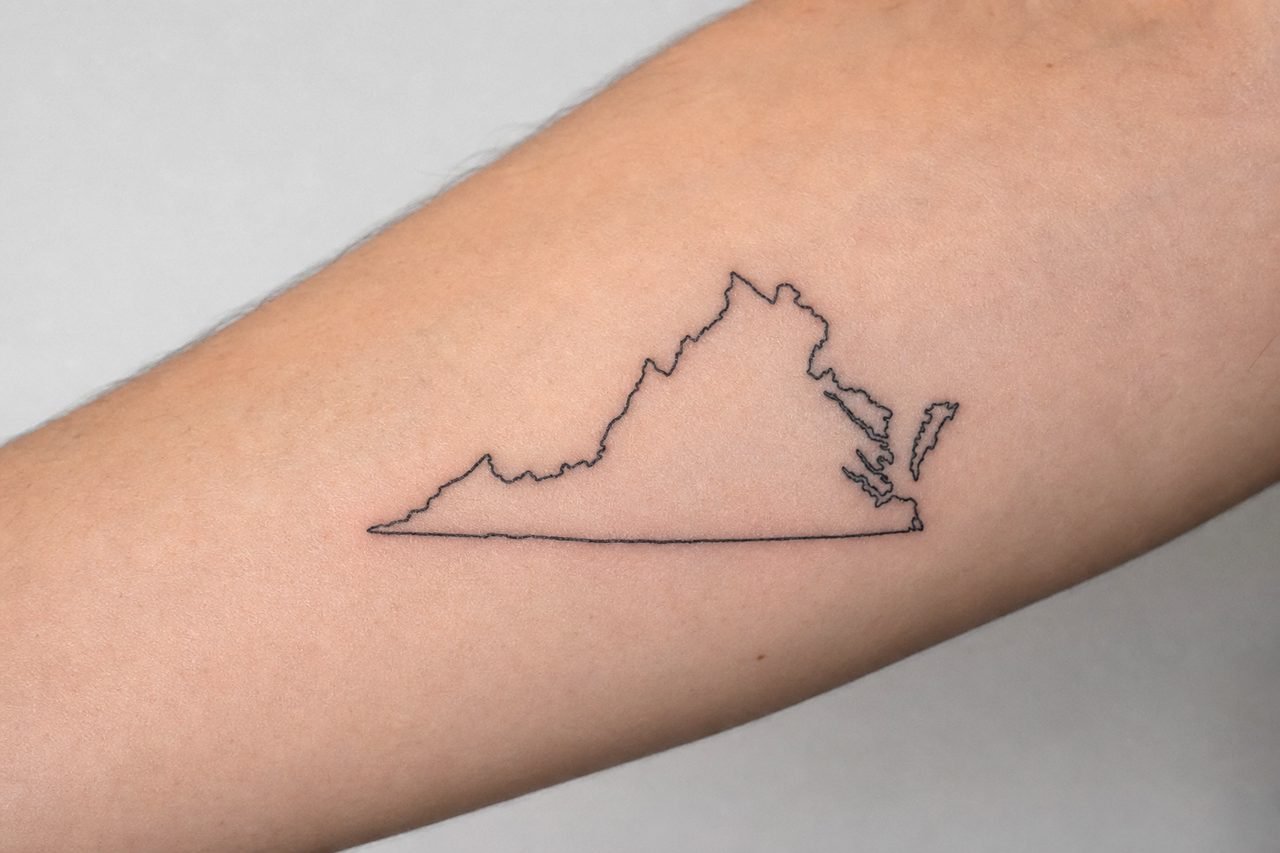
Virginia tattoos carry a distinct visual language. The state packs sharp ridgelines, tidal wetlands, colonial architecture, and naval history into a tight geography, so the challenge isn’t finding subject matter, it’s choosing what to render and how. This guide breaks down the motifs that actually work in skin, where they hold up best, and how to avoid the ones that blur into gray mush inside five years.
Popular Styles That Suit Virginia Imagery
Not every style translates Virginia’s specific landscape faithfully. Some flatten the Blue Ridge into generic hills; others make a cardinal look like a generic red bird. Here’s what actually works.
American Traditional
The bold lines and limited palette of American Traditional suit naval and colonial motifs perfectly. A three-masted ship, the state seal’s “Sic Semper Tyrannis” figure, or a simplified dogwood bloom all read instantly at a distance. The style’s heavy black outlines act as armor against aging, crucial for a piece you’ll carry for decades. Ask your artist to keep detail minimal; a trad cardinal needs white eye dots and black wing separation, not feather texture.
Black and Gray Realism
For mountain ridges, Civil War-era photography references, or the weathered wood of Chesapeake Bay deadrise boats, black and gray realism delivers depth without the color maintenance. The key is contrast. Soft gray washes look stunning fresh but fade to muddy nothing if the artist doesn’t anchor dark accents. Request that your artist map out the darkest points, tree lines, rock shadows, water depth, before starting the soft stuff.
Fine Line and Etching
Line-work interpretations of Virginia’s survey maps, colonial floor plans, or botanical illustrations of native mountain laurel trend hard right now. The catch: fine line demands perfect aftercare and often benefits from touch-ups. Single-needle work on the inner bicep or ribcage, where sun exposure stays minimal, ages significantly better than identical work on a forearm that sees daily UV.
- American Traditional: Best for symbols, seals, birds, ships; ages excellently
- Black and Gray Realism: Best for landscape, architecture, water; requires contrast discipline
- Fine Line/Map Work: Best for small scale, hidden placements; needs protection from sun
- Neo-Traditional: Best for dogwood, cardinal, or oyster with expanded color range
Design Ideas With Regional Weight
Generic state outline tattoos peaked around 2012 and haven’t aged well visually or culturally. Instead, consider these specific Virginia-coded images that carry actual regional recognition.
Natural Motifs
The Blue Ridge Parkway’s milepost markers, rendered small, make surprisingly personal tattoos for anyone with driving memories. A single oyster shell with its irregular, sculptural edges works as a standalone piece or as part of a larger seafood/Watermen theme. The mountain laurel, state flower before dogwood took the title, offers more intricate, less common botanical structure than the overdone dogwood bloom. For river people, the James or New River’s actual watershed shape, simplified to two or three flowing lines, avoids the clip-art feel of a standard outline.
Built and Historical References
Lighthouses: Cape Henry’s twin towers, old and new, provide strong vertical composition. The old Cape Henry lighthouse’s octagonal stone pattern translates to tattooable texture. For smaller work, the Richmond skyline’s distinctive train trestle and church spires reads locally without requiring a full cityscape. Civil War-era Minie balls, cannon trunnions, or belt buckles carry weight for history-focused collectors, though these require careful handling to avoid glorification, context matters in the artist’s rendering.
State Symbols Done Differently
The cardinal and dogwood are unavoidable classics. To execute them without cliché: consider the cardinal in winter plumage against snow (gray wash, red pop), or the dogwood’s branch structure rather than its bloom. The state flag’s armored figure crushing tyranny makes for a dramatic backpiece or thigh piece; the motto itself, in period-appropriate type, works as a ribcage or collarbone banner.
Best Placements for Virginia Themes
Virginia imagery tends toward horizontal landscape formats or vertical lighthouse/tower structures. Match the format to the body part.
Forearm: Ideal for watershed maps, horizontal ridgelines, or ship profiles. The natural cylinder lets you wrap a river’s curve around the arm. Outer forearm sees more sun, factor in future fading.
Upper Arm/Shoulder: The rounded cap suits the dogwood’s radial bloom or a cardinal in flight. Enough meat for solid saturation; easy to cover professionally if needed.
Calf: Vertical lighthouse compositions shine here. The muscle’s teardrop shape echoes the tower form. One caution: calf tattoos often blow out slightly on the inner curve where skin stretches most.
Ribcage: For longer text (mottos, river names, coordinates) or stretched landscape panoramas. Painful, but the flat canvas preserves fine detail that would warp on a joint.
Back/Upper Back: The only place for serious Blue Ridge panorama. A full ridgeline from north to south, with Shenandoah Valley depth, needs this real estate. Expect multiple sessions.
Hand/Finger: Avoid detailed Virginia-specific work here. The state outline, if you must, or simple “VA” in period lettering. Everything else blurs.
Color Choices and Aging Reality
Virginia’s palette is specific: mountain haze blue, dogwood white with pink blush, cardinal scarlet, Chesapeake brown-green, colonial brick red. These colors behave differently in skin over time.
Cardinal red is notoriously difficult. Bright scarlet pigments often shift orange-pink as they settle, especially on warmer skin undertones. A slightly deeper, blue-based red holds truer. White in dogwood petals? It yellows. Most artists now use very light gray or pale pink instead of pure white for “white” flowers, letting the skin itself provide the light value.
Blue ridge haze, those soft atmospheric perspective blues, fades fastest. If you want a mountain piece with depth, the artist should build that haze from a slightly darker base than looks natural fresh. What reads as “too dark” on day one often settles to “just right” by month three.
Black and gray remains the safest long-term bet for Virginia’s natural landscape. Color pops best when isolated: one red cardinal on a gray branch, one pink dogwood among black ink foliage.
Tips for Choosing Your Virginia Tattoo
Start with place, not image. The specific overlook where you proposed, the dock where you learned to crab, the trailhead marker number, these anchor a design in lived experience rather than generic symbolism. A milepost number means more than “I like mountains.”
Research your artist’s healed work, not just fresh photos. Every style looks crisp at week two. Ask to see pieces from two-plus years prior, especially any with the colors or line weight you’re considering. Virginia’s humid summers also mean sweat and sun exposure during healing, plan your appointment for fall or winter if possible, when outdoor activity naturally drops.
For text-heavy designs (mottos, coordinates, historical quotes), verify spelling and Latin grammar. “Sic Semper Tyrannis” has been misspelled in tattoo form more than once. For coordinates, double-check decimal points; a single digit error permanently marks the wrong location.
Consider scale honestly. A detailed deadrise boat with rigging needs inches of space. Shrinking it to fit a wrist guarantees a gray blob by year five. Better to choose a single anchor, a simplified hull silhouette, or a rope coil that reads at small scale.
Final Thoughts
Virginia offers tattoo collectors a genuinely deep visual catalog, geological, botanical, maritime, architectural. The best pieces come from specificity rather than collection. One well-rendered oyster shell from your grandmother’s creek beats a cluttered collage of every state symbol. Work with an artist who understands how your chosen style ages, give the placement serious thought, and let the image carry the weight of your actual connection to the place. The ink lasts either way; make sure the reason behind it does too.
Frequently Asked Questions
How much detail can a small Virginia map tattoo actually hold?
Less than most people expect. At under three inches, state outlines lose county borders, river forks, and text. Simplify to major ridgelines or a single watershed curve, or consider a coordinate set instead.
Do blue ridge tattoos work on darker skin tones?
Absolutely, but the approach shifts. Atmospheric blue haze won’t read; instead, artists use high-contrast black and gray with stylized white highlights, or neo-traditional color palettes with deeper saturation.
What’s the typical healing timeline for a color-intensive piece like a cardinal?
Surface healing runs two to three weeks, but red pigments often look patchy until week six. Avoid swimming in Chesapeake or Atlantic water during this window, bacteria risk is real, and salt stings fresh ink.
Can a Virginia lighthouse tattoo be easily expanded into a larger nautical sleeve?
Yes, if planned from the start. Position the lighthouse with open water on one side and sky above, leaving room for ships, compass roses, or additional coastline elements to wrap naturally.
More Tattoo Ideas
- Washington DC Tattoo Ideas
- Easy Peacock Mehndi Designs That Still Read Clean
- American Traditional Lady Head Tattoos: Complete Style Guide
- Explore more