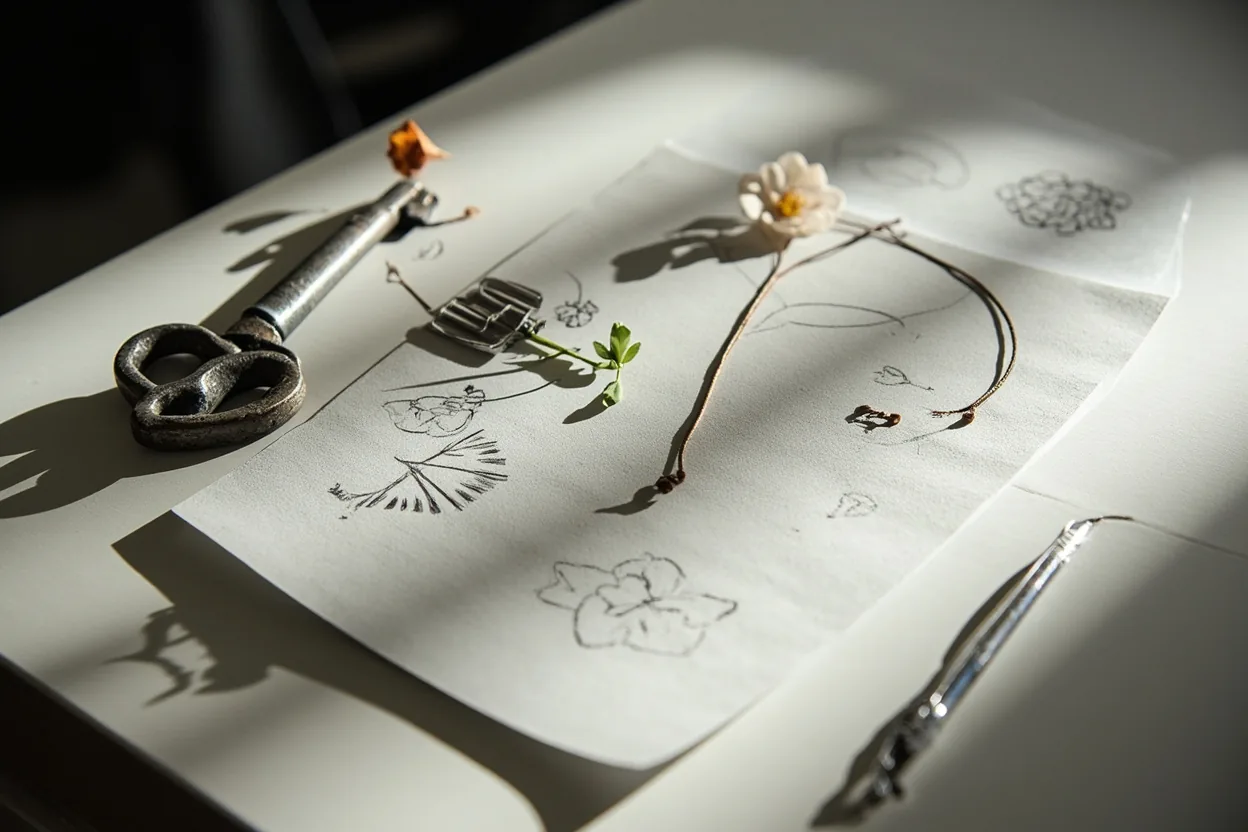
A unique tattoo is not a random tattoo. Random gets old fast. Unique means the design has a reason, the placement makes sense, and the artist did more than trace a popular reference with a new leaf attached.
Quick answer: Unique tattoo ideas work best when they combine a personal symbol, a body-aware placement, and a style that can age cleanly. Think custom birth flowers, abstract family marks, meaningful animals, tiny objects, map details, old handwriting, or a familiar motif drawn in an unusual scale.
Start With What You Actually Own
Objects Over Symbols
Everyone understands a heart. That is also the problem. A matchbook from a city, a key shape, a childhood toy, a family recipe note, a piece of jewelry, or a specific flower can carry more weight without announcing the meaning to strangers.
The trick is simplification. A tattoo is not a photograph. Choose the one detail that makes the object recognizable and let the artist rebuild it for skin.
A compass or anchor tells me nothing about you. Your grandfather’s fishing lure, the exact make of your first car’s hood ornament, the worn shape of a specific tool you use every day, those read as genuinely yours. Bring a real photo, not a Google image. The more specific the object, the more the design locks in.
Detail by Placement
Detail level matters by placement. A tiny pocket watch with moving gears works on a forearm where there’s room to breathe. The same concept crammed onto a wrist turns into a blob after two years. Good artists will tell you straight if the object needs to be simplified to hold up on skin.
Placement Changes Everything
The Body as Canvas
A common motif can feel new when it sits in the right place. A moth on the sternum, a single wildflower along the collarbone, a tiny constellation behind the arm, a traditional rose on the outer thigh, or a small blackwork mark on the shoulder blade can shift the whole mood.
Use the tattoo placement chart before making the final call. A unique placement is only good if it can heal and age there.
The same rose that looks forgettable on a forearm hits completely different wrapped around a shin or sitting on a sternum. Placement changes how the design moves with your body, how visible it is in daily life, and how much the session will test you. Ribs and sternum are brutal. Outer thigh and upper arm are some of the most manageable spots you can pick.
Wear and Longevity
Low-wear zones like the upper arm and thigh keep line work crispy for years longer than hands or fingers, which fade and blur fast from constant friction. A fine-line botanical on a thigh heals nice and stays readable. That same piece on a finger? You are looking at a touch-up within eighteen months, easy.
Two Ideas, Not Five
Building a Clean Concept
The cleanest custom tattoos usually combine two ideas: a lotus and water, a butterfly and a date, a snake and a flower, a moon and a birth month, a family initial hidden inside a geometric shape. Five ideas in one small tattoo becomes a puzzle.
| Base idea | Custom angle | Best style |
|---|---|---|
| Birth flower | Drawn from a real stem, not clip art | Fine line or blackwork |
| Family symbol | Initial hidden in shape or pattern | Minimalist or geometric |
| Animal | Silhouette from posture, not facial detail | Blackwork or illustrative |
| City memory | Small architectural line or map curve | Fine line |
| Old handwriting | One word, cleaned for legibility | Script |
Two concepts with a real connection between them make a tattoo that has actual meaning and stays visually clean. A moth and a single candle flame. A wave and a specific constellation. Pick two things where the relationship is clear without a caption. When you add a third, fourth, and fifth element, the piece loses focus and turns into a collage your artist has to fight to balance.
Why Negative Space Matters
Compositionally, two strong elements give the artist room to build contrast, use negative space, and let each piece breathe. That negative space is doing real work. It keeps the tattoo readable from across the room and prevents the whole thing from muddying up as it ages and spreads slightly under the skin over the years.
Styles That Fail the Uniqueness Test
The Instagram Trap
Some tattoos look unique online because they are impossible to read in real life. Too many micro details, too many symbols, too little contrast, or a placement that stretches the design every time you move.
If the tattoo only works as a zoomed-in photo, it is not ready. Ask the artist what it will look like from normal conversation distance.
Watercolor tattoos, white ink, ultra-fine line geometric patterns, these styles circulate heavily online and look stunning in fresh photos. What those photos do not show is how they heal. White ink fades to a yellowish scar-like texture on most skin tones within a year. Watercolor with no black outline bleeds and loses its shape fast. The piece you saw on social media may look totally different on your skin type after it settles.
Ask for Healed Work
Ask your artist to show you healed examples of the style you want, not just fresh work. Any solid artist has both. If they can only show you fresh photos, consider that carefully. Saturated black and grey pieces with clean solid lines still look intentional in ten years. Wispy all-pastel designs often do not.
Let the Artist Redraw It
Reference, Not Replication
Bring references, but do not ask for a copy. The artist should adjust line weight, spacing, and placement for your skin. That is where the tattoo becomes yours.
If you are unsure whether an artist can do that, use how to choose a tattoo artist before sending a deposit.
Bringing reference is the right move. Handing your artist a screenshot and saying exactly that is the wrong one. Skin is not paper. It curves, it stretches, it tans, it scars. An artist who redraws your reference with proper line weight for your specific placement, with spacing that accounts for how ink spreads in your skin type, is doing the job you are paying for.
Scale matters too. Fine-line or micro-detail designs should run at least twenty percent larger than you initially think. Skin expands, ink spreads, and what reads as crisp at inch-scale turns muddy within five years. Trust your artist when they push back on size.
What to Remember
Unique tattoos on real skin come from three decisions: a symbol that actually belongs to you, a placement that respects how your body moves and ages, and a style that holds up past the first photograph. The best artists will question your choices, suggest changes, and sometimes tell you no. That conversation is not an obstacle. It is the point.
Trends pass. Your skin does not. A design built around your specific object, your specific body, and your specific artist’s redraw will still read as yours in twenty years. Everything else is just decoration that happened to stick around.
Frequently Asked Questions
How do I know if my tattoo idea is truly unique or just trendy?
If you saw it on more than three social media accounts this month, it is trending. True uniqueness comes from personal source material: your own objects, handwriting, or memories, redrawn by an artist for your specific skin and placement.
Will a fine-line tattoo still look good in ten years?
Fine line can age well if it is large enough, placed on low-wear skin, and has sufficient contrast. Finger tattoos, palm lines, and very small fine-line pieces generally blur faster. Ask your artist to show you healed work from five or more years back.
Is white ink a good choice for a subtle unique tattoo?
White ink is risky. On most skin tones it fades to a yellowish or scar-like tone within months to a year. It also yellows faster with sun exposure. If you want subtle, consider light grey or a very desaturated black instead.
How many elements should I combine in one tattoo design?
Two connected elements usually produce the cleanest result. Three can work if they share a clear visual or thematic link. Beyond three, small tattoos become cluttered and hard to read at a distance. Let your artist guide the balance.
Should I let my artist change my design idea?
Yes. A professional artist adjusts line weight, spacing, and scale for how ink behaves in skin. Their redraw is not a rejection of your idea. It is the translation from concept to something that will actually live on your body.