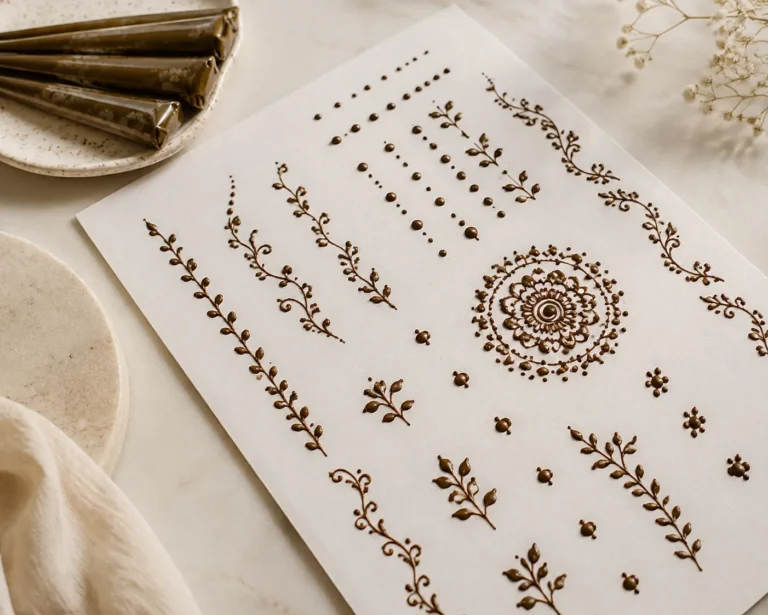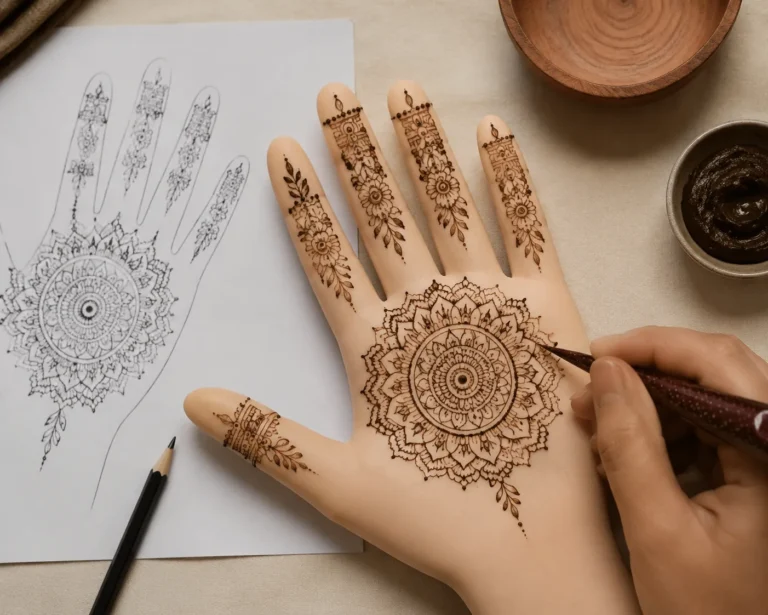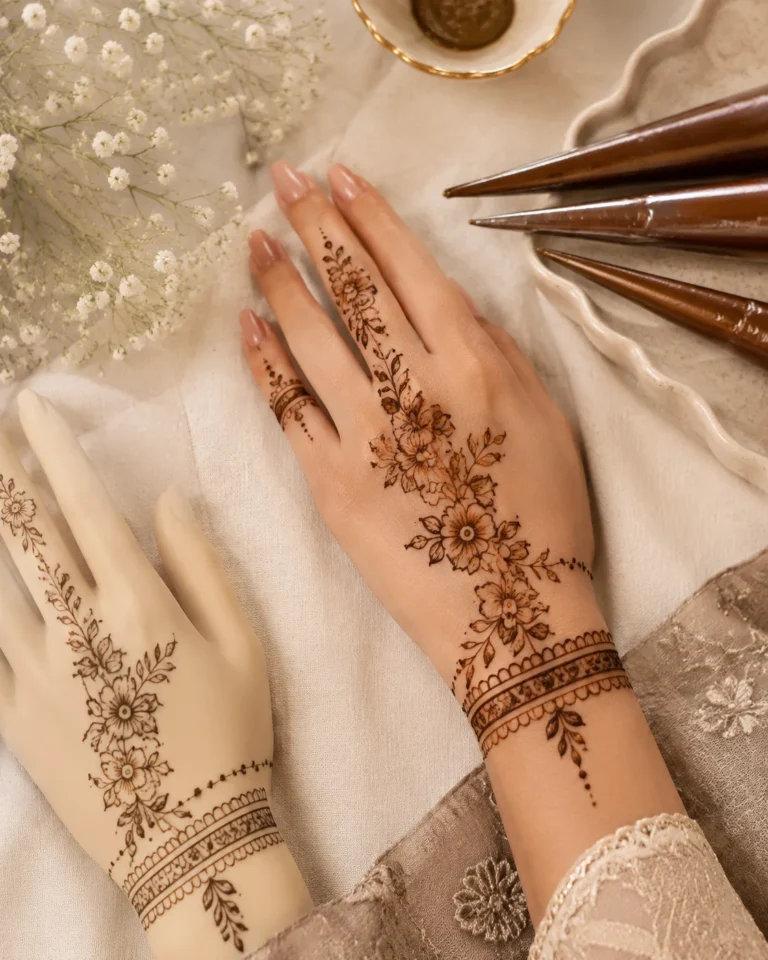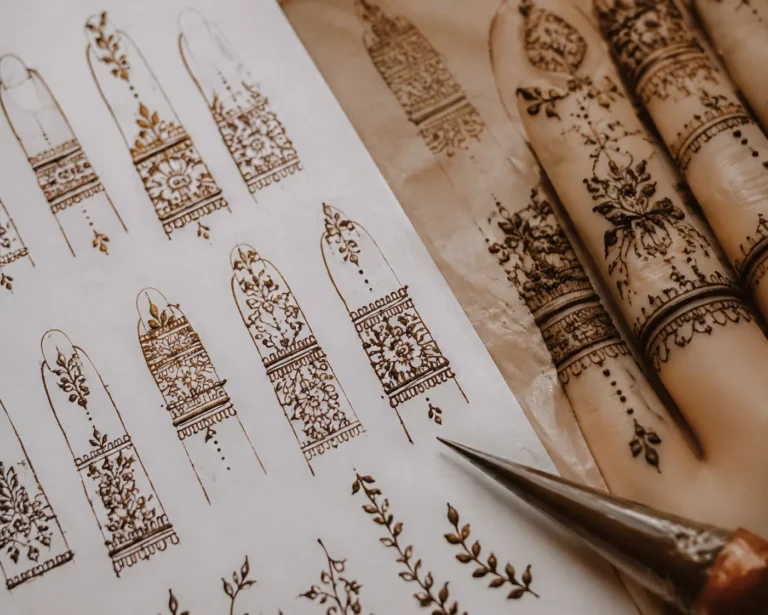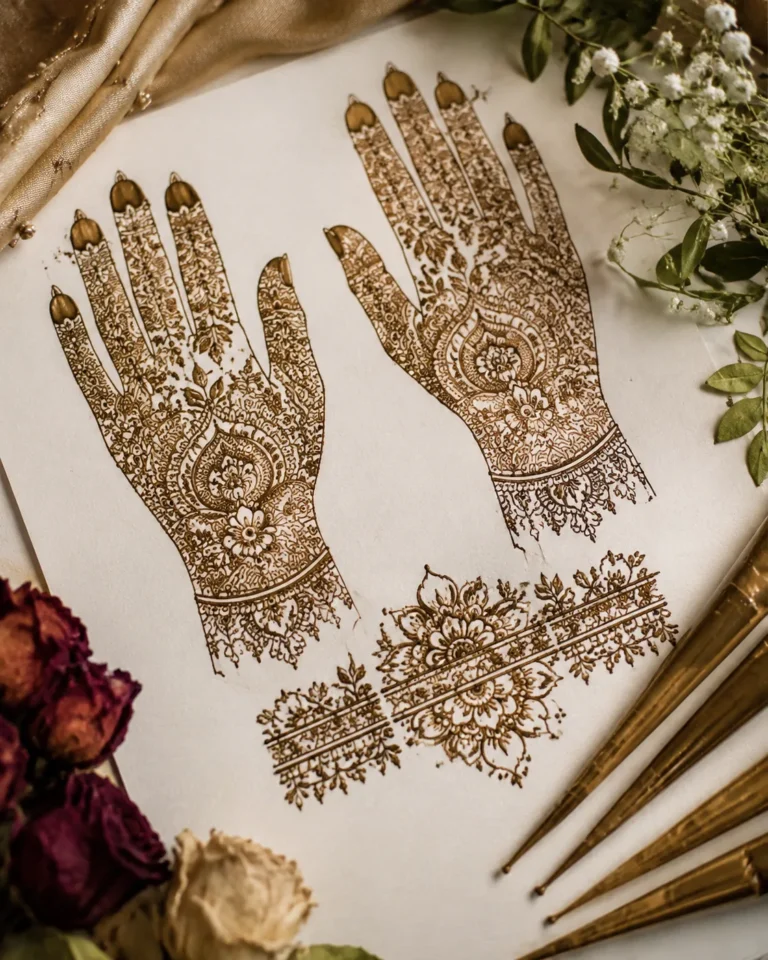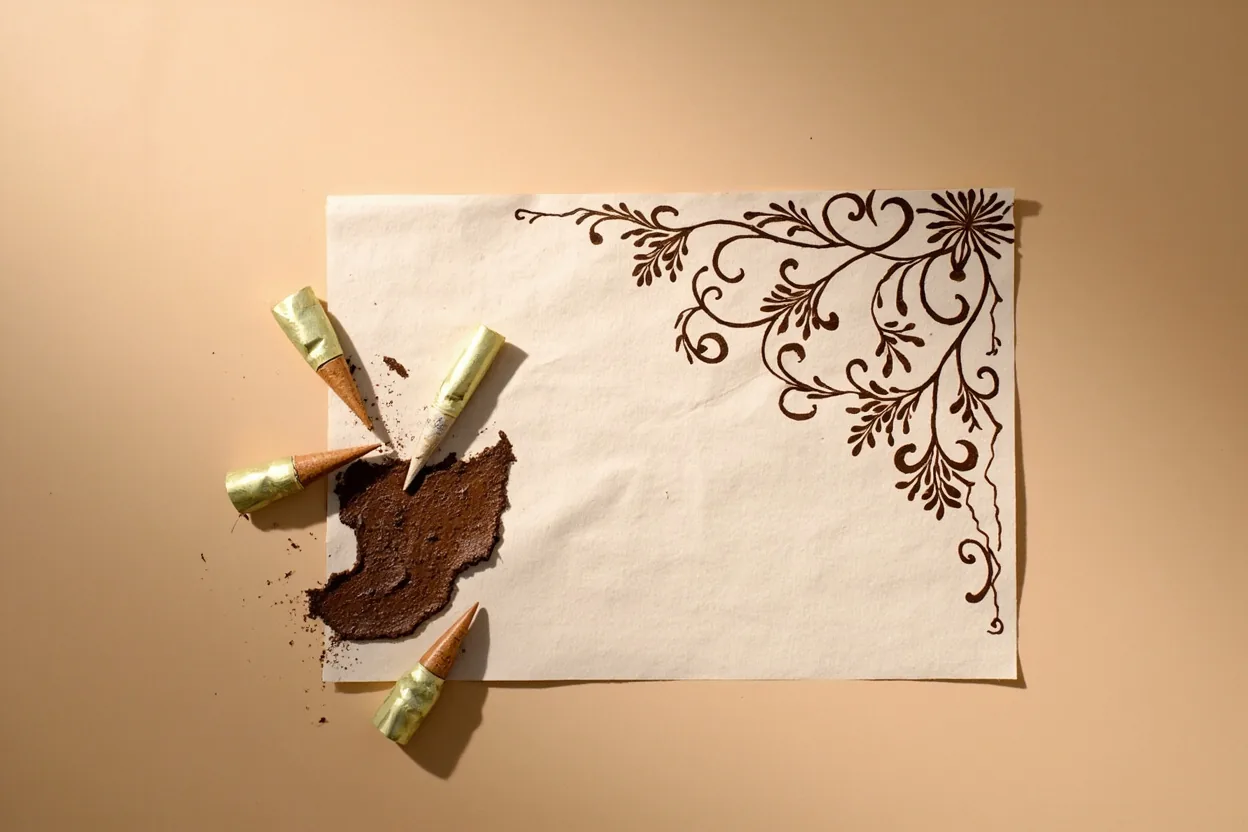
Arabic mehndi designs usually feel lighter than dense full-hand bridal fills. The beauty is in the diagonal movement, open skin, and confident floral rhythm.
Quick answer: Good Arabic mehndi designs use floral vines, paisley accents, diagonal palm flow, finger trails, bracelet wrists, negative space, and bold spacing rather than full coverage.
Arabic mehndi directions
The design should move across the hand instead of filling every inch.
| Option | Best use | Keep in mind |
|---|---|---|
| Diagonal floral | Classic Arabic look | Needs clear flow |
| Open palm vine | Modern negative space | Do not underdraw it |
| Finger trail | Elegant detail | Keep motifs connected |
| Bracelet wrist | Jewelry-style finish | Parallel lines matter |
| Paisley accent | Traditional curve | Can crowd the design |
Arabic mehndi flows in one direction, usually starting from the wrist and pushing up toward the elbow, or down from the ankle toward the toes. The motifs don’t grid out like traditional Indian patterns. You get big bold florals, leaves, and geometric fills with intentional negative space between them. That open space is the whole point. It’s what gives the design that airy, modern read.
When you’re translating this into a permanent tattoo, that directionality still matters. A forearm piece should follow the arm’s natural line. Fighting the flow makes the design look crammed and the linework harder to execute clean. Work with your artist on orientation before they even touch the stencil.
What makes this work on real skin
Arabic mehndi is built on breathing room, the gaps are the design.
Arabic mehndi often looks expensive because it leaves skin open. Empty space is part of the composition.
For events, Arabic designs can be a good middle ground: more polished than a tiny beginner motif, less heavy than full bridal coverage.
Arabic mehndi translates well into fine line black and grey tattoos because the design is already built around contrast. The thick floral outlines hold over time, and the open fill areas age gracefully without muddying. On darker skin tones, your artist needs to push saturation harder on those fills. Thin scratchy lines on melanin-rich skin fade fast and blow out early.
Placement affects longevity a lot here. Forearms, upper arms, and shins are solid choices. Fingers, palms, and the sides of hands are high-wear zones. The linework degrades faster there, especially the fine connector details. A full sleeve-style Arabic piece from wrist to elbow in bold black ink reads from across the room and holds its structure for years.
Before you book or apply it
Choose one flow direction and let the rest of the hand support it.
- Keep flowers related in size.
- Use negative space deliberately.
- Let finger patterns echo the main vine.
- Use safe henna paste only.
If you’re doing actual henna first as a test run, wait the full 72 hours before judging the color. It oxidizes dark over that window. Do a small patch test 24 hours before application if your skin runs sensitive. Black henna sold at markets often contains PPD, a chemical that causes severe reactions and can permanently scar. Only use natural brown-red mehndi paste from a trusted source.
For the tattoo route, bring reference photos of Arabic mehndi specifically, not Indian or Moroccan. Your artist needs to understand the spacing philosophy. Budget for a full forearm piece starting around $400 to $600 at a reputable shop. Healing runs standard two to three weeks. Keep it out of the sun during that window or the fine connector lines will fade before they even settle.
Mistakes to avoid
Do not fill every open area after choosing an Arabic layout. The open space is why the style works.
Avoid making the diagonal vine too thin if it needs to anchor the whole hand.
Safety source note: This guide keeps safety advice conservative and points readers to primary public-health or dermatology sources.
The biggest mistake is over-filling the negative space. Arabic mehndi breathes. The moment you pack every gap with shading or extra detail, you’ve killed what makes it work. Tell your artist to resist the urge to add. The second mistake is scaling down too aggressively. A design meant for a forearm crammed onto a wrist loses its florals and just reads as a blob after it heals.
On the henna side, wiping it off too early is the most common error. Leave the paste on at least six hours, overnight if you can. Moisture is the enemy while it’s drying. Lemon juice and sugar solution patted on keeps the paste from cracking and deepens the stain. Skipping that step gets you an orange result that fades in four days instead of staying rich for two weeks.