The cobra is one of the most loaded symbols you can put on your skin. It doesn’t sit quietly. It rears up, hood spread, ready to strike, and that energy is exactly what draws people to it. This isn’t a soft tattoo. It’s a declaration.
the cobra represents power, danger, and transformation. But the meaning runs deeper depending on the culture, the design, and how you wear it. Let’s break down what this snake actually says, and how to make sure yours says the right thing.
Core Symbolism: What the Cobra Stands For
The cobra’s most universal meaning is duality. It protects and it destroys. Ancient cultures the world over recognized that a snake capable of killing with a single bite was also a guardian worth respecting. In tattoo culture, that same tension holds. A cobra on your skin signals that you carry both sides, strength and danger, wisdom and the capacity to strike.
Protection, transformation, and raw power are the three pillars. People also associate cobras with intuition and heightened awareness because the snake is always alert, always sensing. If you’ve been through something that fundamentally changed you and came out sharper on the other side, the cobra makes a lot of sense as a personal symbol.
Cultural and Historical Roots
A cobra doesn't threaten, it warns. That's the whole point.
In ancient Egypt, the cobra appeared as the uraeus, the rearing serpent worn on the crowns of pharaohs and gods. It represented divine authority and the power to protect the ruler from enemies. The goddess Wadjet took cobra form and was a guardian of Lower Egypt. This isn’t mythology lite, it was serious sacred imagery tied directly to royal power and cosmic order.
In Hindu tradition, the cobra is closely linked to Lord Shiva, who wears a cobra around his neck as a symbol of control over ego and death. The Naga serpents of South and Southeast Asian mythology are powerful divine beings, not simple monsters. Japanese tattooing has long used the cobra as a symbol of wisdom and protection, a creature that strikes only when provoked, making it a symbol of measured, justified force.
Popular Design Variations
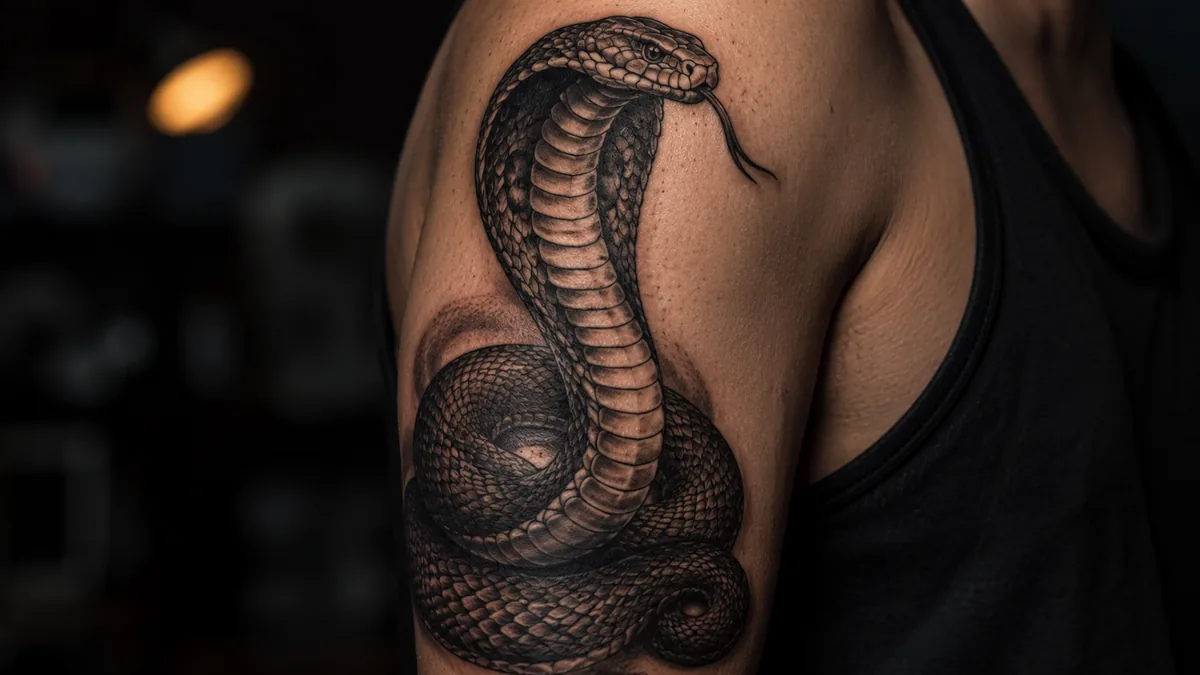
The rearing cobra with hood spread is the classic. You get maximum visual impact. The silhouette reads clean from across the room, which matters a lot for longevity and legibility. Some people go with a coiled cobra, which fits tighter spaces and suggests coiled energy ready to release. A cobra wrapped around a dagger or sword layers in themes of guarded power or sacrifice.
Egyptian cobra designs often incorporate the uraeus crown, sun disk, or hieroglyphic framing and they pair naturally with blackwork or fine line Neo-Traditional. Japanese-style cobras fit into sleeves with peonies and waves, done bold with solid black outlines and saturated color fills. Geometric or minimalist cobras are popular in fine line work, though be aware that fine line in high-stretch zones like the inner arm or ribs can lose definition as it heals.
Black and Grey vs. Color
Black and grey is the workhorse for cobra tattoos. A skilled artist can build incredible texture into scales using whip shading and contrast, making the snake look three-dimensional and alive without a drop of color. Black and grey also ages more predictably. Bold will hold, and a black and grey cobra with solid contrast will still read clearly twenty years down the road.
Color opens up different energy. A bright Egyptian cobra with gold and turquoise accents hits differently than a muted Japanese piece. King cobra designs in color can show that characteristic pale yellow or olive skin realistically. Saturated color packs look stunning fresh but require touch-ups over time, especially in sun-exposed spots. If you’re committed to color, keep the skin out of direct UV as much as possible and moisturize consistently.
Placement and How It Ages
The forearm is the most popular spot for cobras, and for good reason. The rearing pose maps naturally onto the length of the forearm, the skin is relatively stable, and the piece stays visible without effort. The upper arm and shoulder give you more canvas for a fully wrapped or coiled design. The shin and calf are solid low-wear zones that hold detail well and age reliably.
Avoid putting a fine line cobra in high-wear zones like the inner wrist, finger, or inner bicep unless you’re ready for regular touch-ups. These areas flex constantly and the skin texture causes ink to migrate. Ribs and sternum are spicy placements with tighter skin, but they hold detail beautifully if you can sit through the session. A cobra winding up the spine is a commitment but it’s one of the most striking placements for this design.
Style Matchups: Finding the Right Approach
Traditional American cobras are bold, clean, and built to last. Think thick outlines, limited palette, and a flat graphic quality that reads instantly from a distance. Neo-Traditional adds more dimension, richer shading, and exaggerated proportions while keeping that bold structure. Both styles age extremely well because the lines stay crispy and the composition doesn’t rely on microscopic detail.
Realism is a strong choice if you want a photographic, scale-accurate cobra that looks like it could actually bite you. This style demands an artist with serious technical skill. Blackwork and dotwork cobras work well for people who want something graphic and modern. Japanese Irezumi-style cobras are best executed by artists trained in that tradition since the composition rules and shading conventions are specific and intentional.
Who Gets Cobra Tattoos and How to Make It Personal
People drawn to cobra tattoos tend to share a few traits. They’ve usually been underestimated. They know their own power and they don’t need to explain it to anyone. Cobra tattoos are also popular with people who’ve come through a hard transformation, addiction recovery, leaving a toxic situation, surviving serious illness. The snake sheds its skin and keeps moving, and that resonates deeply for a lot of people.
To make it your own, think about what the cobra means to you specifically. Egyptian context? Add hieroglyphic elements. Hindu or spiritual angle? A lotus base or third-eye reference reads clearly. Personal protection? A rearing cobra guarding a name or date works well compositionally. Talk to your artist about the specific reference images you connect with and let them build a custom design around your placement and your story. A cobra that means something specific will always outlast a cobra you picked off a flash sheet.