
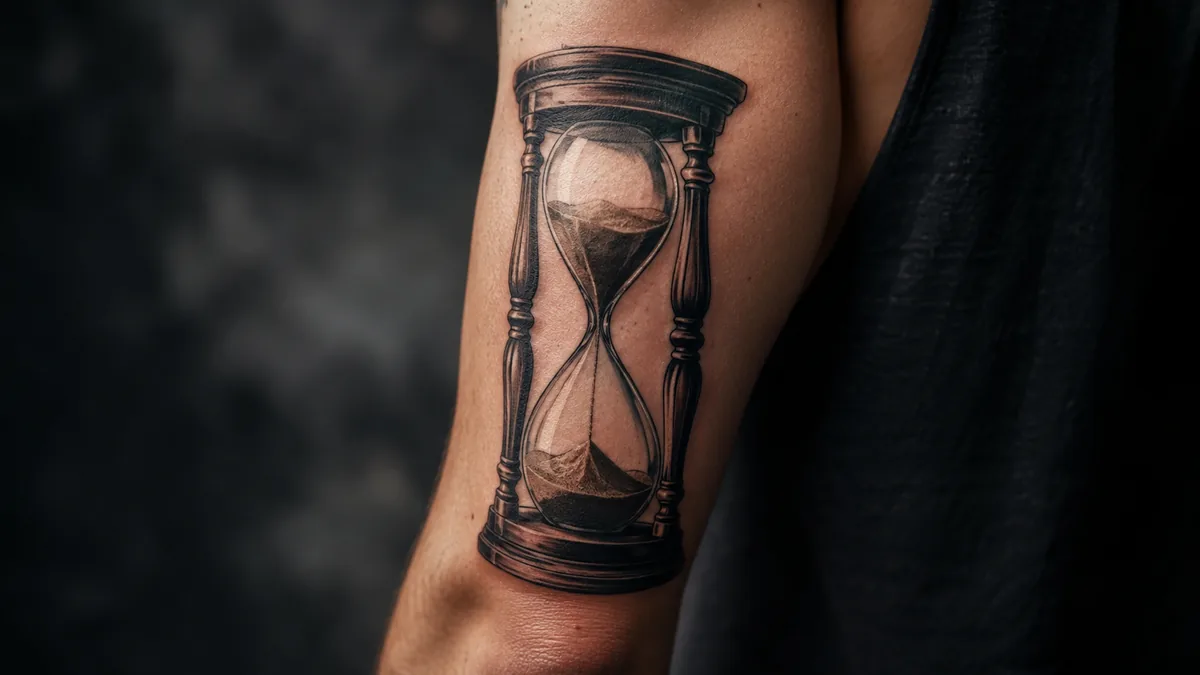
A sand timer tattoo is one of those designs that hits you right in the chest the moment you see it. It’s not subtle. It’s a direct, unflinching reminder that time moves in one direction and it never stops. People get this piece because they want that truth on their body every single day.
The symbolism is old and universal. Every human culture has wrestled with the passage of time, and the hourglass has been its most recognizable symbol for centuries. As a tattoo, it carries that full weight, but it also opens up in personal directions. Grief, transformation, balance, survival. The sand timer means something real, and that’s exactly why it stays popular.
The Core Meaning: Time Is Running Out
At its most fundamental, the sand timer tattoo is about mortality. The sand falls and you cannot stop it. That grain-by-grain drain is a visceral image of a finite life. A lot of people get this piece after a close call, a major loss, or a period that forced them to reckon with how short everything really is. It’s not morbid for the sake of morbid. It’s honest.
The reading most people land on is urgency. Stop wasting time. Live with intention. Some clients want it as a daily gut-check, a permanent note to themselves not to coast. Others get it as a memorial, marking a specific loss and the understanding that came with it. Both readings are valid, and both are common.
Historical and Cultural Background
Every grain that falls is a second you don't get back.
The hourglass has been a real symbol in Western culture since at least the 14th century, when mechanical hourglass devices became common in Europe. It showed up in medieval art as part of the memento mori tradition, artwork designed to remind viewers of death. Skulls, hourglasses, wilting flowers. These were not decoration. They were philosophical statements about impermanence.
In alchemy, the hourglass represented the element of time as a force that transforms everything. Sailors used them practically to measure shifts at sea, which gave the symbol an additional layer of navigation and journey. By the time tattooing became widespread in the West, the hourglass was already deeply embedded as a symbol of mortality and the human condition. It transferred to skin naturally.
What the Sand Itself Represents
Look closer at the design and the sand matters. When the top chamber is full and the bottom is empty, the reading is youth, potential, time ahead. When it’s flipped and the bottom is full, it signals experience, things lived through, time already spent. Many clients choose a design that shows the sand mid-fall, caught in motion. That’s the most common placement of meaning: right now, in the middle of it.
Some people add specific amounts of sand as a way to mark something personal. A chamber that’s three-quarters empty carries a different emotional weight than one that’s half and half. Your artist can dial that in intentionally. If you care about that detail, bring a reference sketch or describe it clearly at your consultation. Don’t leave it up to guessing.
Popular Design Variations and Styles
Traditional and neo-traditional sand timers are bold, graphic, and built to last. Thick outlines, saturated fill, crispy contrast. They read from across the room and hold up through decades of aging because the linework is solid. These often include added elements like roses, flames, skulls, snakes, or wings wrapped around or growing through the glass chamber. Every addition shifts the meaning slightly, and that’s by design.
Fine line and blackwork sand timers have surged in popularity over the past several years. Fine line versions are delicate, detailed, often hyper-realistic looking, with thin architectural lines depicting the glass frame and stippled or whip-shaded sand. Blackwork versions go hard in the opposite direction, with heavy negative space and strong contrast. Both styles work well. Fine line is trickier to age cleanly in high-wear spots, so placement becomes critical.
Color Versus Black and Grey
Black and grey is the default choice for this design and it suits the symbolism. The restraint of a black and grey sand timer matches the weight of what it represents. A skilled artist can get incredible depth in the glass using grey wash and negative space highlights. The sand itself can be rendered with fine texture work that looks genuinely dimensional when healed.
Color opens up different emotional territory. Blue or purple glass reads ethereal, almost supernatural. Red sand reads aggressive, urgent, alive. Gold or amber tones give the piece a warmer, almost hopeful quality. If you go color, choose a saturated palette so the piece doesn’t fade into mush in a few years. Color in fine detail areas will shift faster than bold fields, so factor that into the design from the start.
Best Placements and How It Ages
The sand timer is a vertical shape, which gives you a lot of placement options. The forearm is the most popular. It’s a low-wear spot, the skin is relatively stable, and you see it yourself all the time, which matters for a piece that’s meant to remind you of something. The calf and shin work great for the same reasons. The upper arm and bicep are solid spots for larger, more detailed versions. The thigh handles big pieces well and ages nicely.
Stay away from the inner wrist for detailed fine line work. Blowout risk is real on that thin skin, especially with intricate glass rendering. The hand and finger placements will fade faster than almost anywhere else on the body, so if you want it there, go bold. High-contrast black will hold longer than fine detail in high-wear zones. Talk to your artist honestly about longevity before you commit to a placement you’ll regret.
Pain by Placement
The forearm sits in the easy to moderate range for most people. The outer forearm especially is pretty manageable. Inner forearm gets spicier toward the elbow ditch, so if your design extends there, be ready for that. The shin and calf are generally tolerable for people with average pain tolerance, though the shin bone area can get intense. The ribcage is where sand timer tattoos get genuinely difficult, spicy enough that some people tap out mid-session.
Upper arm and shoulder placements are typically some of the most comfortable on the body. Good blood flow, decent muscle cushion, the needle doesn’t feel like it’s hitting bone. The sternum and chest are tougher, and anything near the inner arm or armpit climbs fast in intensity. Go in rested, eaten, hydrated. That does more for your session than anything else.
Who Gets This Tattoo and How to Make It Yours
This design shows up on a wide range of people. Survivors of illness or accidents who came out with a sharper sense of urgency. People who lost someone and want to carry that loss as purpose. People in recovery who mark time as a meaningful thing they choose to spend well. Philosophers and overthinkers who want something on their body that says what they actually believe. The symbolism is broad enough to be personal to almost anyone.
To make it yours, anchor it to a specific meaning before you walk into the shop. Consider adding elements that connect to your story. Flowers tied to a person you lost, a phrase in the glass, a specific symbol woven into the frame. Your artist can build around a concept if you bring one. A sand timer with no context is still a strong piece. But a sand timer with a story behind every detail is the kind of work that people ask about for the rest of your life.









