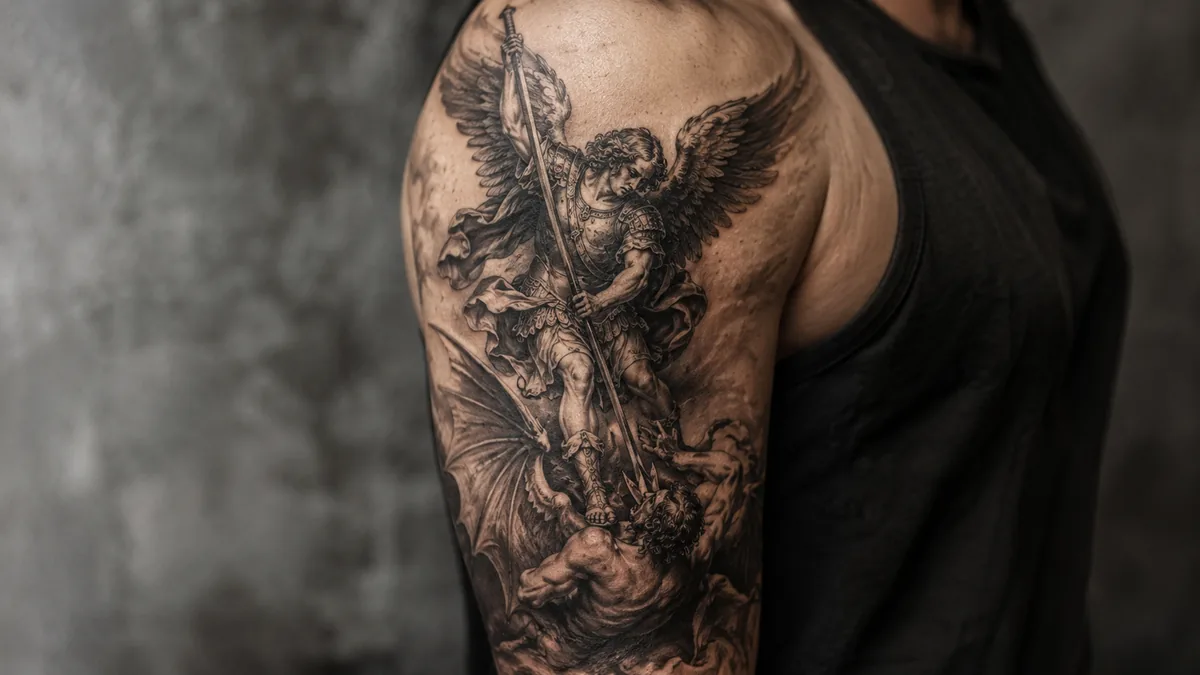
Saint Michael is one of the most requested religious tattoos in any shop. And it makes sense. The image is powerful, the symbolism runs deep, and the design translates beautifully to skin whether you go full baroque or stripped-back black and grey.
a Saint Michael tattoo is about protection and the fight between good and evil. It’s not decorative filler. People who get this piece usually mean it. They’re carrying something, marking a victory, honoring a role, or pledging an allegiance to something bigger than themselves.
What a Saint Michael Tattoo Actually Means
Saint Michael the Archangel is the warrior of God in Abrahamic tradition, showing up across Christianity, Judaism, and Islam. His core role is defender and protector, the one who cast Satan out of Heaven. That story is the backbone of almost every Saint Michael tattoo you’ll see. The meaning boils down to this: good triumphing over evil, light defeating darkness, and divine protection over the person wearing the ink.
People also get this tattoo to represent justice, strength, and courage in battle, literal or personal. First responders, military, law enforcement, and veterans make up a huge chunk of Saint Michael collectors. He’s the patron saint of soldiers, police officers, paramedics, and firefighters. The tattoo is often a badge of identity as much as a spiritual symbol.
The Historical and Religious Background
He doesn't symbolize perfection. He symbolizes fighting anyway.
Saint Michael appears in the Book of Revelation as the leader of God’s army against the dragon, widely interpreted as Satan. He also shows up in Daniel as a protector of Israel, and in the Book of Jude. The Roman Catholic and Eastern Orthodox traditions both venerate him heavily. His feast day, Michaelmas, was historically one of the most important in the Christian calendar, which tells you how seriously people took him before tattoo culture even existed.
The Renaissance and Baroque periods gave us most of the visual language we use today. Raphael’s famous painting and Guido Reni’s Saint Michael Defeating Satan are the reference images that feed directly into tattoo designs. That image of a winged warrior in armor, standing over a fallen demon with a sword or spear raised, is not a modern invention. It’s centuries old and loaded with meaning.
Popular Design Variations
The classic version shows Michael in full armor, wings spread, sword raised, standing on top of a defeated Satan or serpent. That composition reads from across the room and works at almost any size above a fist. Some clients want the realistic face rendered in detail, others want it slightly idealized or icon-style. Scrolls with Latin phrases like ‘Quis ut Deus’ (Who is like God, Michael’s literal name-meaning) are common additions. Scales of justice, shields with crosses, and halos round out the most popular elements.
Simpler versions exist too. Silhouette-only designs in solid black hit hard and age exceptionally well. Fine line interpretations are getting popular, especially on forearms, but they need a skilled hand and realistic maintenance expectations from the client. Neo-traditional Saint Michaels bring bold outlines and saturated color, making the figure pop aggressively. Illustrative black and grey with heavy whip shading and soft gradients is probably the most consistently requested version in American shops right now.
Color vs. Black and Grey
Color Saint Michaels are stunning when done right. Gold armor, blue or white robes, deep red wings, vivid green or red for the serpent below. Saturated pieces like this command attention and carry a stained-glass quality that fits the religious subject matter perfectly. The tradeoff is that color requires more upkeep. It fades faster than black ink, especially in high-wear areas, and you’ll likely be back for a refresh within five to ten years depending on sun exposure and skin type.
Black and grey is the workhorse choice and it’s the one most tattoo artists will honestly steer you toward for a piece this detailed. The contrast holds longer, the fine details in armor and feathers survive the healing process more predictably, and the overall composition tends to age gracefully into a softer, more painterly look. If you want something that still looks clean and solid two decades from now, black and grey with bold linework as the foundation is the safer long-term bet.
Placement and How It Ages
The back is the natural home for a full Saint Michael composition. You’ve got real estate to work with, the skin stays relatively flat, and the wings can stretch naturally. A full back piece with Michael as the centerpiece is genuinely one of the most impressive tattoos a person can carry. The upper arm, from shoulder cap down to the elbow, is the second most common placement. It works well for a quarter to half sleeve dedicated to the figure alone or as an anchor in a larger religious sleeve.
The chest is another strong choice, especially for people with personal or spiritual reasons tied to the heart. Ribs are popular but spicy, and the skin there tends to be thinner and more prone to blowout if the artist isn’t careful with pressure. Avoid hands, necks, and inner elbows for detailed work like this unless you understand those zones fade and blur faster than anywhere else on the body. Bold outlines hold. Hairline details in high-wear zones don’t.
Style Matchups: Which Tattoo Style Works Best
Realism and illustrative black and grey are the dominant styles for Saint Michael tattoos, and for good reason. The subject matter is inherently cinematic, with dramatic lighting, complex armor, and dynamic poses. A good realism artist can render this scene with the depth of a painting. Look for artists who post healed work, not just fresh shots. A piece that looks crispy on day one but muddy at two years isn’t a good Saint Michael tattoo.
Neo-traditional brings heavier linework and stylized color palettes that give the piece more of a graphic pop. It’s a great option if you want it to feel bold rather than reverent. Blackwork and woodcut-inspired approaches are less common but can be striking, reducing the image to high-contrast shapes that read hard from a distance. Fine line is the riskiest style for this subject. The detail density in armor and feathers is brutal on fine line longevity, so be sure your artist has a portfolio of healed fine line religious work before committing.
Who Gets This Tattoo and How to Make It Personal
Beyond first responders and military, a lot of people come in for a Saint Michael tattoo after surviving something serious. A cancer diagnosis, a bad accident, an addiction. The tattoo becomes a marker of having fought through darkness. Others get it as a memorial piece, representing a loved one who served or died protecting others. Some are straightforward Catholics or Orthodox Christians marking their faith. The meaning shifts depending on who’s sitting in the chair, and that’s part of what makes it endure as a tattoo subject.
To make it personal, think about what’s specific to your story. Adding a birth year, a name in a banner, the badge number of someone you’re honoring, or a specific scripture reference grounds the piece in your reality rather than generic imagery. Talk to your artist about whether Michael should look triumphant, determined, or battle-weary. The expression on his face changes the emotional tone of the whole piece. A great artist will want to know what this means to you before they put pencil to paper.