
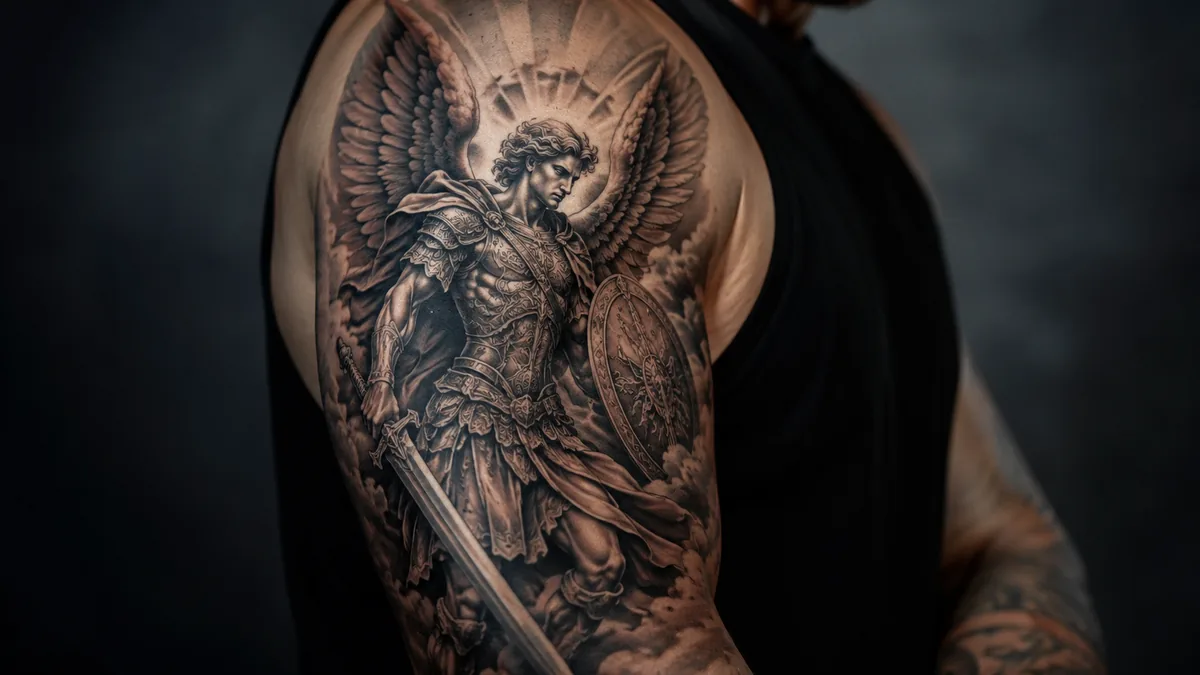
Archangel Michael is one of the most powerful tattoo subjects you can put on your body. He’s the warrior angel, the defender, the one who cast Satan out of Heaven. People don’t get this tattoo because it looks cool on a flash sheet. They get it because it means something deep.
The symbolism is layered but clear: protection, divine justice, strength over evil, and personal faith. If you’re Catholic, Orthodox, military, or just someone who’s been through hell and came out standing, this piece carries real weight. Here’s what it actually means and how to wear it right.
Core Meaning: Protection and Divine Power
Archangel Michael is the protector. In every major tradition that recognizes him, he’s the one standing between humanity and destruction. As a tattoo, he represents a shield, a force that watches over the person wearing it. A lot of clients describe it as carrying a guardian on their skin.
He’s also tied to divine justice and righteous strength. Not aggression for its own sake, but the power to fight for what’s right. People who’ve survived serious hardship, violence, illness, or loss often connect with that idea. The tattoo says: I faced something dark, and I’m still here.
Historical and Religious Background
Michael doesn't just have wings, he has a sword, a verdict, and a foot on the devil's neck.
Michael appears in the Bible, the Torah, and the Quran, making him one of the few figures shared across Christianity, Judaism, and Islam. In the Catholic tradition he’s the patron saint of soldiers, police officers, and paramedics. The image of him standing over a defeated Lucifer comes from the Book of Revelation and has been painted and sculpted for centuries.
The most iconic visual, Michael with his sword and foot on a fallen figure, traces directly to Renaissance and Baroque religious art. Guido Reni’s 1636 painting is probably the single biggest influence on how tattoo artists draw him today. That’s real history. The imagery has been consistent for four hundred years.
Popular Design Variations
The classic is full-figure Michael in armor, sword raised or pointed down at Satan, wings spread wide. That version reads strong from across the room and works as a large back piece, chest piece, or full sleeve element. Some clients want a portrait-style face close-up with wings framing it, which fits a thigh or rib placement well.
There’s also the minimal approach: just the silhouette, the sword, or a single wing with a name or date. Fine line versions are popular right now, though they fade faster than bold traditional or black and grey. Scales of justice get added when the client wants to emphasize judgment over pure warrior energy. Each variation shifts the meaning slightly without losing the core.
Black and Grey vs. Color
Black and grey is the dominant choice for this subject, and for good reason. The drama of a shaded Michael, deep blacks in the shadows of the armor, soft whip shading on the wings, looks cinematic and ages gracefully. A skilled artist can make this piece feel like a classical painting on your skin. It holds well over time if the lines are solid and the grey tones are properly saturated.
Color versions are striking, especially with gold armor, red or blue robes, and a deep sky background. The saturated pigments look incredible when fresh. The tradeoff is maintenance. Color fades faster than black and grey, especially on areas with friction or sun exposure. If you go color, commit to touch-ups every few years or the piece starts looking tired.
Placement and How It Ages
The back is the most popular placement, and it earns that reputation. You have the canvas to go large, spread the wings fully, and give the whole composition room to breathe. A full back Michael heals well because it’s a low-friction zone compared to hands or feet. The chest is the second top choice, with Michael centered or slightly off to one side over the heart.
Thighs and upper arms work for medium-scale pieces. Avoid cramming too much detail into small spaces. This design does not compress well. Fine line versions on the forearm or inner bicep can look clean when fresh, but detail-heavy angels get muddy over time. Bold will hold. If your artist recommends going slightly bigger than you planned, trust them.
Pain Zones for This Piece
Because Michael typically runs large, you’re probably hitting multiple zones in one session or across multiple sittings. The back is manageable for most people, the spine gets spicy but tolerable. The chest is more intense, especially toward the sternum and collarbone. Ribs are where clients tap out, so if your design wraps there, build that into your pain tolerance math.
Thigh pieces are generally on the lower end of pain. Inner bicep is moderate, with some nerves in the armpit area lighting up near the end of a long session. Eat a solid meal before you sit, stay hydrated, and communicate with your artist. A large Michael can easily run three to five hours. No shame in splitting it into two sessions and letting your body recover.
Who Gets This Tattoo and How to Make It Personal
Military and law enforcement are a huge part of the clientele for this piece, given Michael’s status as a patron saint of those professions. First responders, veterans, and people who work in high-risk fields wear it as both a blessing and a statement of identity. It’s also common among people who’ve lost someone, with a name or date worked into the design.
Faith communities across Catholic, Orthodox, and evangelical backgrounds get this piece as a straightforward religious statement. But plenty of non-religious clients choose it for the pure symbolism, overcoming darkness, standing firm, finding strength after a hard time. Talk to your artist about what specific element resonates most. The sword, the defeated figure, the wings, the armor, each one can be emphasized to reflect your personal story.









