
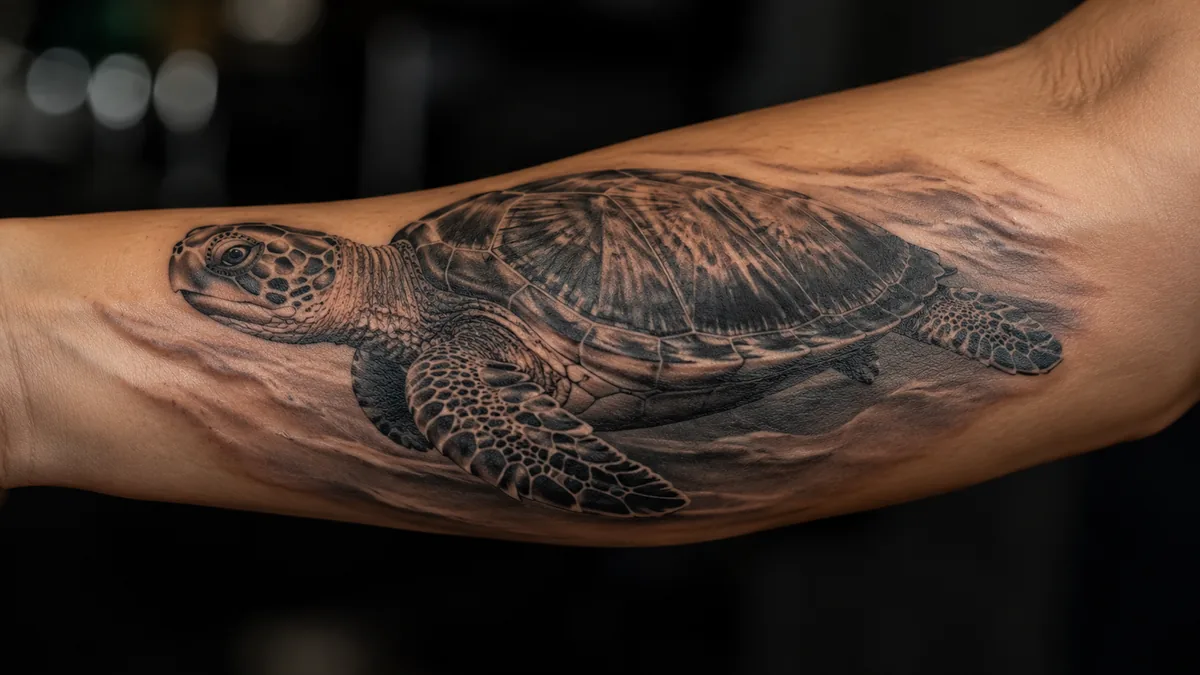
Sea turtle tattoos have been popular for decades, and the meaning holds up. These animals live for over a century, cross entire oceans on instinct, and survive conditions that would wreck most creatures. People get them because they want to carry something that actually stands for something, not just a cool animal.
The symbolism cuts across cultures and personal stories. Longevity, patience, protection, finding your way home. If you’re going traditional Hawaiian, fine line, or bold neo-trad, the meaning lands the same. This is one of those tattoos that reads clean on the skin and hits hard in the meaning department.
Core Symbolism: What a Sea Turtle Tattoo Actually Means
The sea turtle stands for longevity above all else. These animals can live 80 to 100 years in the wild, some species even longer. That’s the number one reason people reach for this image. It’s about endurance, slow steady progress, and the long game. You don’t rush, you navigate, you survive.
Beyond age, the sea turtle is deeply tied to navigation and finding your way home. Female sea turtles return to the exact beach where they were born to lay their eggs, sometimes after decades at sea. People who’ve been lost and found their footing again, or who’ve moved far from home and stayed grounded, feel that one hard.
Cultural and Historical Background
A sea turtle doesn't rush the ocean, and a good tattoo shouldn't rush the artist.
In Hawaiian and broader Polynesian tradition, the sea turtle, called honu in Hawaiian, is one of the most sacred symbols. It represents good luck, endurance, and the spirit of the ocean. The honu is a navigator and a protector. Polynesian tattoo culture, including traditional Samoan and Maori work, has incorporated turtle imagery for centuries as a mark of guidance and connection to ancestors.
In many Indigenous cultures of the Pacific Islands and North America, the turtle represents the earth itself. Some creation stories describe the world resting on a great turtle’s back. That layer of meaning, being grounded, carrying weight without breaking, resonates with a lot of people even outside those traditions. Just be aware of the difference between appreciation and appropriation, and talk to your artist.
Popular Design Variations and Styles
You’ve got a wide lane here. Traditional and neo-traditional sea turtles are bold, high-contrast, and read from across the room. The shell gets rendered with thick outlines and saturated fills, perfect for anyone who wants the tattoo to stay crispy for decades. Tribal and Polynesian styles use geometric patterns within the shell and body, often incorporating symbols that add personal or cultural layers.
Realism and watercolor styles are also huge in this subject. A realistic sea turtle in black and grey can be stunning, especially when the shell texture is done right. Watercolor treatments add blues, greens, and teal washes for a more painterly feel. Fine line sea turtles are trending but require a skilled hand and a low-wear placement to hold detail long-term.
Color vs Black and Grey
Color sea turtles pop, especially with greens, teals, and deep ocean blues. A saturated color piece on the right skin tone is a showstopper. The shell gives your artist a natural mosaic to work with, and it translates beautifully into bold palette choices. Just know that color fades faster than solid black, especially in high-sun zones. Sunscreen is your best friend.
Black and grey sea turtles hold up better over time and tend to feel more versatile across body placement. A well-whip-shaded black and grey turtle on the forearm or shoulder will still look solid in 20 years if it was done right. If you’re torn, go talk to your artist about your skin tone and lifestyle. Both options are strong, but the commitment is different.
Best Placements and How It Ages
The shoulder blade, upper arm, and thigh are classic placements for this subject. The round shape of the turtle’s shell fits naturally into those curved muscle groups. You get enough real estate to add ocean elements, waves, or coral without crowding, and these are moderate-pain zones. Low-wear areas mean the detail holds longer.
Avoid the inner wrist, fingers, and feet for anything with fine line detail. Those zones are spicy on the pain scale and the tattoo will blow out or fade faster with friction and sun exposure. The upper back and sternum work great for larger pieces. The ribcage is a popular placement but it’s spicy and requires real commitment. Bold lines will hold anywhere better than ultra-thin fine line work.
Personal Meaning: Who Gets This Tattoo and Why
Ocean people get sea turtles. Surfers, divers, sailors, people who grew up on the coast or feel called to the water. For them it’s identity as much as meaning. But you don’t need to live near the ocean for this to be your tattoo. People who’ve survived serious illness, loss, or long difficult transitions reach for the turtle because it represents slow steady survival, not flashy strength.
Parents get sea turtles to represent raising children and watching them navigate the world. Veterans, cancer survivors, people in recovery. The turtle doesn’t sprint, it endures. If you have a personal story that lines up with that energy, this tattoo will feel right every single time you see it. Make it yours by working with your artist on elements that lock in your specific chapter.
Working With Your Artist to Nail the Piece
Bring reference photos but stay open. A good artist will tell you what reads clean at the size you want and what will turn into a muddy blob in five years. Fine line hatching inside a tiny shell sounds cool until the lines merge together after healing. Go bold enough that it holds. Discuss whether you want a realistic shell pattern or a stylized one, and if you’re adding a background scene or keeping it clean and isolated.
Think about the long game. A sea turtle with hard lines and solid fills will look better at 20 years than an ultra-delicate watercolor piece in a high-friction zone. Talk about touch-up plans if you’re going light washes or fine line. Your artist should be able to tell you exactly how a design will heal on your specific skin. That conversation before you commit is what separates a great tattoo from one you’re already fixing in three years.









