
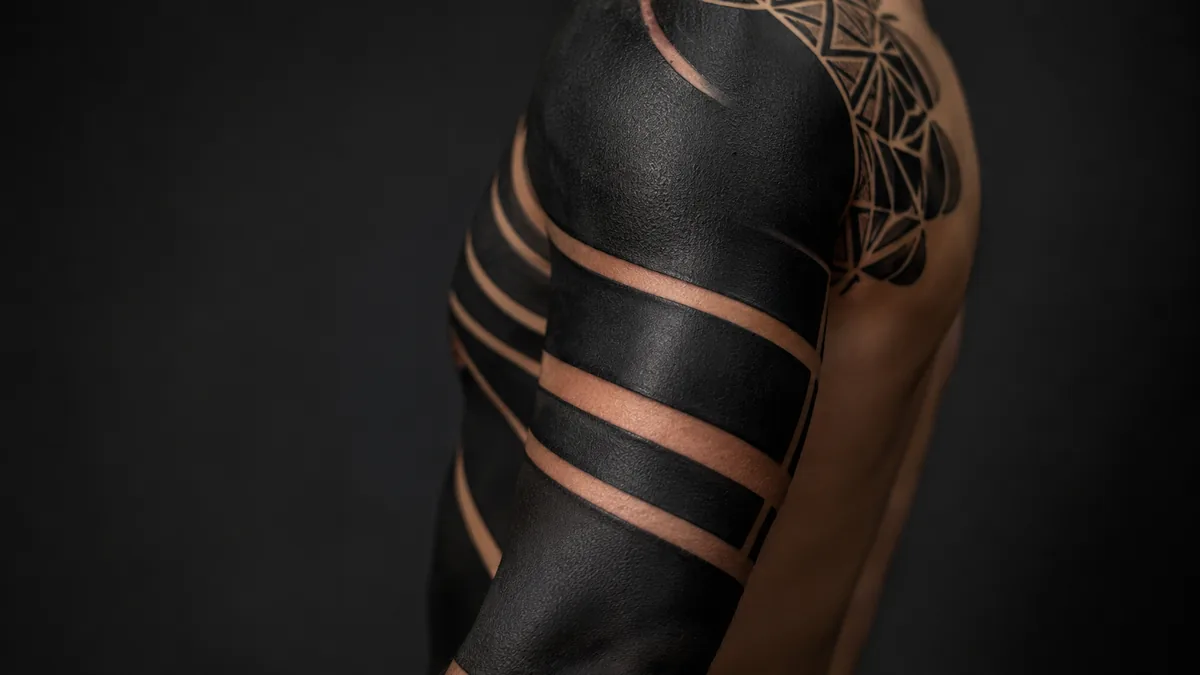
Blackout tattoos are exactly what they sound like: large areas of skin filled in completely with solid black ink. No outline tricks, no shading gradients, no peeking skin. Just dense, saturated black from edge to edge. They’re one of the boldest statements you can walk into a shop and ask for.
The meaning behind a blackout piece runs deeper than the ink itself. Some people are covering something up. Some are making a power move about ownership over their own body. Some just want something that reads from across the room with zero apology. The reasons are personal, but the symbolism threads through all of them.
The Core Meaning: Reclaiming Your Skin
The most common reason people get blackout tattoos is reclamation. They’re covering old work they regret, scars they don’t want to explain anymore, or skin that carries memories they’ve moved past. The solid black is a full stop. It says: that chapter is done. Whatever was there before doesn’t define you now. It’s a deliberate, permanent reset.
That act of covering carries real psychological weight. Clients who go this route often describe it as freeing. The blackout becomes a before-and-after line on their body. It’s not erasure exactly, because the skin remembers, but it’s a public-facing signal that you’ve chosen something new over something old.
Darkness, Strength, and the Void
You are not hiding something. You are choosing what your skin says from here on out.
Beyond cover-ups, blackout tattoos carry a symbolism tied to darkness itself. In a lot of traditions, solid black represents the unknown, the void, endings, and raw power. People who resonate with shadow work, inner struggle, or periods of deep personal transformation are drawn to the blackout for exactly that reason. It’s not nihilism. It’s acknowledgment that darkness is part of the human experience.
Some clients pair blackout panels with negative space designs cut out of the black, letting the skin show through as the actual image. That contrast between void and light becomes its own statement: something surviving inside the dark. A lotus, a geometric shape, a portrait left bare while everything around it goes black. The symbolism doubles up cleanly.
Historical and Cultural Context
Blackout tattooing isn’t some brand-new Instagram trend. Heavy black saturation has roots in traditional Polynesian tattooing, specifically in styles like Pe’a from Samoa and various Maori and Hawaiian traditions, where large solid black areas covered significant portions of the body to signal status, lineage, and spiritual protection. The full coverage wasn’t decorative for its own sake. It carried meaning about who you were and where you came from.
Modern blackout tattoos borrow the visual weight of those traditions without always carrying the cultural specifics. That’s worth being honest about when you’re choosing one. If you’re drawing directly from Polynesian tradition, that’s a conversation to have with an artist who understands the context. If you’re working in the contemporary Western blackout style, it’s its own thing, descended from those roots but now operating with its own distinct symbolism.
Design Variations: From Full Sleeve to Accent Panels
Blackout tattoos range from full limb coverage to targeted panels. A full blackout sleeve is the most committed version: the entire arm, top to bottom, solid black. Some people do half sleeves or calf panels. Others go for geometric blackout sections that frame existing work or act as bold negative space backgrounds. The variation in approach changes how the piece reads, but the density of the black is always the through-line.
Negative space blackout designs are their own category. The artist fills everything black except a shape cut out intentionally, letting the bare skin become the image. A white-ink overlay on black is also possible but fades unpredictably and needs consistent touch-ups. Most experienced artists will steer you toward clean negative space work over white-on-black if longevity matters to you.
How Blackout Tattoos Age and Heal
Bold will hold, and blackout tattoos are the proof. Fully saturated black is one of the most stable things you can put on skin. It doesn’t fade into blurry chaos the way fine-line work does. It softens slightly over years, the edges losing a little crispness, but it stays readable and solid. That’s part of why so many people choose it for high-wear zones like the forearm or calf where lighter work gets beat up faster.
Healing a blackout piece takes commitment. You’re covering a large surface area, which means more aftercare, longer healing time, and real attention to keeping it moisturized. Peeling on a fully saturated piece is more dramatic than on a regular tattoo. Your artist should walk you through the process specific to the size of your piece. Follow that protocol and the healed result will be clean and dense.
Placement, Pain, and What to Expect in the Chair
Placement matters a lot with blackouts. The inner arm, inner thigh, and ribs are spicy. The outer forearm, upper arm, calf, and thigh are much more manageable for large-scale black work. For a full limb blackout, expect multiple sessions. Responsible artists won’t hammer a full arm in one sitting. The skin needs time to absorb ink properly, and rushing a saturated piece increases the chance of blowout or uneven density.
Time in the chair for blackout work is longer than most people expect. Full saturation requires multiple passes with a shader to build the black to a true solid. Your artist will likely use a magnum or curved magnum needle grouping for the fill, which covers ground efficiently. The sound is different, the pressure is different, and the healing is more intense. Go in knowing that, and you’ll be fine.
Who Gets Blackout Tattoos and How to Make It Personal
The people who get blackouts are all over the map. Collectors covering old regrettable work, people reclaiming skin after medical procedures or trauma, artists who want a bold design statement, and folks who just love the aesthetic of heavy black work. There’s no single type. The motivation shapes the meaning more than any external symbolism does. That’s what makes the blackout personal regardless of how it looks from the outside.
To make your blackout yours, be specific with your artist about why you’re doing it. That context shapes decisions: where exactly the black starts and stops, whether negative space is part of the concept, whether you want crisp geometric edges or a more organic border. The more intentional you are going in, the more the finished piece will actually say what you want it to say. Bring references, ask questions, and trust a specialist who’s done real blackout work before.









