
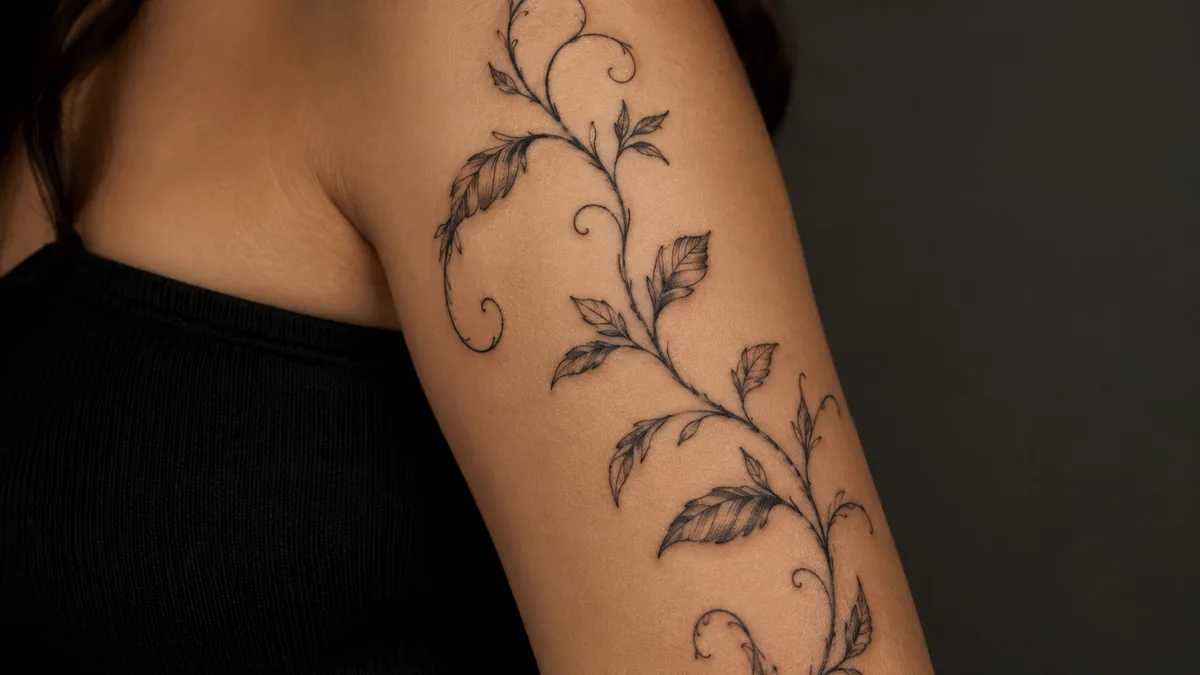
Vines don’t stop growing. That’s the whole point. A vine tattoo is one of the oldest nature symbols in the book, and people still get them because the meaning holds up. Growth, persistence, connection, the way life keeps reaching even when conditions are rough.
The design is flexible too. Wraps around an arm, climbs a spine, curls around an ankle. It can be delicate fine line or bold blackwork. The meaning shifts slightly depending on what you pair it with, but the core stays the same: this is a living thing that keeps going.
Core Symbolism: What a Vine Tattoo Actually Means
Vines represent growth, resilience, and endurance. A vine doesn’t grow in a straight line. It bends, wraps, climbs over obstacles, and finds a way forward. That’s why people who’ve pushed through hard chapters, grief, addiction, a rough few years, often land on a vine. It’s not a dramatic symbol. It’s quiet and honest.
Connection is the other big one. Vines link things together. They’re used to represent relationships, family bonds, the way lives intertwine. Some people get a vine to mark a long friendship or a partnership that’s held through real pressure. Others just relate to the idea of reaching, always reaching, toward something better.
Historical and Cultural Background
A vine doesn't grow straight, that's the whole point.
Grapevines show up in ancient Greek and Roman iconography tied to Dionysus and Bacchus, gods of wine, abundance, and celebration. In those traditions, the vine was a symbol of fertility, joy, and the harvest. Early Christian art borrowed the imagery too. The grapevine appears repeatedly in biblical text as a symbol of spiritual connection and fruitfulness, “I am the vine, you are the branches” is one of the most quoted lines in the New Testament.
In Celtic knotwork, interlacing vine and tendril patterns represent the continuity of life, the endless cycle of growth and renewal. Japanese tattooing also incorporates vine and botanical elements as natural motifs tied to seasonal beauty and the passage of time. None of this is forced or borrowed loosely. Vines have genuinely carried symbolic weight across cultures for thousands of years.
Design Variations: From Delicate to Bold
Fine line vine tattoos are everywhere right now. Thin, precise lines wrapping around a forearm or ankle, sometimes with tiny leaves, sometimes bare stems. They look clean out of the gate and feel minimal. The trade-off is longevity. Fine line work in high-wear zones or on skin that moves a lot can spread and lose definition over time. Low-wear placement matters more with this style.
Blackwork and neo-traditional vines are a different beast. Thick outlines, solid black fill, high contrast. These read from across the room and hold up much better over years of sun and wear. Some artists do illustrative botanicals with shading, others do geometric or abstract vine forms. Ivy, wisteria, and grapevine are common choices because they each carry their own layer of meaning on top of the vine itself.
Color vs Black and Grey
Black and grey vine tattoos are clean and versatile. They work on almost every skin tone when the contrast and values are handled right. A good whip shade on the leaves gives depth without going full color. These age predictably. The grey lightens a bit, the black stays solid if it was packed well. Bold will hold applies here the same as anywhere else.
Color vine tattoos can be stunning, especially with lush greens, deep purples for grapes, or soft botanicals with muted tones. The risk is fading, particularly with lighter greens and yellows. Saturation matters. A heavily saturated piece holds color better than a light pastel one. Sun exposure accelerates fading on any color tattoo, so placement plays into this decision more than people expect.
Placement and How It Ages
Vines are built for wrapping placements. The forearm, upper arm, thigh, and calf are classic. A vine running up the spine or around the ribcage is popular and looks incredible, though the ribcage is spicy and the spine takes patience. Ankle and wrist wraps are common but watch the fine line aging issue there. Hands and fingers are the hardest to maintain because of constant movement and wear.
For longevity, the upper arm, outer forearm, and calf are your safest bets. Skin there is relatively stable, not constantly folding or rubbing. The inner bicep and inner arm hold ink well and stay out of the sun. Whatever zone you pick, talk to your artist about line weight. A vine tattooed with lines that are too thin for the placement will look blown out and muddy within a few years.
What You Pair It With Changes Everything
A vine on its own reads as growth and resilience. Add a rose and you bring in love, passion, sometimes loss depending on the style. Add ivy specifically and you layer in loyalty and fidelity, ivy is one of the traditional symbols for enduring bonds. Grapevines pull in abundance and celebration. Wisteria adds a Japanese influence and a sense of beauty in impermanence. The vine is a framework. What grows on it is where you make it personal.
Skulls woven into vines appear in a lot of traditional and neo-traditional work. Life growing through death. Butterflies or birds perched on vines add transformation or freedom to the narrative. Some people integrate dates, coordinates, or initials into the design without making it look like a memorial piece. Talk to your artist about how to layer meaning without cluttering the read of the tattoo. Simplicity usually wins at any scale.
Who Gets Vine Tattoos and How to Make Yours Personal
Vine tattoos cross every demographic. They’re not gendered, not tied to a specific subculture, not locked into one style. That’s part of why they hold up as a concept. A 22-year-old getting their first sleeve starter piece and a 45-year-old marking a decade of sobriety can both land on a vine and mean it completely differently.
To make it yours, get specific. What kind of vine? What does it grow toward or wrap around? Is it bare and structural or full of leaves and blooms? Does it cover something, connect two things, or stand alone? Bring reference images, talk about what the piece is marking for you, and let your artist design something that fits your body rather than just placing a flash outline. That’s the difference between a tattoo you got and a tattoo that means something.









