
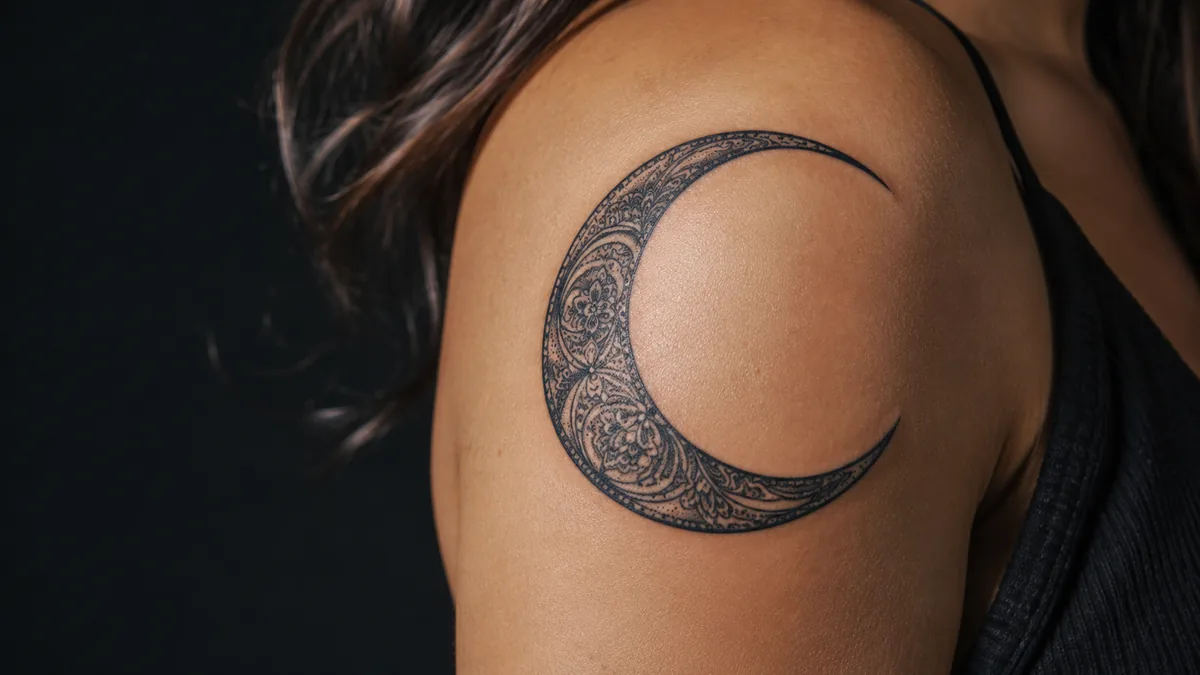
The crescent moon is one of those tattoos that looks simple and hits hard. A thin arc of light against the dark. People see it and immediately understand it without needing a label. That’s the power of a symbol that’s been around longer than writing itself.
This piece earns its spot on skin because it carries real weight. Change, mystery, the feminine, the in-between. If you’re thinking about getting one, here’s what it actually means and what you need to know before you sit down in the chair.
Core Meaning: Change, Cycles, and the In-Between
The crescent moon represents transition. It’s not the full moon, not the new moon. It sits right in the middle of a cycle, and that’s exactly the point. Most people who get this tattoo are marking a shift in their life. A chapter closing. A new one starting. The crescent says: I’m moving through something.
It also carries strong associations with intuition and inner knowledge. The crescent shows what the moon knows even when most of its face is hidden. That idea resonates with people who trust their gut over logic, who navigate by feeling. It’s a quiet confidence. Not loud about it, but solid.
Feminine Energy and Goddess Symbolism
The crescent does not light the whole sky, it marks the moment everything is about to change.
The crescent moon has been tied to feminine energy across dozens of cultures for thousands of years. Artemis in Greek myth, Diana in Roman tradition, both virgin huntresses shown with a crescent at their brow or in their hair. Selene, the moon goddess herself, wore it as a crown. These weren’t just decorative choices. The crescent tracked the lunar cycle, which ancient peoples linked directly to female biology and fertility.
In modern tattooing, people use the crescent to honor womanhood, maternal lineage, or their own feminine power without leaning on overtly religious imagery. It works for anyone who identifies with the moon’s energy regardless of gender, but statistically it skews toward women getting this one. It’s personal, not prescribed.
Spiritual and Mystical Associations
Outside of specific goddess mythology, the crescent moon sits comfortably in broader spiritual symbolism. In Islamic tradition the crescent and star together are a recognized emblem of faith, though that specific paired design carries different weight than a standalone crescent tattoo. The standalone crescent in Western tattoo culture leans more toward paganism, Wicca, and general lunar spirituality. It’s a symbol for people who feel connected to nature’s rhythms, moon phases, and cycles of growth and release.
Some people use the crescent to represent manifestation. The waxing crescent specifically, the one growing toward full, is about setting intentions and building toward something. If someone gets a waxing crescent, they’re usually in a hopeful, forward-moving headspace. A waning crescent points toward release, letting go, rest. Small difference in orientation, big difference in personal meaning.
Popular Design Variations
The bare crescent outline is the classic. Clean, thin, reads from across the room. Pair it with a face in profile inside the moon and you’ve got centuries of artistic tradition behind you. That crescent-with-a-face design shows up in old sailor tattoos, Americana flash, and woodblock prints alike. Add a star tucked beside it and the composition tightens up nicely. Floral fills, botanical details growing along the arc, are huge right now in fine-line work and they age better than you’d expect if the artist spaces them right.
Geometric and mandala-style crescents bring in sacred geometry vibes. Celestial compositions stack the crescent with suns, planets, and phases of the moon in a full spread. Blackwork crescents with heavy fill and bold outlines sit on the opposite end of the spectrum from fine-line, but both can be stunning depending on skin tone and placement. Let your artist guide you on line weight for your specific spot.
Black and Grey vs. Color
Black and grey is the default choice for a crescent and for good reason. The shape is geometric and the contrast between black ink and bare skin already communicates everything the symbol needs to say. A well-executed black and grey crescent with soft whip shading behind it looks clean, heals nice, and stays legible for years. Fine-line single-needle work on a crescent can look incredible fresh, but be honest with your artist about your skin type. Fine lines on certain skin tones or textures can blow out or fade faster.
Color opens up the mood considerably. Deep navy or indigo backgrounds with a pale yellow or white crescent feel celestial and dramatic. Gold or yellow ink on the crescent itself pops against dark skin beautifully when an artist knows how to saturate properly. Watercolor washes around the shape are popular but unpredictable long-term. If you want color, go with an artist whose healed work you’ve seen in person, not just fresh photos on Instagram.
Placement and How It Ages
The crescent is a versatile shape. It fits a wrist, the back of the neck, behind the ear, the inner ankle, the collarbone, a sternum piece, the ribcage, or scaled up for a forearm or upper arm. Smaller placements behind the ear and on the wrist are high-wear zones. Rings, sleeves, and friction will work on those spots over years. Expect to touch up fine-line work in those areas. A bolder line weight holds longer in those spots, so think about that trade-off.
The ribcage and sternum are spicy as spots go, but placement is protected from sun and friction so the tattoo lasts better structurally. The upper arm and forearm give your artist room to work with detail and the design reads well in everyday life. Wherever you put it, keep it out of the sun during healing and use SPF on it after. UV light is the main enemy of any tattoo’s longevity.
Who Gets This Tattoo and How to Make It Yours
The crescent moon crosses a lot of demographics. Witchy and pagan communities love it. Spiritual but non-religious people love it. People coming out of hard periods in their lives, breakups, grief, addiction recovery, big moves, are drawn to it as a marker of transition. It shows up on first-timers because it’s approachable and on heavily tattooed collectors because the shape works well as a compositional anchor in larger pieces.
To make it personal, anchor the design to a specific moment or meaning rather than just liking how it looks. Think about phase orientation: waxing or waning. Think about what you put inside or around it. A birth flower growing along the arc. A constellation that matters to you. Your artist can work initials or coordinates into the negative space subtly. The crescent is a strong foundation. Build something on it that’s actually yours.









