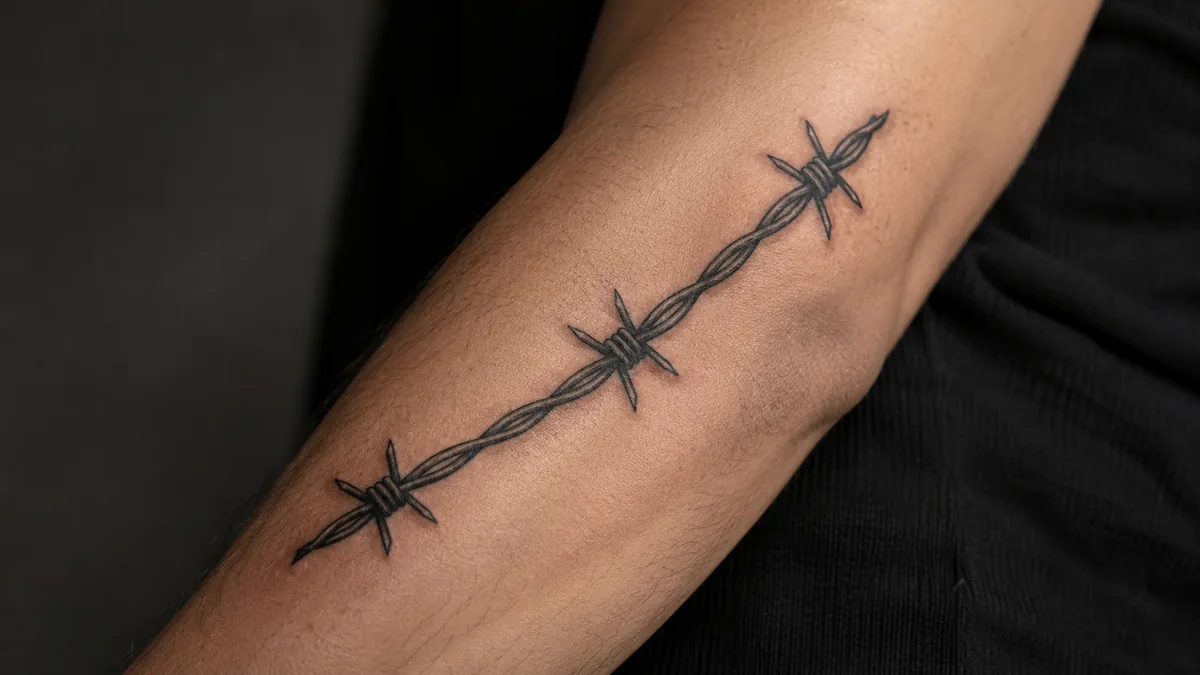
Barb wire tattoos mean one thing at the core: you’ve been through something and you’re still standing. The symbol is built into the design itself. Sharp points, rigid lines, a material made to contain and to hurt. People wear it because it communicates toughness without a speech.
It’s one of the most recognized silhouettes in American tattooing. Simple, bold, reads from across the room. But there’s more going on beneath the surface than most people realize. The meanings are layered, personal, and in some cases carry real historical weight.
Core Meaning: Strength, Struggle, and Survival
Barb wire is a barrier material. It was engineered to stop movement, to mark boundaries, to inflict pain on anything that pushes through. As a tattoo, that context carries directly over. The person wearing it is saying they’ve hit hard limits in life and kept going anyway. It signals resilience. Not soft resilience either. The grit-your-teeth, keep-moving kind.
A lot of people get it after a difficult stretch. Illness, incarceration, loss, addiction recovery, military service. The wire becomes a visual record of something they survived. It’s not decorative for these clients. It’s a marker. The meaning is earned, not borrowed.
Protection and Boundaries
Barb wire does not ask for permission, it just holds the line.
Beyond survival, barb wire reads as a warning. Don’t cross this. The design wraps around the body, and that wrapping motion reinforces the idea of a perimeter. Wearing it says something about how you move through the world. There are lines you don’t cross, things you protect fiercely, and you’re not afraid to make that visible.
Some clients are specific about this. They’re coming in after setting hard limits in relationships, or leaving toxic situations behind. The tattoo is a reminder as much as a statement. Every time they see it, it reinforces what they’re protecting and what they’ve decided they won’t tolerate anymore.
Historical and Cultural Background
Barb wire has real history. It was invented in the 1870s and transformed the American West, literally reshaping how land was controlled and who had power over movement. It became a tool of division and, later, of confinement. It appeared heavily in imagery around prison camps and wartime detention. That weight is real and it sticks to the symbol.
In tattoo culture, the barb wire armband exploded in the 1990s. Pamela Anderson’s bicep wrap in the 1995 film Barb Wire made it a pop culture moment, but the design was already circulating in biker, prison, and hardcore subcultures well before that. The mainstream surge didn’t erase those original roots. Both meanings coexist.
Design Variations: Armband, Crown of Thorns, and Custom Wraps
The armband is the classic execution. A clean wrap around the upper arm or lower leg, continuous loop, solid black. It’s timeless and still works. The crown of thorns variation places the wire around the forehead in portrait tattoos or wraps it as a standalone headband design, which pulls in a spiritual reading connected to suffering and sacrifice, specifically Christian iconography.
Custom wraps go further. Some clients add roses growing through the wire, which balances beauty against pain. Others integrate names, dates, or animals caught in or breaking through the wire. Skulls tangled in barb wire lean hard into the danger and mortality angle. Each addition shifts the read without losing the core symbolism.
Black and Grey vs. Bold Black Linework
Most barb wire tattoos work best in solid black. The design depends on clean, crispy lines and sharp contrast. A bold traditional execution with packed black fills and thick outlines holds for decades. It reads clearly, doesn’t rely on color to carry the image, and the high-contrast silhouette stays legible as the skin ages and the piece settles.
Fine line barb wire is doable but riskier long-term. Thin lines in high-wear zones can blow out or fade unevenly. Black and grey with whip shading adds dimension to pieces that incorporate other elements like skulls or flowers. Color is rare and usually unnecessary. If someone does add color, deep red on the barb points is the most common choice, leaning into the blood and pain symbolism.
Placement, Pain, and How It Ages
The upper arm armband is the most popular placement and the most practical. Decent skin thickness, manageable pain level, ages well. The bicep and outer arm hold ink solidly over time. The lower leg works similarly. Both zones are low-wear relative to hands or feet, so the lines stay tighter longer. A clean wrap on a muscular limb with consistent skin tone is the ideal scenario.
Avoid fine line barb wire on the inner wrist, fingers, or inner bicep. Those areas are spicy to tattoo, prone to blowout on thin linework, and wear fast. If you want placement in a higher-wear zone, go bolder. Thick lines hold. Fine lines in those spots will look blown and muddy inside a few years. Your artist should be straight with you about this before you commit.
Who Gets It and How to Make It Your Own
Veterans, ex-convicts, survivors of illness, athletes, bikers, and people who’ve simply had a rough run all reach for this design. It’s not exclusive to any one group, and the meaning doesn’t require explanation. The symbol communicates directly. That’s its power. It’s also one of the few designs that reads as tough regardless of gender or body type.
To make it personal, think about what you’re wrapping and why. Adding something that breaks through the wire changes the message from containment to escape or triumph. Integrating a specific flower, animal, or date ties it to a concrete moment in your life. Talk to your artist about flow, scale, and spacing. A wire that fits your body’s curves and moves with the limb looks intentional. One that’s too tight or too sparse looks like an afterthought.