A knot tattoo isn’t just a cool shape on your skin. It’s one of the oldest symbols humans ever used, and it carries real weight. Unity, love, strength, fate, eternity, the idea that something holds and doesn’t let go. People have been tying knots to mark moments for thousands of years, and getting one inked is a direct extension of that instinct.
The specific meaning shifts depending on the knot you choose. A Celtic knot reads differently from a sailor’s knot or a simple infinity loop. This guide breaks down what each major style actually means, what the cultural roots are, and how to get one that holds up on skin for the long haul.
Core Symbolism: What a Knot Tattoo Actually Means
At its foundation, a knot represents connection and continuity. Something tied together that resists being pulled apart. That core idea branches into a handful of meanings depending on context: commitment between people, the bond of family, the permanence of love, or the unbreakable nature of a personal promise. It’s a tight concept and it translates cleanly to tattoo work because a knot has no loose ends.
A lot of clients come in wanting a knot because they’ve been through something hard and came out holding. That resilience angle is real. A knot under tension is strongest. It’s not just pretty geometry. When someone points to their wrist and says ‘I want a knot right here,’ there’s usually a story behind it, and the symbol earns that story.
Celtic Knots: The Most Recognized Variation
The right knot never loosens, that is the whole point.
Celtic knotwork comes from early medieval Ireland, Scotland, and Wales. The defining feature is no beginning and no end. The lines loop continuously through themselves, which is exactly why these designs became symbols of eternity and the cyclical nature of life, death, and rebirth. The triquetra, the Celtic cross knot, the Dara knot, they all carry that same infinite-loop logic. Real historical use shows up in illuminated manuscripts like the Book of Kells and on stone carvings going back to around the 7th century.
In tattoo terms, Celtic knots read as a bold, graphic style. Black and grey works great with tight, even line weight. The symmetry rewards clean execution. A sloppy Celtic knot looks rough fast because the eye catches any deviation in the interlacing. Go to an artist who has done Celtic work before. Check their portfolio specifically for it. This isn’t a design you want someone freestyling on your skin.
The Sailor’s Knot and Its Maritime Roots
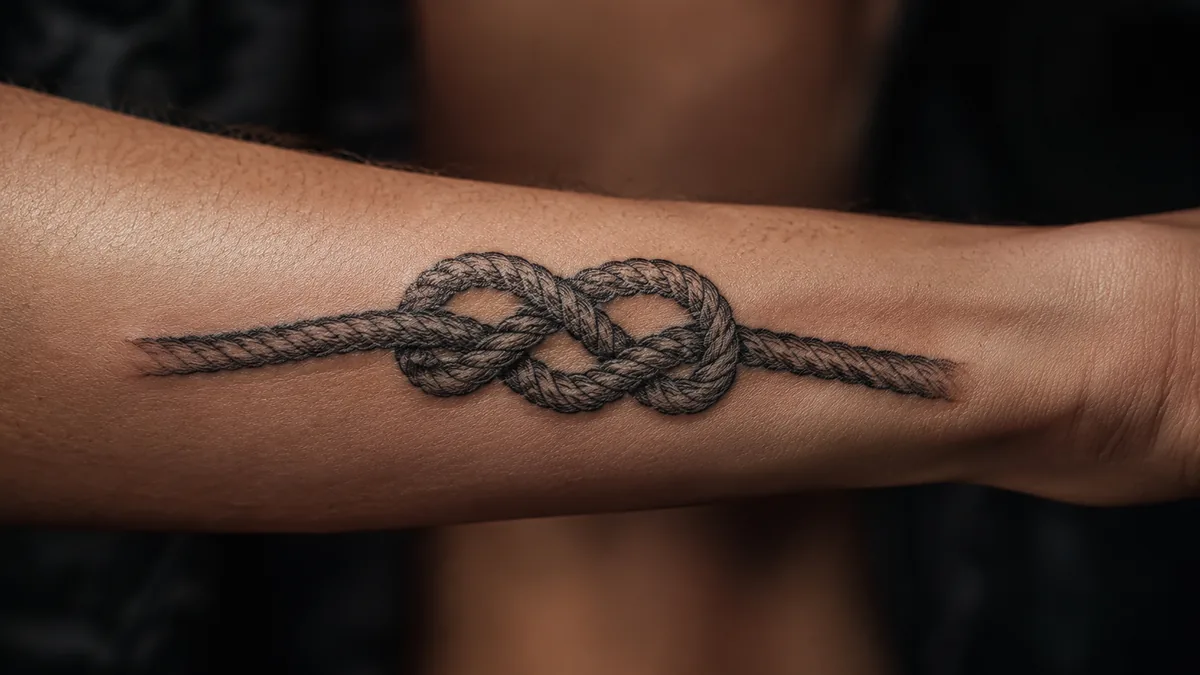
The sailor’s knot, often drawn as two ropes interlocked in a square or reef knot pattern, has roots in maritime tradition. Sailors tied knots as practical tools for survival at sea, but they also carried them as tokens of love and connection. A common tradition had sailors giving knot-based gifts to loved ones before voyages, symbolizing the hope of return and the bond that stretched across the ocean. The heart knot variant evolved from this, two loops forming a heart shape.
As a tattoo, the sailor’s knot leans vintage. It pairs perfectly with traditional American flash, think bold outlines, limited color palette, red and black or black and grey. It heals well in that style because the lines are thick enough to hold over time. High-wear spots like fingers and hands will degrade faster, so if you want that crispy read for years, wrist, forearm, or upper arm is the smarter call.
The Infinity Knot and Love Knot Meanings
The infinity knot is closely related to the figure-eight shape and carries obvious symbolism: endless love, a bond without finish line, ongoing connection. It’s a popular couples tattoo for exactly that reason. The love knot is a variation where two loops intertwine, representing two people joined together. Neither of these has a single ancient origin story you can pin down, they evolved across multiple cultures as natural extensions of rope-and-bond thinking.
These designs tend toward the simpler, cleaner end of the spectrum. Fine line work suits them well for placements like the inner wrist, collarbone, or behind the ear. One honest note: fine line tattoos in high-wear zones fade and blur. If you go delicate, protect it with sunscreen and keep it out of constant friction. A slightly bolder line weight gives you the same clean look and lasts significantly longer.
The Gordian Knot: Cutting Through Complexity
The Gordian knot comes from Greek mythology. King Gordias of Phrygia tied an impossibly complex knot, and prophecy said whoever untied it would rule Asia. Alexander the Great reportedly solved it by slicing through it with his sword. That story gave us a phrase still in use today: ‘cutting the Gordian knot’ means solving an overwhelming problem with a bold, unconventional move. As a tattoo, it symbolizes overcoming impossible odds, decisive action, and refusing to be beaten by complexity.
Visually, a Gordian knot tattoo is a dense, tangled mass of rope that has no clear path through it. Sometimes it’s shown with a sword or blade cutting through. It’s a more unusual choice than a Celtic knot and signals that the wearer has a specific story in mind. This design needs room to breathe. An upper arm or thigh gives the artist space to make the intricacy actually legible, rather than a muddy blob.
Style Variations: From Traditional Flash to Fine Line
Knot tattoos work across a wide range of styles. Traditional American gives you bold outlines, flat fill, and strong contrast that reads from across the room and holds for decades. Bold will hold is a real principle here. Blackwork and geometric styles treat knots as pure form, often incorporating sacred geometry or mandala elements. Fine line tattooing renders them with delicate single-needle work, soft and intricate but demanding clean skin and a skilled hand.
Black and grey knots have a timeless quality. The shading gives depth to the interlacing and makes the over-under pattern of the ropes pop. Color is less common but works in a traditional context, where a two-tone rope with bold color fills makes the knot jump off the skin. Watercolor or illustrative styles can also carry it, though softer edges will fade and blur faster than solid linework. Know what you’re signing up for with each style before committing.
Best Placements and How Knot Tattoos Age
Forearm and upper arm are the workhorses for knot tattoos. The surface is flat, the skin is relatively stable, and you get good visibility without the placement being too bold a commitment. Chest and back give you room for larger, more complex knotwork. Wrist works for smaller, simpler designs. Avoid the outer hands and fingers unless you’re prepared to touch up regularly. That skin is high-wear and the ink migrates fast, what looks crispy leaving the studio can look blown out in a year.
A well-executed knot tattoo with solid black linework holds its shape for a long time. The interlacing pattern is forgiving in aging because the contrast between the rope lines and the background keeps the design readable even as the ink settles slightly. Thinner lines will require touch-ups sooner. Placement in the ditch of the elbow or behind the knee is spicy and those areas can cause patchy healing. Talk to your artist about what to realistically expect from your specific placement.
Who Gets Knot Tattoos and How to Make It Yours
Knot tattoos cut across a wide range of people. Couples getting matching pieces, someone marking a close friendship, a person with Irish or Scottish heritage honoring their roots, someone who pulled through a rough stretch and wants a symbol of holding together. The design is flexible enough to carry personal meaning without explaining itself to every stranger who sees it, which is part of the appeal.
To make it yours, bring reference images of the specific knot type you want and think about what detail you want to add. A name worked into the knotwork, a specific rope style like a nautical twist, a particular color that ties to a memory, or combining the knot with another element like an anchor or a ring. Talk to your artist openly about the meaning. A good tattoer will use that context to tighten the design. Don’t just pull a clipart knot off Pinterest. Commission something built for your body.