
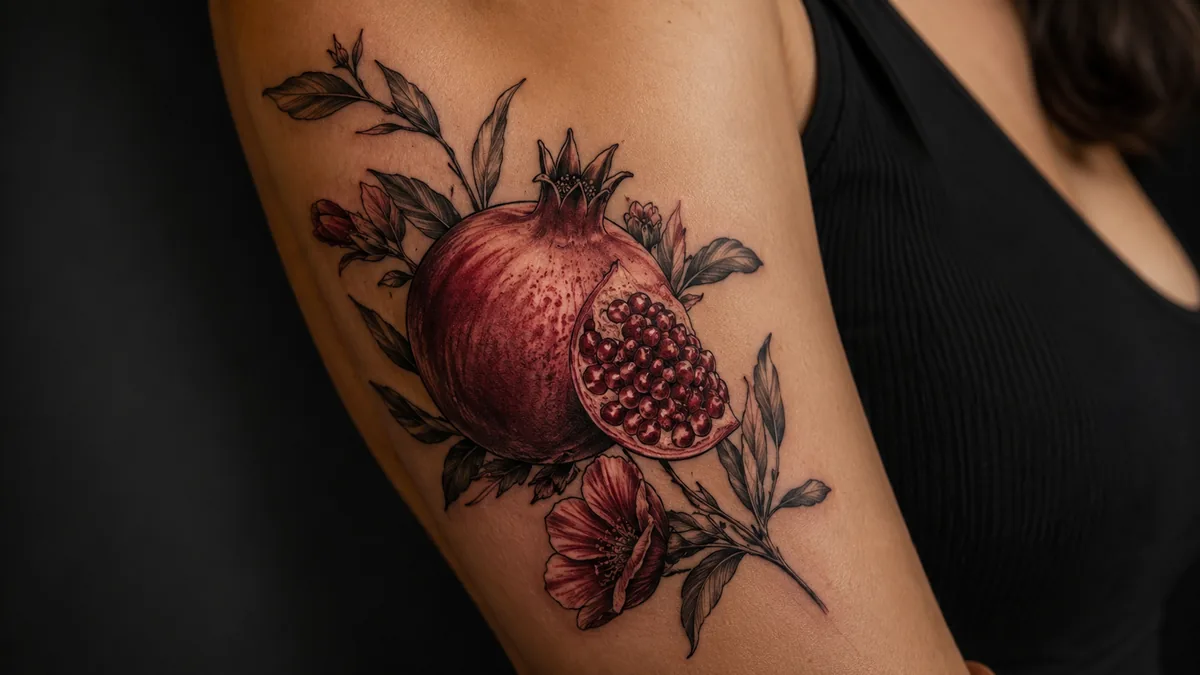
The pomegranate is one of those tattoos that carries serious weight. It looks like fruit, sure, but people have been loading this thing with meaning for thousands of years across dozens of cultures. Fertility, death, rebirth, abundance, the underworld. It’s all in there.
If you’re considering a pomegranate tattoo, you’re not just picking a pretty botanical. You’re tapping into one of the oldest symbols in human history. Here’s what it actually means, where it comes from, and how to get it done right.
Core Symbolism: What a Pomegranate Tattoo Actually Means
The pomegranate holds two big ideas at once: life and death. Those hundreds of seeds packed inside make it a natural symbol of fertility, abundance, and new beginnings. Cracking one open reveals that explosion of red seeds, which is why it’s been tied to prosperity and potential across cultures for centuries. You get a lot from one source. That’s the whole concept.
But the pomegranate also bleeds. That deep red juice reads as blood, sacrifice, and the fragility underneath beauty. So the same fruit that means abundance also means loss. That duality is exactly why this tattoo resonates. People get it when they’re holding two truths at once, like grief and growth, or love and pain.
The Myth Behind It: Persephone and the Underworld
Six hundred seeds, one fruit, the pomegranate holds everything at once.
The most well-known story attached to the pomegranate is Greek myth. Persephone, daughter of the harvest goddess Demeter, was taken to the underworld by Hades. She ate six pomegranate seeds while down there, and that bound her to the underworld for six months of every year. Those months became winter. Her return became spring.
That myth makes the pomegranate a symbol of cycles, of being bound to something, and of the in-between state of existing in two worlds. Tattoo clients who’ve dealt with trauma, loss, or a life split between two identities often connect hard with this story. It’s not dark for the sake of dark. It’s honest about how life actually works.
Other Cultural Meanings Worth Knowing
Beyond Greece, the pomegranate shows up everywhere with real symbolic weight. In Persian culture it represents love and fertility at weddings. In Chinese tradition the seeds symbolize many children and good fortune. Jewish tradition connects it to the Torah’s 613 commandments, with each seed said to represent one. In Christianity it appears in religious art as a symbol of resurrection and the church.
In Aztec iconography the pomegranate appears alongside blood and sacrifice. In Buddhism it’s one of three blessed fruits alongside the peach and citrus. This is a genuinely cross-cultural symbol, which means your tattoo can carry one specific cultural meaning or speak to a broader human experience. Know which lane you’re in before you sit.
Design Variations: From Bold Traditional to Delicate Fine Line
The pomegranate gives you a lot of design flexibility. A bold American traditional version with thick outlines, saturated reds, and heavy black fills will read clean from across the room and age like a champ. Whole fruit or cut-open halves both work. The open version lets you show the seeds, which amplifies the symbolism of abundance and inner richness.
Fine line botanical styles have blown up recently, and the pomegranate fits perfectly. Thin crispy lines with subtle shading, maybe some stippling on the seeds, looks excellent in black and grey. Neo-traditional lets you push the color and ornamentation without losing structure. Some clients add snakes, flowers, or moths to deepen the narrative. Keep it intentional. Every element should earn its spot.
Color vs. Black and Grey
Color is the natural choice here. The pomegranate’s deep ruby red is iconic, and a skilled artist can make that saturated red sing against the skin. Add some olive green on the rind and leaves, maybe a pop of gold on the crown, and you’ve got something that genuinely pops. Color pomegranates age best when the lines are solid and the artist doesn’t go too light on pigment.
Black and grey works beautifully too, especially in a fine line or illustrative approach. The contrast between the dark exterior and the lighter shaded seeds translates well without color. Whip shading on the rind and careful dot work on the seeds gives a ton of texture. If you run warm and want to avoid long-term color fade, black and grey is the smarter call.
Placement: Where It Sits and How It Ages
The pomegranate is a medium-sized design that fits well in a lot of spots. Upper arm, thigh, ribcage, and shoulder blade give it room to breathe and let a good artist really nail the detail. The thigh is especially solid for botanical work. Low-wear zone, heals nice, and you’ve got canvas for a piece with real presence.
Avoid high-wear spots if you’re going fine line. Hands, fingers, and inner wrists chew up delicate linework fast. Blowout risk goes up in softer skin areas too. If you want it on the forearm or sternum, those can work, but go bolder on the lines so it holds over time. Ribs are spicy for pain. Upper arm is the friendlier starting point if you’re newer to sitting.
Who Gets This Tattoo and How to Make It Yours
The pomegranate attracts people who think in layers. You see it on folks going through major life transitions, people interested in mythology or spirituality, women celebrating fertility or mourning pregnancy loss, and anyone drawn to symbols that hold opposing truths. It’s also popular among people with Greek, Persian, or Middle Eastern heritage who want to honor that lineage.
To make it personal, think about which meaning actually lands for you. Are you coming out of a hard season and stepping into something new? Lean into the Persephone angle. Do you want to celebrate abundance and family? Focus on the seeds and ripe fruit. Talk to your artist about which elements to emphasize. A pomegranate that means something specific to you will always hit harder than one chosen purely for aesthetics.









