
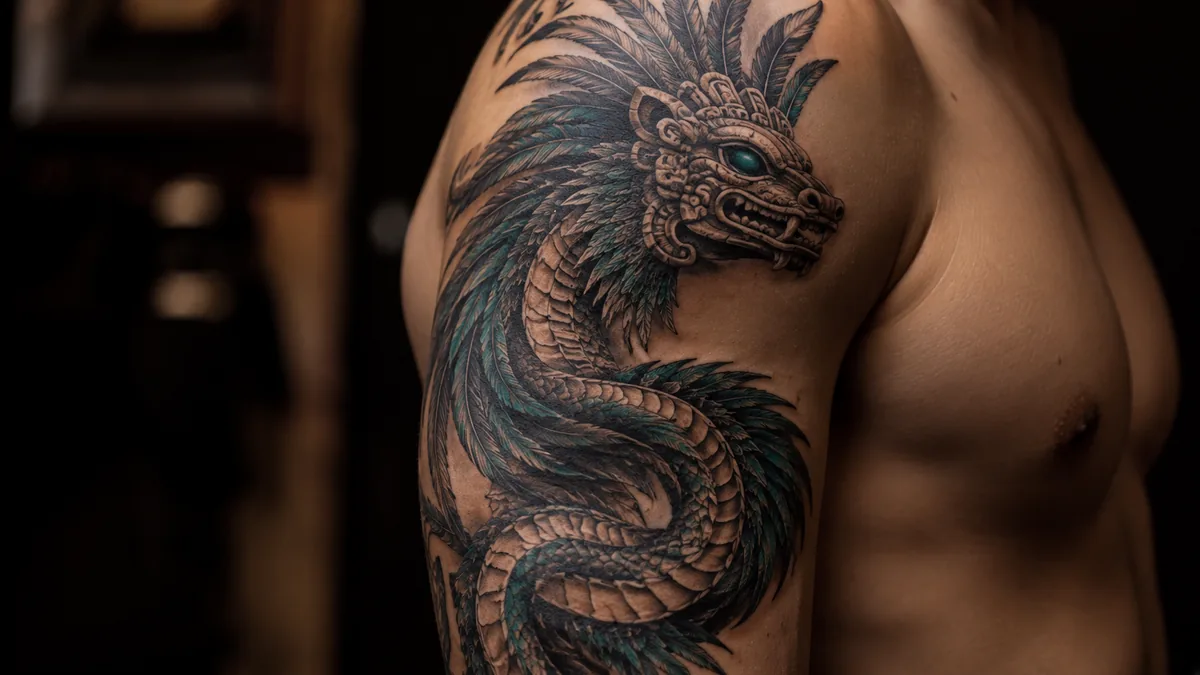
The quetzalcoatl tattoo is one of the most visually loaded pieces you can put on your body. It pulls from deep Mesoamerican mythology, carries real weight as a symbol, and when it’s executed well, it stops people cold. This isn’t a trend piece. This is a deity with thousands of years of meaning behind it.
If you’re thinking about getting one, you should know what it actually represents before you sit down in the chair. The symbolism is layered, the design options are massive, and placement matters a lot for a piece this complex. Here’s the full breakdown.
What Quetzalcoatl Actually Symbolizes
Quetzalcoatl is the Feathered Serpent, one of the most important deities in Aztec and broader Mesoamerican religion. The name comes from Nahuatl: quetzal, meaning the brilliantly plumed bird, and coatl, meaning serpent. That combination is the whole point. It merges the sky and the earth, flight and the ground, the divine and the mortal. As a tattoo, it carries that duality front and center.
Most people get it to represent transformation and transcendence. The serpent sheds its skin, it’s reborn, it moves between worlds. The feathers add the element of ascension, rising above. It also strongly ties to knowledge and wisdom in Aztec tradition, since Quetzalcoatl was specifically associated with wind, learning, arts, and the priesthood. It’s a heavyweight symbol, not decorative filler.
The Real Mythology Behind the Image
A feathered serpent that small just looks like a confused lizard with wings.
Quetzalcoatl was worshipped across multiple Mesoamerican cultures, including the Aztec, Toltec, and Maya, though the Maya called the equivalent deity Kukulkan. In Aztec cosmology, Quetzalcoatl was one of the creator gods, responsible for creating humanity in the current world age by descending to the underworld and retrieving the bones of the dead. That story alone explains why so many people connect it to themes of sacrifice, death, and rebirth.
There’s also a human avatar of Quetzalcoatl in Toltec and Aztec legend, a priest-king who was eventually exiled and promised to return. That narrative layer adds meanings of destiny, cycles, and return. If you’re going deep with this piece, there’s real mythology to draw from. That context makes it feel earned rather than purely aesthetic.
Popular Design Variations
The most classic version is the full feathered serpent, a massive coiling snake body covered in iridescent quetzal feathers, often shown with a massive open jaw and a headdress. Traditional Aztec stone carvings from Teotihuacan are a common reference point for this style. The serpent wraps, spirals, or rears up. Some designs incorporate the sun disk, calendar glyphs, or jade elements to ground it more firmly in Aztec iconography.
You can also go with a portrait-style piece showing just the head, massive fanged jaw open, feathers flaring out like a crown. That version reads incredibly well as a chest or shoulder cap piece. Neo-traditional and new school artists love adding bold linework and stylized feather shapes that pop from a distance. Watercolor versions exist but they don’t age as clean. Stick to solid fills and defined edges if longevity matters to you.
Color vs Black and Grey
Color is where this piece really sings. The quetzal bird’s feathers are naturally iridescent green and red, and that palette maps perfectly onto the serpent form. A fully saturated color piece with teal, emerald, gold, and crimson is going to read from across the room and hit hard. That said, color needs committed maintenance. UV exposure fades green fast, so keep it out of the sun or commit to touch-up sessions every few years.
Black and grey is a totally valid choice and it ages more predictably. A skilled artist can do incredible depth work with whip shading and smooth gradients, making the feathers and scales look almost three-dimensional. Fine line black and grey quetzalcoatl pieces have a cleaner, more understated energy. They still carry the same symbolic weight. If you run warm or have oily skin, black and grey will hold structure better long term than bright color fills.
Best Placement and How It Ages
The thigh, back, and chest are the best real estate for a full quetzalcoatl piece. The serpent body needs room to coil and the feathers need space to breathe. Cramming it into a forearm means sacrificing detail. A full back piece lets the serpent stretch top to bottom with the head at the shoulder blades or the base of the skull. Chest and rib placement works well for the head and upper coil, especially as a wrap-around that spills onto the shoulder.
Placement also dictates how it ages. Inner bicep and rib pieces in fine line will get soft faster because skin moves and stretches there. Bold traditional-style linework on the outer thigh or upper arm holds structure for decades. High-wear areas like wrists and hands will blur the detail on fine-scale work within a few years. Wherever you place it, go bold on the outlines. Thin crispy lines on a large-scale mythological piece look stunning fresh but require consistent touch-ups to stay sharp.
Pain by Zone for This Piece
Pain is part of the conversation for any large-format tattoo, and quetzalcoatl pieces tend to be large-format. Thigh placement is genuinely manageable for most people, one of the more tolerable large-area zones. Upper arm and shoulder cap are in the moderate range. Back pieces range from tolerable mid-back sessions to pretty spicy work near the spine and shoulder blades. Ribs are notoriously rough, especially for sessions over two hours.
Chest placement near the sternum gets spicy fast. The skin is thin, the bone is close, and the vibration from the machine is a lot. If you’re wrapping a full coil across the chest and over the ribs, break it into multiple sessions. Your artist will thank you and the work will be cleaner for it. Fatigued skin doesn’t hold ink as well, and a tired client moves more. Plan the sessions smart.
Who Gets This Tattoo and How to Make It Yours
People with Mexican, Aztec, or broader Mesoamerican heritage get this piece as a direct cultural and ancestral connection, and that’s probably the strongest reason to get one. It’s a real deity from a real living cultural tradition, not a defunct mythology. That context matters and adds depth to the piece that no amount of artistic skill can manufacture. If that’s your background, lean into the iconography, reference actual pre-Columbian art, and honor the source material.
Outside that context, people get it for the symbolism of transformation, duality, wisdom, and rebirth. Those are real human themes and the tattoo earns its meaning through that lens too. To make it personal, work with your artist on what the piece is actually saying. Is it the sky and earth duality? Is it a rebirth piece tied to a specific event in your life? Let that narrative guide the composition choices. A piece with a personal story behind it always sits different than one chosen purely from a flash sheet.









