
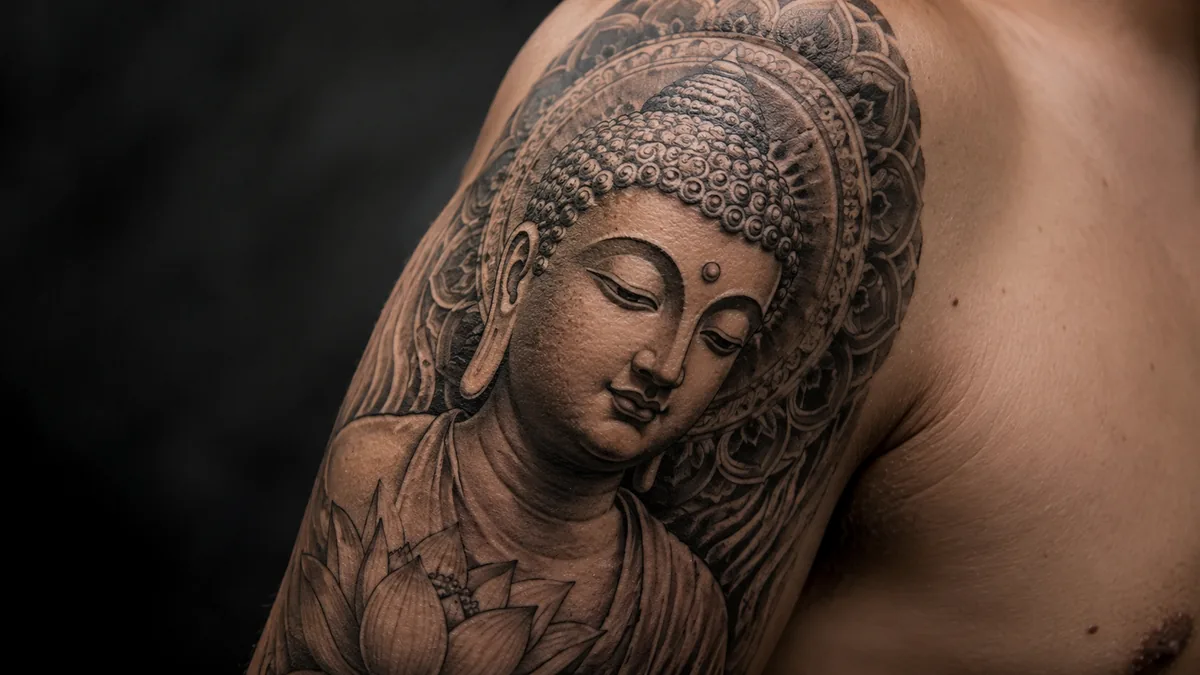
Buddha tattoos are one of the most requested spiritual pieces in any shop. People want them for real reasons: they’ve been through something heavy, they practice Buddhism, or they just connect hard with the idea of finding stillness in a chaotic world. The meaning is genuine, and the imagery is rich.
That said, this is also one of the most misunderstood tattoos out there. Culture matters. Placement matters. And not every smiling round figure is Siddhartha Gautama. So before you book that appointment, here’s what you’re actually putting on your skin.
What a Buddha Tattoo Actually Means
a Buddha tattoo represents enlightenment, inner peace, and the path toward spiritual awakening. Siddhartha Gautama, the historical Buddha, walked away from wealth and comfort to understand suffering and how to move beyond it. Getting his image tattooed is a way of carrying that intention with you. Peace over chaos. Awareness over reaction. It’s not decorative for most people who choose it.
The symbolism goes deeper depending on the pose. A meditating Buddha signals mindfulness and calm. A reclining Buddha represents the moment of parinirvana, final liberation from the cycle of rebirth. A laughing Buddha, often confused with the historical Buddha, actually represents Budai, a Chinese folkloric figure tied to joy, abundance, and good luck. Different images, different meanings.
Cultural and Historical Context You Should Know
The lotus blooms in mud, your Buddha tattoo should mean something, not just look peaceful.
Buddhism originated in ancient India around the 5th century BCE and spread across Asia, splitting into distinct traditions. Theravada Buddhism, prominent in Thailand, Sri Lanka, and Southeast Asia, treats the Buddha as a historical teacher. Mahayana traditions, common in China, Japan, and Korea, hold a broader cosmology with many Buddhas and bodhisattvas. That history directly shapes the iconography you see in tattoo studios today.
In many Southeast Asian countries, particularly Thailand and Sri Lanka, tattooing Buddha’s image is considered deeply sacred and sometimes legally or socially sensitive. Thai monks use Sak Yant tattooing as a spiritual practice, each symbol hand-poked with religious intention. That context is real. If you’re not Buddhist, that doesn’t mean you can’t get the tattoo, but knowing the roots keeps you from just slapping something meaningful onto your skin without understanding what it carries.
Popular Design Variations and What They Say
The seated, meditating Buddha with hands resting in the dhyana mudra, palms up in the lap, is the most common design. It reads clean, holds well in most sizes, and communicates stillness instantly. The dharma wheel behind him or lotus flowers beneath him add layers: the wheel symbolizes the cycle of existence and the Buddha’s teachings, the lotus represents purity rising from muddy water. Pair them or go solo, both work.
Geometric Buddha designs have become a go-to in recent years, with mandala-style linework surrounding the face or the full figure. Realistic portrait-style Buddhas in black and grey are another strong call, especially for larger placements. Japanese-influenced Buddha pieces with bold outlines and flat color blocks suit a traditional or neo-trad approach. Each style shifts the mood from serene and introspective to bold and graphic, so pick what matches the feeling you’re going for.
Black and Grey vs. Color
Black and grey is the dominant choice for Buddha tattoos, and for good reason. The soft gradients in whip shading create a sense of depth that fits perfectly with the contemplative nature of the image. A well-executed black and grey Buddha with smooth transitions reads beautifully on skin and ages far more gracefully than heavy color work. Fine line Buddha faces in the portrait style also hold up well when placed on low-wear zones.
Color is less common but works well in specific styles. Traditional Japanese pieces with saturated reds, blacks, and greens give the Buddha a bold, graphic presence. Watercolor-style Buddha tattoos look striking fresh but tend to fade and bleed more over time, especially without a solid black outline anchoring the design. If you want color, ask your artist to build in structure. Bold will hold. Watercolor without line work is a slow fade.
Best Placements and How It Ages
The back is the most natural home for a large Buddha piece. You’ve got real estate, flat skin, and the piece can breathe. A full back Buddha meditating under the Bodhi tree is a serious commitment and a serious statement. Chest placements work well too, particularly centered on the sternum or across one pec. The outer upper arm and the forearm are the most popular spots for mid-size to sleeve-filler Buddha work.
Placement affects how long it stays crisp. The inner arm, the ribs, and the back of the knee are spicy and high-wear in spots. Fine line detail in high-wear zones blurs faster. The upper arm, the outer thigh, and the back are low-wear zones where detail holds much longer. A Buddha face in fine line on the inner forearm will need touching up faster than the same piece on the outer calf. Talk to your artist about line weight relative to where it’s going.
Who Gets Buddha Tattoos and How to Make Yours Personal
Practicing Buddhists get this tattoo as a daily reminder of their path. People in recovery get it to mark a hard-won shift toward inner peace. Martial artists, yogis, and meditators get it because the imagery aligns with how they move through the world. And plenty of people get it simply because they’ve found real meaning in Buddhist philosophy without formally practicing the religion. All of those are legitimate.
To make it personal, think about which aspect of the Buddha’s story connects with yours. If it’s the idea of sitting with suffering until you understand it, lean into the meditating pose. If it’s about releasing attachment, the reclining figure fits. Add elements that are specific: a birth flower, a meaningful phrase in Pali or Sanskrit, a lotus in a specific color. Work with your artist on composition rather than pulling a flash design. A piece that tells your story will always outlast something you picked off the wall.









