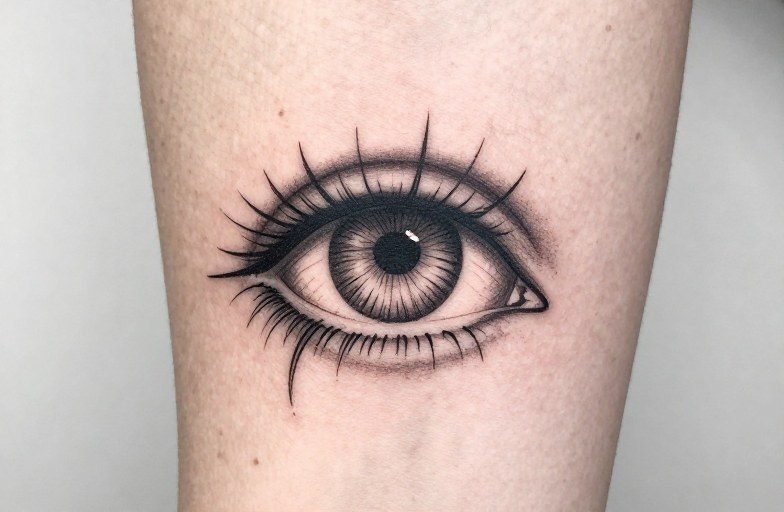
The eye of the storm tattoo represents finding stillness at the center of turmoil. It’s about surviving chaos without being destroyed by it, and recognizing that control often means staying calm while everything else rotates around you. Most people who choose this design aren’t claiming they’ve mastered their storms, they’re marking the ongoing effort to stay centered.
Symbolism & History
The Meteorological Reality Behind the Metaphor
Real hurricanes have a physical eye: a circular zone of sinking air, clear skies, and relative calm surrounded by the eyewall’s most violent winds. That structure, peace enclosed by destruction, gives the symbol its weight. The eye isn’t separate from the storm; it’s created by it, defined by it, existing only because the surrounding chaos organizes around that central point.
This maps cleanly onto lived experience. The calm isn’t an escape from difficulty but a position within it. People who’ve weathered addiction, grief, high-pressure careers, or turbulent relationships often gravitate toward this image because it acknowledges that the storm doesn’t end, you learn to occupy its center.
Cross-Cultural Threads
The concept of centered calm appears across traditions, though the storm metaphor itself is more recent. Some trace it to maritime culture and the terrifying experience of passing through a hurricane’s eye. Zen Buddhism’s “eye of the storm” teaching, remaining undisturbed by external events, predates the tattoo trend by centuries but shares the same geometry. Celtic spiral motifs and certain Native American whirlpool symbols also encode the idea of dynamic stillness, though these are distinct from the modern storm-eye design.
- Maritime tradition: sailors who survived the eye reported eerie calm before renewed violence
- Psychological framing: the term entered popular usage through therapy and self-help in the mid-20th century
- Contemporary meaning: personal resilience, emotional regulation, survival without bitterness
Common Variations & Styles
Visual Approaches
The design splits between literal and abstract representations. Literal versions show a satellite-view hurricane spiral with a clear central circle, sometimes incorporating a human eye or compass rose in that center. Abstract versions use geometric mandala patterns, concentric circles, or negative space to suggest the form without depicting it directly.
Line work dominates this subject. Fine single-needle lines can render the spiral’s delicate structure, but they blur faster on high-movement areas and may require touch-ups within a few years. Bold traditional lines hold better but sacrifice the meteorological detail that makes the image recognizable. Black and grey shading creates the storm’s depth and movement; color, deep blues, greys, occasional violent reds, adds emotional temperature but ages faster and can muddy the spiral’s readability.
Combined Elements
Common additions include:
- Compass roses: suggesting direction maintained through chaos
- Clock faces or hourglasses: time as the storm’s medium
- Breaking waves: the storm’s effect on the physical world
- Silhouetted figures: a person standing in or emerging from the eye
- Script: names, dates, or short phrases, though these often clutter the design’s inherent balance
Placement of added elements matters. Script wrapped around the spiral’s edge usually works better than text placed in the eye itself, which disrupts the symbolic calm.
Best Placements
The circular form favors certain body areas. The shoulder cap, outer thigh, and upper back all provide flat, rounded surfaces that complement the design’s geometry. The sternum works for smaller pieces but limits size; the sternum’s movement and thinner skin also make healing more finicky, with longer scabbing periods and higher risk of patchy healing.
Forearms and calves allow the spiral to wrap slightly, suggesting motion, but the design’s impact depends on seeing the full circle at once. Wrapping too far around a limb breaks the composition. Ribs and sides accommodate larger versions but hurt significantly more due to bone proximity and thinner fat padding, worth budgeting for if you want scale, not a factor to dismiss.
Scale matters practically. Under three inches, the eye’s detail becomes muddy within a few years as ink spreads slightly. Five to eight inches allows the spiral’s bands to stay distinct and the central eye to remain visually quiet. Larger pieces can incorporate background elements but risk becoming generic “storm” tattoos rather than specifically the eye.
Who Chooses This Tattoo / Personal Meanings
Common Motivations
People drawn to this design often occupy high-stress roles, emergency workers, military personnel, healthcare staff, executives, or have survived specific traumatic periods they’re not interested in depicting literally. The symbol communicates experience without exposing details. It’s protective: the storm’s violence is visible, but the wearer’s position is the calm center, not the damage.
Others choose it during transition periods: recovery, career changes, leaving relationships, getting sober. The tattoo marks a decision rather than an achievement, the commitment to seeking center, not the claim of having found it permanently.
Ambiguity as Feature
The eye of the storm allows multiple readings. It can suggest someone who causes chaos while remaining untouched, or someone battered by external forces who refuses to be destroyed. Context, placement, accompanying elements, the wearer’s demeanor, usually clarifies which reading applies. The design’s flexibility is part of its persistence in tattoo culture; it accommodates complexity without requiring explanation.
Similar Symbols
Several designs occupy adjacent symbolic territory. The ouroboros (serpent consuming its tail) shares the circular self-containment but adds cyclical time and self-creation/destruction. Mandalas offer geometric calm without the storm’s threat. Anchor tattoos reference stability through external attachment rather than internal centering. The Japanese ensō circle captures the moment of creation and the acceptance of imperfection, calm, but not specifically tested by chaos.
The eye of the storm distinguishes itself by keeping danger visible. The spiral’s outer bands aren’t decorative; they’re the point. Without that surrounding threat, the image becomes merely a circle. This tension, beauty and danger interdependent, gives the tattoo its particular resonance for people who don’t want to pretend their difficulties never happened.
Final Thoughts
The eye of the storm tattoo works because it’s structurally honest. The calm it depicts is temporary, conditional, and surrounded by forces that could overwhelm it. That matches how most people actually experience resilience, not as a permanent state but as a position held with effort, sometimes successfully, sometimes not.
As a design choice, it rewards technical precision in the spiral’s execution and thoughtful placement that preserves the circle’s integrity. As a personal symbol, it carries weight without demanding disclosure. You wear the geometry of survival, and whether you explain the particular storm is entirely yours to decide.
Frequently Asked Questions
Does an eye of the storm tattoo always have to include a human eye in the center?
No. The ‘eye’ refers to the storm’s calm center, not necessarily a literal eye. Many designs use a clear circle, compass rose, or abstract space. Adding a human eye is one variation among many, not a requirement.
How well does the fine spiral detail hold up over time?
Fine lines in spiral patterns tend to blur and soften within five to ten years, especially on high-movement areas. Bold lines and strategic negative space age more predictably. Plan for potential touch-ups or design with slightly thicker line weights from the start.
Can this design work as a cover-up tattoo?
It’s challenging. The eye’s center requires clean, light skin to read as calm space. Dark existing tattoos make this difficult. A skilled artist might adapt the design into a darker, more filled storm scene with a lighter center, but the pure eye-of-the-storm concept works best on fresh skin.
Is there a difference between a hurricane eye and a tornado eye in tattoo symbolism?
Mostly in visual structure. Hurricane eyes appear as circular spirals viewed from above; tornadoes are vertical funnels. Symbolically, both convey similar meaning, but the hurricane eye’s concentric rings offer more design flexibility and clearer metaphorical reading of layers of chaos surrounding calm.
Related Tattoo Meanings
- Filled Tear Drop Tattoo Meaning: Symbolism, Styles Placement
- Five Point Star Tattoo Meaning: Symbolism, Styles What to Know
- Fly Tattoo Meaning: Decay, Resilience, and Unflinching Honesty
- Explore more