
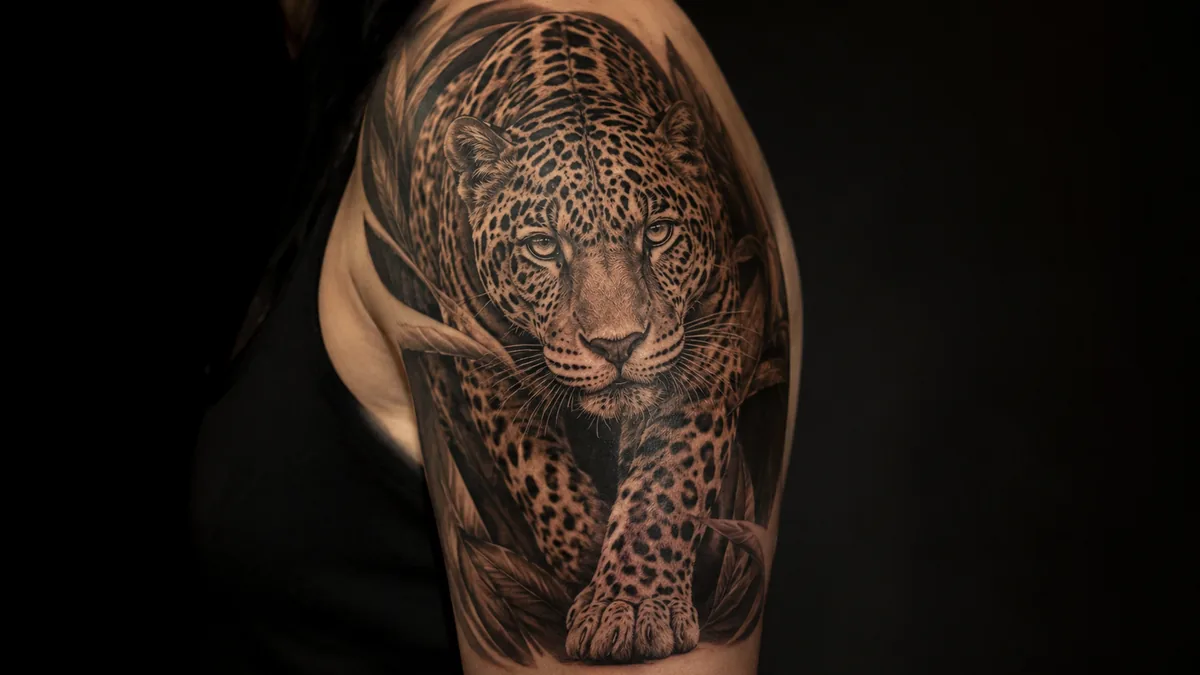
The jaguar is not a house cat scaled up. It’s the apex predator of the Americas, and that weight comes through in every tattoo done right. People get this big cat inked for a reason, and it goes deeper than just liking the animal.
the jaguar tattoo means raw power, independence, and the ability to move through darkness without losing your footing. It carries serious cultural history from Mesoamerican civilizations, and it translates cleanly into modern tattoo language across every style.
Core Symbolism: What the Jaguar Tattoo Actually Means
The jaguar stands for strength, stealth, and dominance. Unlike the lion, which rules in the open, the jaguar operates in shadow. It’s patient, precise, and it does not miss. That’s the energy people are chasing when they sit in the chair for this one. Power that does not announce itself.
It also represents confidence and self-reliance. The jaguar hunts alone. It does not need a pack. People who get this tattoo tend to connect with that energy, a kind of quiet authority. It also carries themes of courage, ferocity, and the ability to face fear head-on. Those are the meanings that read across cultures.
Mesoamerican Roots: Where This Symbol Comes From
The jaguar doesn't ask permission. Neither should the tattoo wearing it.
The jaguar was sacred to the Aztecs, Maya, and Olmec civilizations. The Aztecs had the Jaguar Warriors, an elite military order. These fighters wore jaguar skins and were considered among the most powerful soldiers in the empire. The jaguar was tied directly to Tezcatlipoca, the god of darkness, night, and sorcery.
For the Maya, the jaguar ruled the underworld and the night sky. The Mayan sun god transformed into a jaguar at night to travel through the underworld and emerge reborn at dawn. That cycle of death and rebirth is part of what makes the jaguar a duality symbol. Light and dark. Life and death. Both sides of the coin.
Duality and the Shadow Self
The jaguar lives between two worlds in indigenous cosmology, the living world and the spirit world, daylight and darkness. That duality is one of the most compelling reasons people choose this tattoo. It is not purely a good-or-evil symbol. It holds both.
A lot of clients describe the jaguar as a representation of their shadow self, the parts of their personality that are fierce, private, or not easily understood by others. That psychological layer gives the piece meaning that goes beyond decoration. It is personal without needing explanation.
Popular Design Variations and Styles
The most popular jaguar designs are the face or portrait, especially the snarling or roaring head, the full-body stalking or prowling pose, and the spotted hide as a pattern element. Geometric and neo-tribal takes on the jaguar connect back to Mesoamerican art and read really clean in bold linework. The skull-jaguar hybrid is another strong option, leaning into that underworld symbolism.
For style, black and grey does serious work here. The spots and fur texture give the artist a lot to play with in whip shading. Fine line can be gorgeous on the face, but it will blur faster in high-wear zones. Neo-traditional gives you saturated color and bold outlines that hold up over years. Realism is the highest-risk, highest-reward route. Pick an artist with a strong animal portfolio.
Color vs. Black and Grey
Black and grey jaguar tattoos age reliably. The coat pattern, spots, and shadow under the brow all translate well in greyscale. A skilled artist can get serious depth in the fur using contrast and whip shading alone. It reads from across the room without needing color to carry it.
Color opens up options, especially with a spotted coat. Gold, amber, and deep green backgrounds nod to the jungle setting and make the animal pop. Full color realism can be stunning but requires touch-ups. If you go color, make sure your lines are solid underneath. Bold will hold. Soft color without structure tends to fade muddy.
Best Placements and How It Ages
Large-scale jaguar pieces land well on the chest, back, thigh, and upper arm. These areas give your artist room to work and the skin tends to age more gracefully. The back is the top pick for a full-body piece or portrait with background. The thigh is excellent, lower wear, stays saturated, and heals nice.
Avoid the inner wrist and fingers for detailed work. Those are high-wear, high-fade zones and fine line detail will soften fast. The ribcage is spicy, genuinely rough, but it is a great canvas. The forearm is a solid middle ground. Good visibility, decent aging. If you want the snarling face to still look crispy in ten years, placement matters as much as style.
Who Gets Jaguar Tattoos and How to Make It Yours
Athletes, martial artists, and people in competitive fields get this one a lot. The connection to peak physical performance and controlled aggression is real. It also draws people going through major personal transitions, recovery, reinvention, a hard chapter they came out the other side of. The jaguar as a symbol of resilience and transformation fits those stories.
To make it personal, think about which meaning you are actually connecting with. Power, stealth, duality, indigenous heritage, personal transformation. Tell your artist. That conversation shapes whether you go realistic or geometric, full color or solid black, roaring or still. A great jaguar tattoo tells one story clearly. Narrow it down and the piece will be stronger for it.









