
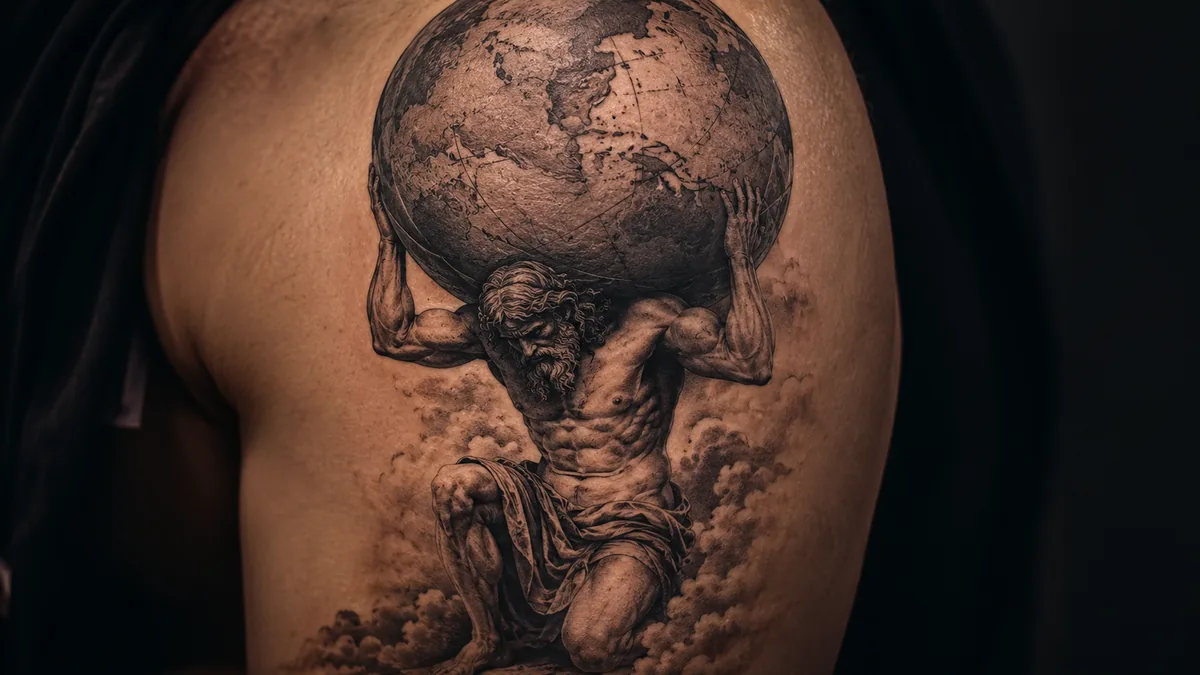
Atlas is the Titan from Greek mythology condemned to hold up the celestial heavens for eternity. As a tattoo, that image carries serious weight, literally and symbolically. People who get Atlas on their skin are usually making a statement about endurance, about carrying heavy loads without breaking.
The design reads instantly. A powerful figure, stooped under the weight of a massive sphere, muscles straining, holding steady. It’s one of those tattoos that communicates something personal without needing an explanation. You either resonate with that image or you don’t.
Core Meaning: Strength Under Pressure
Atlas tattoos are fundamentally about bearing weight. The symbolism is strength, resilience, and endurance under enormous pressure. Most people who choose this image are working through something heavy in their life or honoring the fact that they’ve survived it. It’s not a flex tattoo. It’s a quiet acknowledgment that life puts real burdens on people and some carry them without crumbling.
There’s also a strong theme of responsibility. Atlas didn’t just carry something heavy; he carried it because it was his duty. That resonates with parents, caretakers, military veterans, first responders. Anyone who’s ever felt the world pressing down on their shoulders and showed up anyway. The tattoo says: I carry this, and I keep going.
The Myth Behind the Image
Atlas doesn't ask for help. That's the whole point.
In Greek mythology, Atlas was a Titan who fought against the Olympian gods in the Titanomachy. When the Titans lost, Zeus punished Atlas specifically by condemning him to hold up the sky, or in later traditions, the celestial globe, for eternity. He wasn’t just strong; he was punished for his defiance. That adds a layer some wearers connect with deeply, the idea of carrying a burden as a consequence of fighting back.
It’s worth knowing that the famous image of Atlas holding a round sphere comes from Renaissance-era sculpture and art, not ancient Greek sources. The original myth described him holding the heavens, not a globe. Either way, the visual shorthand is locked in culturally. Most tattoo clients aren’t after academic accuracy; they’re after the feeling, and that feeling is universal.
Popular Design Variations
The classic version is a muscular male figure, bent forward, holding a detailed globe or sphere on his back and shoulders. You’ll see everything from hyper-realistic anatomical renderings to geometric interpretations where the globe becomes a wireframe or mandala. Neo-traditional shops love putting bold outlines and ornamental fill around the figure. Blackwork artists strip it down to stark contrast with heavy blacks and clean negative space.
Some clients go for just the globe with cracked lines suggesting immense pressure, or Atlas from a top-down view showing only the sphere crushing downward. Portrait-style Atlas pieces in black and grey are popular, pulling from classical sculpture references like the Farnese Atlas. Fine line single-needle work exists too, though it needs a low-wear placement to age properly and can be harder to read from distance.
Black and Grey vs. Color
Black and grey is the dominant choice for Atlas tattoos, and it makes sense. The subject matter is serious and sculptural. A well-executed black and grey Atlas with solid whip shading and crisp linework looks like carved stone. It ages reliably when done in solid mid-tones, and the realism style that suits the figure best translates cleanly without color. Bold will hold here because the design relies on contrast and muscle definition.
Color versions exist, mostly in neo-traditional and illustrative styles. Deep blues and greens on the globe, warm gold tones on the figure itself. Done right it’s striking and saturated, but it demands an artist who knows how to layer color properly, and you’re looking at more touch-up sessions over the years. If you want color, go with an artist whose healed color work you’ve seen in person, not just fresh photos on Instagram.
Best Placements and How It Ages
Atlas needs space. The design has real vertical height and detail, so small placements compress it into an unreadable mess. The back is the obvious choice, upper back especially, where you have room to show the full figure with the globe above. Full sleeve placements work when Atlas is the centerpiece, usually positioned on the upper arm or shoulder cap. The chest is another solid option, particularly for a figure bent forward with the globe pushing toward the sternum.
Avoid placing Atlas on high-wear zones like hands or inner wrists if you’re going fine line. The detail won’t hold. Elbow ditches are spicy and distort with movement, which compromises the figure’s proportions over time. Ribs and sternum hurt but age beautifully with proper sunscreen habits. A well-placed Atlas in black and grey on the upper back or shoulder will still read clean 15 years out. Blowout risk is low in those zones if your artist has solid technique.
Who Gets Atlas Tattoos and Why
Atlas tattoos attract people who’ve been through it. Single parents raising kids solo, people who’ve survived serious illness or loss, anyone in a caretaking role who feels the weight of others depending on them. Veterans and first responders connect with the duty angle. Athletes and bodybuilders gravitate toward the physical strength symbolism. It’s also common among people who’ve dealt with depression or anxiety, wearing it as a reminder that they’ve carried that invisible weight and kept standing.
The tattoo works as a tribute too. People get Atlas to honor a parent who sacrificed everything, a sibling who held the family together, or themselves after a period they barely survived. Because the figure is nameless in most designs, it’s easy to project your own meaning onto it. You don’t have to explain who you mean. The image just holds it.
Making It Personal and Working With Your Artist
If you want the standard Atlas, any strong realism or neo-traditional artist can execute it. But if you want it to mean something specific to you, bring reference and talk to your artist before the appointment. Consider what the sphere represents in your version. Is it the earth, literally? Is it an abstract weight? Some clients add elements inside the globe, waves, stars, a specific landscape. That kind of detail makes it yours instead of a copy of someone else’s piece.
Bring in reference images of the style you want, not just Atlas images. Your artist needs to see whether you want smooth black and grey realism, bold neo-trad outlines, or clean geometric linework. Ask to see healed photos from their portfolio, not just fresh tattoos. A design like this lives on your body for life. Spend the time finding an artist whose healed work looks exactly like what you want. Don’t rush it, and don’t cheap out on the placement you actually want.









